Link Building Strategy in 2026: The Complete Framework for Sustainable Authority and Measurable ROI
Introduction
Organizations still allocate roughly 28 to 36 percent of their total SEO budget to link acquisition, and link building is consistently rated the highest ROI activity inside the SEO function. That part isn’t the problem. The problem is what happens after the invoice clears. Most finance teams cannot trace that spend to a single qualified lead, a single influenced deal, or a single dollar of pipeline. Ask a CMO what their link budget produced last quarter and you’ll get a Domain Rating chart. Ask them what it produced in revenue and the room goes quiet.
That gap is not a link building problem. It’s an operating model problem. Most teams execute link building in silos: outreach happens here, reporting happens there, and nobody owns the thread connecting a backlink to a closed deal. The tactics themselves are not broken. The infrastructure around them is missing.
This guide exists to fix that. By the end of it, you will have a complete framework to architect a link building program, whether in-house, outsourced, or hybrid, that integrates with your internal site structure, survives AI-search quality thresholds, and produces a report your CFO can actually act on.
The State of Link Building in 2026: Moving Past Legacy Tactics
How AI Search Engines Recalibrated Authority Signals
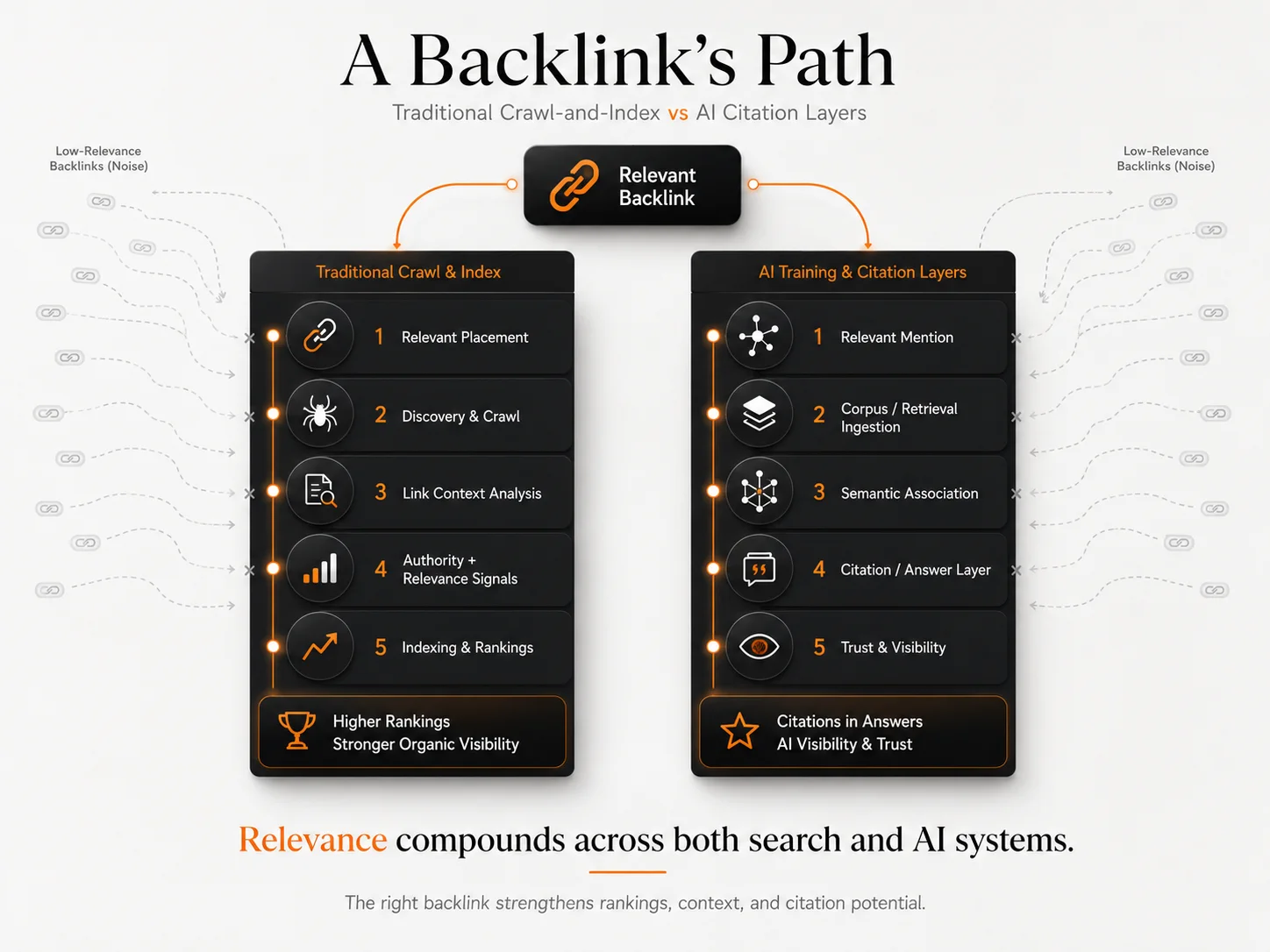
The shift from Google’s traditional PageRank-weighted SERPs to AI Overviews, ChatGPT citations, and Perplexity’s reference model has raised the authority floor rather than lowered it. Links haven’t stopped mattering. They’ve been reassigned a job.
Here’s the mechanism worth understanding. AI answer engines mostly pull citations from pages that already rank well in traditional search, not from a separate link graph of their own. Analysis of AI Overview citations has repeatedly found that the overwhelming majority of cited URLs were already sitting on page one of organic results for that query. In other words, a backlink’s real value in 2026 is that it helps a page earn the ranking position that makes it eligible to be cited at all. Skip the ranking step and the citation never happens.
What has changed is which links do that job. Referring domain relevance and topical clustering now carry more weight than raw volume. A handful of niche-relevant referring domains from sites your buyers actually read will move a page further than a stack of generic directory links ever will, and unlinked brand mentions are increasingly correlating with AI citation frequency even more strongly than the links themselves. That doesn’t make backlinks obsolete. It means a link from an irrelevant, low-context source has effectively zero tolerance left in the system. Spam tolerance in 2026 is close to zero, and the sites that treat link building as pure volume are the ones getting flagged, not cited.
Why Vanity Metrics Still Sabotage Budget Approvals
Here’s the recurring failure pattern. An SEO team walks into a quarterly review with a Domain Rating chart and a links-acquired count. Finance sees numbers that don’t map to CAC, LTV, or pipeline velocity, and the link budget gets cut, not because the links didn’t work, but because nobody could prove it in a language the CFO speaks.
This disconnect between SEO dashboards and business intelligence remains the single most common reason link budgets get slashed at renewal time, and it’s entirely avoidable. The fix isn’t better links. It’s a different report. We cover the full migration from output-focused KPIs to revenue-aligned reporting in From Vanity Metrics to Revenue: The Link Building Reporting Overhaul, which is worth reading before your next budget conversation, not after.
Building the Foundation: Internal Architecture Before External Acquisition
The Technical Prerequisite Most Teams Skip
Here’s a mistake we see constantly. A team spends four months and a five-figure budget earning quality backlinks, then routes most of that new authority into a page that’s three clicks deep, poorly internally linked, and barely crawled. The external investment was sound. The internal architecture wasted it.
Acquired authority is capped by internal topology. Orphan pages, wasted crawl budget, and flat site architecture all prevent link equity from ever reaching the URLs that actually convert. You can buy the best backlinks money can earn and still see nothing move if the page receiving them isn’t structurally positioned to receive that equity. Before you scale outreach, audit what’s actually happening inside your own site. Our deep-dive technical resource on fixing crawl and equity distribution before you spend a dollar on outreach is Stop Losing Traffic to Orphan Pages: A 2026 Internal Linking Framework.
Crawl Budget and Equity Distribution Models
The practical exercise here is mapping your high-intent commercial pages to the supportive content hubs that feed them, so every new backlink amplifies ranking potential where it actually drives revenue rather than diffusing into pages nobody converts on.
For the pre-outreach technical audit itself, Screaming Frog and Sitebulb remain the standard tools for surfacing crawl issues before you start building links toward a broken foundation. Pair that with Google Search Console to identify orphaned, high-value pages that are already ranking on page two, since those are frequently your fastest wins: they don’t need new content, they need internal links and a handful of targeted external ones to push them onto page one.
Designing Your Link Building Operating Model
The Four Operational Approaches: A Decision Framework
Before you touch outreach, you need to decide who is doing the work: a fully in-house team, freelance specialists, a boutique agency, an enterprise agency, or a hybrid of in-house strategy with outsourced execution. Each comes with a distinct cost structure, a different level of control, and a different scalability ceiling. None of them is universally correct. The right model depends on your link volume needs, your internal headcount, and how much oversight capacity you actually have to spend on vetting and managing the work.
Link Building Operating Model Comparison (2026 Benchmarks)
| Model | Typical Monthly Investment | Timeline to First Results | Control & Oversight | Scalability | Ideal Scenario | Primary Risk |
|---|---|---|---|---|---|---|
| Fully In-House | $10,000 to $18,000 | 6 to 9 months | Maximum | Limited by headcount | Enterprise with dedicated content team | Process consistency and burnout |
| Freelance Specialist | $3,000 to $7,000 | 3 to 5 months | Moderate | Low volume | Early-stage or niche-market focus | Quality variance and capacity limits |
| Boutique Agency | $5,000 to $15,000 | 4 to 6 months | Moderate | High | Growth-stage SaaS and B2B | Transparency and templated outreach |
| Enterprise Agency | $15,000 to $50,000+ | 3 to 6 months | Structured reporting | Very high | Market leaders in competitive verticals | Generic playbooks and account drift |
| Hybrid (In-House + Outsourced) | $8,000 to $20,000 | 4 to 7 months | High | Very high | Scaling organizations bridging strategy and execution | Coordination overhead and duplicated effort |
Industry benchmarking in 2026 places the competitive minimum spend for high-difficulty niches like SaaS, finance, and legal at roughly $8,400 a month just to stay in the game, with the majority of organizations allocating close to a third of their total SEO budget to this line item alone. If your program is sitting well under that floor, you’re not being lean. You’re underfunding the channel and then wondering why it doesn’t move the needle.
In-House vs. Outsourced: When to Make the Call
The break-even question is straightforward even if the answer isn’t: at what link volume and organizational maturity does building an in-house team become more cost-effective than paying agency retainers indefinitely? Generally, if you need daily editorial integration, deep product knowledge baked into every pitch, and you already have content infrastructure to feed it, in-house wins. If you need immediate scale, existing outreach relationships, or a competitive intelligence perspective you don’t have internally, outsourcing wins.
We’ve documented what happens when this decision gets made without a framework, and it isn’t pretty. The operational case study for teams navigating their first outsourcing decision, or recovering from a mismanaged agency transition, is How to Outsource Link Building: From $30K Disaster to 200% Growth.
How to Vet Link Building Partners Without Getting Burned
Most agency vetting happens backward. A prospect walks a marketing team through a polished sales deck, case studies get name-dropped, and a contract gets signed before anyone has actually reverse-engineered the agency’s real link inventory. That’s how a five-figure retainer turns into a portfolio of low-quality directory placements nobody wants to admit to six months later.
A repeatable due diligence process fixes this. Reverse-engineer the agency’s actual placed links rather than trusting their pitch deck, insist on speaking with the account strategist who’ll run your campaign rather than only the sales rep who closed it, and require live reporting dashboard access before you sign anything. This kind of vetting only works if it’s grounded in documented procurement practices and verified red flags, things like PBN footprints, exact-match anchor over-optimization, and foreign directory patterns that keep showing up in low-quality link portfolios. Skipping that groundwork is how buyers end up defending a vendor’s placements they never actually reviewed.
Expert Tip
Demand that prospective agencies walk you through three links they built in the last 90 days, explaining the outreach cadence, editor relationship, and content justification. If they cannot produce this within 48 hours, they are likely using network shortcuts.
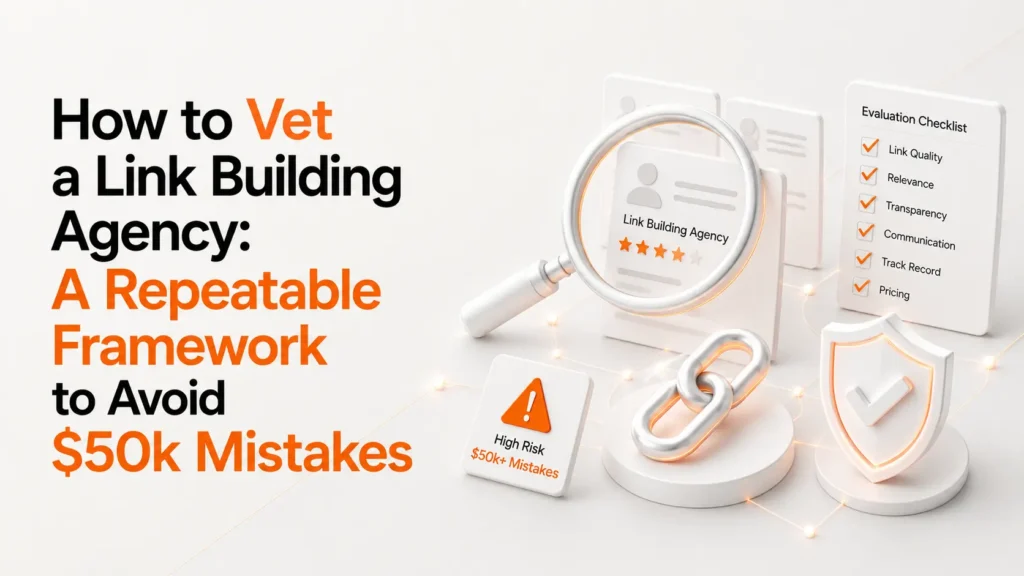
For the complete vetting checklist and the questions that separate a real link building partner from a reseller of shortcuts, see How to Vet a Link Building Agency: A Repeatable Framework to Avoid $50k Mistakes.
The Relationship-First Outreach Framework
Why Transactional Link Begging Stopped Working
Cold email success rates for the generic “resource page” pitch have collapsed into fractions of a percent across most saturated verticals. Editors and content managers in 2026 are operating with genuine pitch fatigue, and a growing share of inboxes now run AI filtering before a human ever sees a submission. The template that worked in 2019 gets deleted unread in 2026.
The asset-exchange model is what’s replacing it. Successful outreach now requires offering something concrete before you ask for a citation: proprietary data, a design asset, expert commentary, or access to a community the editor actually wants in front of. Ask first, offer nothing, and you’re competing with a thousand other emails doing the exact same thing.
Building a Partnership Pipeline Instead of a Prospect List
The shift here is subtle but changes everything downstream. Instead of building a spreadsheet of one-off link targets, segment prospects by relationship potential: publishers, newsletter operators, and industry community managers who control recurring content calendars are worth ten times a single guest post placement, because they’re a channel, not a transaction.
We built the tactical execution manual for exactly this, covering outreach templates, follow-up cadences, and value-first pitching structures, in The Relationship-First Link Building Outreach Framework: Stop Begging, Start Building. If your current outreach process is still running templated pitches at a cold list, start there before running another campaign.
Tactical Execution: Proven Acquisition Channels for 2026
Broken Link Building as a Resilient, White-Hat Acquisition Channel
Broken link building remains one of the few tactics that stays structurally sound even in an AI-search environment, because it solves a real editorial problem instead of forcing an unnatural placement. A site with a dead resource has a user-facing 404. You’re not asking for a favor. You’re offering a fix.
The modern workflow leans on Wayback Machine exports, SEO tool 404 exports, and content gap analysis to identify replaceable dead resources at scale rather than hunting them manually one site at a time. For the full standard operating procedure on discovery, content replacement, and conversion-focused outreach, see Broken Link Building in 2026: A Complete Guide to Earning Backlinks and Leads.
SaaS Link Building: Leveraging Product-Led Content and Integration Ecosystems
SaaS companies sit on link assets that a standard content site simply doesn’t have: API documentation, integration marketplace listings, tool comparison widgets, and free-utility calculators. These aren’t marketing collateral. They’re citation magnets, because comparison articles and setup guides link to them organically without an outreach email ever being sent.
The data backs this up clearly. SaaS teams that lean into product-led assets, think integration pages, free tools, and original research, consistently post faster referring-domain growth than teams relying solely on editorial guest contributions, and original research specifically tends to pull a meaningfully higher volume of links than standard blog content. Integration ecosystems compound this further: every partner in a marketplace like a Slack App Directory or a Zapier integration network represents a co-marketing link opportunity that most non-SaaS businesses simply don’t have access to. If you’re a SaaS growth lead reading this and your integration pages don’t already link back to your partner’s site (and vice versa), that’s an open opportunity sitting unclaimed right now.
Vertical-Specific Authority Tactics
Not every business has product-led assets to lean on. For B2B services, e-commerce, and local markets, the framework adapts: relationship-driven digital PR becomes the primary lever instead, because there’s no free tool or API doc to earn links organically. The tactics change, but the underlying principle doesn’t: earn the link by solving a real problem for the linking site, not by asking for a favor.
Comparative Analysis: Link Acquisition Tactics by Resource and Risk
2026 Link Building Tactics Comparison
| Tactic | Average Success Rate | First Link Timeline | Primary Resource Required | Risk Profile | Best Use Case |
|---|---|---|---|---|---|
| Broken Link Building | 8–12% | 2–4 weeks | Content researcher | Very Low | Sites with extensive content libraries |
| Relationship-Driven Outreach | 12–20% | 3–6 weeks | Partnership manager | Very Low | Niche authorities and SaaS brands |
| Data Studies and Original Research | 4–8% | 6–12 weeks | Analyst/content lead | Low | Brand awareness and PR campaigns |
| Strategic Guest Contributions | 5–10% | 2–4 weeks | Subject matter expert | Medium | Thought leadership in defined verticals |
| Resource Page Link Building | 6–10% | 2–5 weeks | Outreach specialist | Low | Educational content and free tools |
| SaaS Directory and Integration Placement | 35–55% | 1–2 weeks | Product marketer | Very Low | Product-led growth companies |
A note on how to read this table: the SaaS directory figure reflects submission-based acceptance rates on marketplaces and directories, not cold outreach conversion, so don’t benchmark your relationship-driven outreach team against it. Also worth tracking separately which of these tactics require an ongoing editorial relationship versus a one-time submission, because the resourcing implications are completely different. A guest contribution needs a subject matter expert every time. A directory placement needs one person for an afternoon.
It’s also worth building link decay into your planning from the start. Independent link-rot research tracking billions of links over nearly a decade has found that a large share of backlinks eventually go dead or get removed, with roughly one to two percent of links dying every week and a meaningful chunk disappearing within the first year alone. That means a non-trivial portion of any ongoing program isn’t building new authority, it’s replacing inventory that quietly disappeared. Budget for that reality instead of being surprised by it at your next quarterly review.
Measurement, Reporting, and ROI Attribution
Overhauling the Link Building Report: From Output to Outcome
Before: link building reporting in most organizations is a weekly export of links acquired and a screenshot of a Domain Rating chart trending upward. It looks like progress. It answers exactly one question: are we active? It answers nothing finance actually cares about.
After: a three-tier reporting model that satisfies SEO operators, marketing leadership, and finance simultaneously, because each tier answers a different question at a different cadence, and none of them get treated as the whole story on their own.
Link Building Metrics Framework by Stakeholder
| Metric Category | Specific Examples | Business Question Answered | Reporting Frequency | Actionability |
|---|---|---|---|---|
| Output / Vanity | Links acquired, Domain Rating shifts | Are we active? | Weekly | Low—avoids strategic decisions |
| SEO Performance | Keyword ranking changes, organic traffic growth | Are we visible? | Bi-weekly | Medium—indicates trajectory |
| Engagement Quality | Referral traffic volume, time on site from backlinks | Are links sending buyers? | Monthly | High—validates relevance |
| Revenue Impact | Assisted conversions, organic CAC, LTV of backlink-sourced leads | Are we profitable? | Monthly / Quarterly | Critical—justifies budget |
The bridge between these tiers is attribution modeling, and this is where most teams quietly fall apart. If your CRM and GA4 setup is still running last-click attribution by default, your link building program is getting zero credit for every assist it makes further up the funnel, which is most of what link building actually does. A visitor who reads a backlinked article in month one and converts on a branded search in month three shows up as branded search in a last-click model. The link did the work. It gets none of the credit. Multi-touch attribution isn’t a nice-to-have here. Without it, you’re reporting a number that structurally cannot reflect what link building contributed, and then wondering why the budget conversation keeps going sideways.
Building the Business Case with Stakeholders
A defensible ROI narrative needs three components: a calculated cost-per-quality-link (not cost-per-link overall, quality-filtered), a modeled ranking-to-revenue correlation curve specific to your business, and a forecast of pipeline contribution from organic authority gains that your finance team can sanity-check against actuals. The foundational evidence piece for presenting this kind of revenue correlation data at board level is Link Building in 2026: The Data-Backed Case for ROI.
Worth noting for that conversation: SEO leads driven by strong organic rankings close at a meaningfully higher rate than outbound and traditional marketing leads, which is one of the more compelling data points to bring into a budget defense conversation. It reframes link building from a cost center into a channel with a demonstrably better close rate than most of what marketing is currently funding.
Future-Proofing Your Program in the AI Search Era
Penalty-Proof Velocity and Anchor Text Standards
Sustainable link acquisition depends on natural velocity curves and semantic anchor diversity. Sudden spikes in exact-match commercial anchors remain the fastest way to trigger algorithmic suppression in 2026, and this hasn’t changed even as everything else around link building has.
For monitoring, Link Whisper or an internal spreadsheet model works fine for anchor text distribution audits, and Google Search Console remains the tool for catching Manual Actions before they compound into a bigger recovery project.
Expert Tip
Maintain a 60/30/10 distribution: approximately 60% branded or natural language anchors, 30% topical/semantic phrases, and no more than 10% exact-match commercial terms.
This is a conservative target relative to some of the industry benchmarking floating around, and that’s intentional. Independent studies of top-ranking pages have consistently found average exact-match anchor usage sitting close to zero among the sites that actually hold competitive rankings long-term. Some agencies will tell you 15 percent exact-match is safe if the rest of your profile is clean, and for an aged, high-authority domain that might hold. If you’re managing a five- or six-figure organic budget and can’t afford a six-month recovery cycle from a manual action, staying well under 10 percent is the more defensible position, not the more aggressive one.
Aligning Acquisition Strategy with AI-Platform Citation Logic
AI search platforms prioritize source diversity, recency, and topical domain clustering when selecting citations. That means your link building program now needs to optimize for citation probability inside AI training and retrieval data, not just blue-link rankings in classic SERPs.
Here’s the part that surprises most teams: unlinked brand mentions are now correlating with AI citation frequency even more strongly than traditional backlinks in several large-scale studies. That doesn’t make backlinks irrelevant. It means the smartest placements in 2026 do double duty, functioning as both a link and a contextual brand mention on a source the AI engine already trusts. A relevant, in-context placement on a site inside your niche is worth more now than it was two years ago, precisely because it feeds both systems at once. A generic, off-topic placement feeds neither.
For the complete advanced playbook on AI-era risk mitigation, citation optimization, and penalty recovery protocols, see Link Building in the Age of AI Search: A Complete Playbook for Penalty-Proof Links.
Conclusion
Sustainable link building in 2026 is an operational system, not a tactic list. Success requires internal technical foundations, a deliberate operating model, relationship-driven outreach, vertical-specific execution, and revenue-attached reporting. Skip any one of these and the rest of the investment underperforms, not because the tactics failed, but because the system around them wasn’t built to carry the weight.
Before this framework, link building was a black-box expense measured in arbitrary scores that nobody outside the SEO team could interpret, let alone defend. After implementing it, it becomes a transparent revenue channel with defensible ROI, stakeholder trust, and real protection against both algorithmic shifts and AI-search disruption.
Audit your current program against the operating model comparison table above. Identify whether your immediate constraint is technical foundation, team structure, or reporting clarity, then prioritize the guide in this hub that addresses your weakest pillar first.
The organizations winning organic growth in 2026 aren’t the ones acquiring the most links. They’re the ones building link programs that finance teams understand, engineers can support, and AI platforms cannot ignore.
Frequently Asked Questions
How long does it take to see revenue impact from a new link building program?
Most organizations observe measurable organic ranking movement within three to four months of consistent quality acquisition, with revenue attribution becoming statistically reliable around month six. Programs focused on product-led SaaS assets or broken link building tend to reach engagement-quality milestones faster than digital PR campaigns.
Is link building still necessary now that AI search engines summarize answers directly?
Yes, but its function has shifted. AI platforms rely on authoritative source attribution to generate summaries. A site with strong, relevant backlink profiles is significantly more likely to be cited as a source in AI-generated responses, making links a direct determinant of visibility in zero-click environments.
What is the difference between Domain Rating and actual link value?
Domain Rating is a proprietary metric estimating overall site authority based on backlink volume. Actual link value depends on referring page relevance, editorial context, traffic sent, and whether the link is followed. A single link from a niche-relevant mid-DR publication with engaged referral traffic often outperforms a generic link from a high-DR generalist site.
Should I hire an in-house link builder or outsource to an agency in 2026?
Hire in-house when you require deep product knowledge, have existing content infrastructure, and need daily integration with your editorial calendar. Outsource when you need immediate scale, specialized outreach relationships, or a fresh competitive intelligence perspective. Many scaling SaaS teams use a hybrid: in-house strategy with outsourced execution.
How do I recover from a manual action or algorithmic suppression caused by past link building?
Begin with a full backlink audit using Google Search Console and third-party crawlers to identify manipulative patterns (PBNs, exact-match anchor manipulation, paid links without disclosure). Document your findings, disavow irredeemable domains, and submit a reconsideration request only after you have removed or nofollowed the problematic links and can demonstrate a policy change.
How much should a legitimate link building program cost per month?
For sustainable, white-hat acquisition, expect to invest between $5,000 and $15,000 monthly for boutique agency support, or $8,000 to $18,000 for an in-house specialist with tooling and content costs. Sub-$3,000 monthly retainers in competitive English-language markets often rely on low-quality directory placements or private blog networks that carry penalty risk.