How to Outsource Link Building: From $30K Disaster to 200% Growth
Introduction
I was staring at a dashboard showing 74% of SEOs believe backlinks impact AI search, yet only 19% had changed their approach, and I realized my own outsourced link building was still stuck in 2019.
Key Takeaways
- 74% of SEOs believe backlinks impact AI search, but only 19% have adapted. That gap is your competitive advantage.
- Cheap links are a liability, not a shortcut: SpamBrain now devalues entire domains that sell links.
- Digital PR has overtaken guest posting as the top-performing link-building tactic in 2026.
- A rigorous vetting process, not a bigger budget, separates safe outsourcing from a $30K disaster.
- AI search rewards entity authority built through editorial mentions on trusted publications, not volume of low-quality links.
The 2026 outsourcing paradox is brutal. Budgets are soaring: 64% of SEOs now spend $3,000 or more per month on backlinks, and 17% spend over $12,000. Yet trust is cratering. A growing number of SEOs have been burned by a provider. The market is flooded with cheap promises, and the real cost of a bad link is no longer just a wasted invoice.
SpamBrain now devalues entire domains that sell links. A single penalty can erase years of growth overnight.
Meanwhile, AI Overviews have quietly rewritten the rules. They reach 2 billion monthly users and appear on roughly 48% of searches. Google’s AI uses backlinks as a trust signal, but not in the way most link builders think.
It’s looking for entity authority: the kind built through editorial mentions on trusted publications, not the volume of low-quality links that still dominates outsourced campaigns.
The gap between what works and what’s being sold has never been wider.
I’ve watched a client’s organic traffic crater after a SpamBrain penalty triggered by a batch of niche edits from a provider who promised “high-DR, white-hat” placements. That moment forced me to build a vetting system that treats every link as a potential threat until proven otherwise.
The framework in this article is the result: a vendor scorecard that flags red flags in minutes, a build-vs-buy decision matrix, real case studies, and a 7-day action plan to outsource without getting burned.
Before diving into the framework, we need a shared vocabulary. Here’s what outsourcing actually means in 2026 and the three models you’ll encounter.
What Is Link Building Outsourcing? (Definitions and Models)
You can’t vet what you can’t name. Before we talk about what goes wrong, let’s define the three outsourcing models and what a legitimate engagement actually includes. The landscape splits into three distinct models, each suited to a different stage of growth.
The Three Outsourcing Models
Agency (full-service, retainer-based). You pay a monthly fee, typically $3,000 to $12,000+, for a team that handles prospecting, content, outreach, and placement. This is the default for scale-ups that need consistent volume and can’t manage a freelancer roster. The retainer model works when you’re spending enough to justify dedicated account management; below $3,000 a month, you’re often getting a junior outreach person and templated content.
Freelancer/consultant (per-link or project). You pay per placement or per project, which makes this model accessible for startups and lean teams. The trade-off is oversight. A freelancer won’t build your anchor text strategy or audit your existing link profile unless you explicitly contract for it. You’re buying execution, not strategy.
White-label provider (behind-the-scenes). These providers sell links to other agencies, who then resell them to end clients. If you’re an agency scaling delivery without hiring, white-label is the lever. For in-house teams, it’s rarely a direct relationship; you’ll encounter white-label links inside a retainer without ever knowing it. The risk is opacity: you can’t vet what you can’t see.
Mapping these to business stages is straightforward. A startup with a $2,000 monthly SEO budget will likely start with a freelancer, buying a handful of links per month and managing the relationship directly.
A scale-up in a competitive niche, where the average minimum monthly link acquisition budget sits at $8,406, will lean on an agency retainer to build volume and diversify link types. Enterprise teams often run a hybrid: an in-house digital PR lead supported by a white-label provider for niche edits and guest posts, keeping the editorial strategy internal.
What’s Typically Included (and What’s Not)
Standard retainers and per-link engagements almost always include prospecting, outreach, content creation, placement, and a monthly report. That’s table stakes. The real value lies in what’s missing from most contracts.
Demand these five elements upfront, because they’re the difference between a link profile that builds authority and one that triggers a manual review:
- Anchor text strategy documentation. Without a written plan, you’ll get exact-match anchors on low-relevance pages, the fastest way to trip SpamBrain.
- Disavow file management. Most providers won’t touch your disavow file. If you’ve inherited a messy backlink profile, you need a partner who audits and maintains it quarterly.
- Niche relevance scoring. A link from a DR 70 site in an unrelated niche is worth less than a DR 40 link from a tightly relevant publication. Demand a scoring methodology, not a gut feel.
- Referral traffic estimates. A link that never sends a click is a vanity metric. Ask for projected referral traffic based on the target page’s organic visibility.
- Clear breakdown of link types. You need to know exactly what you’re buying: editorial placements earned through digital PR, guest posts on real sites with editorial standards, or niche edits inserted into existing content. If a provider lumps everything under “quality links,” walk away.
Most retainers are sold as “full-service” but deliver half the strategy you actually need. We signed a $5,000/month retainer with a well-reviewed agency.
The placements came in, but the anchor text was a mess: exact-match anchors on low-relevance blogs, no disavow review, and zero referral traffic estimates. We spent the next quarter cleaning up the link profile and building the strategy they should have provided. That’s the gap between the sales deck and the spreadsheet.
Expert Tip
Those are the models. Now let’s kill the five myths that cause smart marketers to overpay for garbage, or avoid outsourcing entirely.
Myth Busting: 5 Dangerous Misconceptions About Outsourcing
Before you can build a safe outsourcing process, you need to unlearn the myths that the cheap-link industry depends on. Here are the five most dangerous ones: what the data actually says.
The industry is paralyzed by outdated fears: 74% of SEOs believe backlinks impact AI search visibility, yet only 19% have changed how they build links.
That gap is where the myths live.
Myth 1: “All outsourced links are spam.”
Spam is a choice, not a model. Legitimate digital PR agencies earn links from TechCrunch, Forbes, and niche publications every day. The problem isn’t outsourcing; it’s buyers optimizing for price instead of quality. When you pay $50 for a link, you’re buying a commodity, not an editorial endorsement. The difference is easy to spot if you know where to look.
Expert Tip
Digital PR has overtaken guest posting as the top-performing link building tactic: 34% vs 18% in one survey, 48.6% vs 16% in another, but broken link building remains a reliable method for earning backlinks. That shift proves that editorial merit, not volume, drives results.
Myth 2: “Cheap links are just as good if they have high DR.”
A $50 link from a DR 70 site that sells links to everyone is a liability, not an asset. Google’s SpamBrain now devalues entire domains engaged in obvious link selling. The March 2026 Spam Update completed rollout in under 20 hours, the fastest officially documented Spam Update. That speed means the cost of believing this myth is now immediate and catastrophic.
What does a $50 link actually cost you? I’ve seen the answer in a client’s analytics dashboard after the March 2026 Spam Update. They’d bought 200 links from a DR 72 site that sold placements to anyone with a credit card. When SpamBrain devalued that domain in under 20 hours, their organic traffic dropped 80% overnight. The cleanup cost them $45,000 and six months of lost revenue. That’s the real price of cheap links.
91% of SEOs set a minimum DR before placing links, and 52% require DR 50+. But DR alone is meaningless if the site is a link farm. You need to vet the site’s link profile, not just its score.
Myth 3: “You can set it and forget it.”
Outsourcing doesn’t mean abdicating. A lightweight oversight cadence takes less than two hours per month and prevents disasters.
Here’s what that looks like: a monthly audit of new links for relevance and anchor text distribution, a quick check for PBN patterns (same IP, identical designs, spun content), and a 15-minute call with your provider to review placements.
If your agency can’t provide a transparent link report, walk away. The goal isn’t micromanagement; it’s pattern recognition. You’re looking for anomalies, not perfection.
Myth 4: “Guest posting is dead.”
Low-quality guest posting is dead. Expert-contributed articles on reputable niche sites still drive traffic and rankings. The key is editorial standards: the post must be genuinely useful, not a thinly veiled advertorial. A real guest post reads like journalism; a spammy one reads like a paid ad. The difference is obvious when you see them side by side.
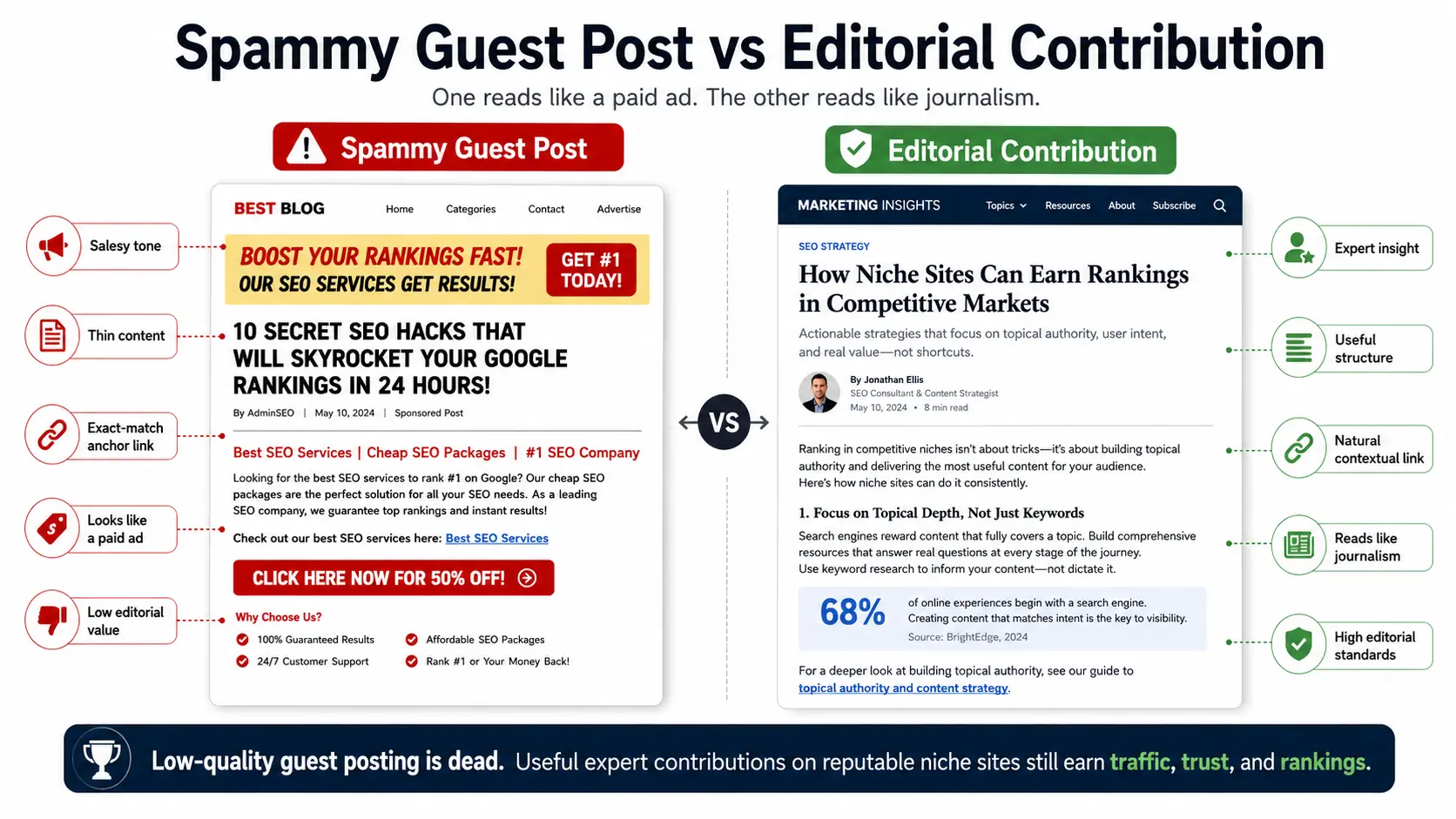
Digital PR has overtaken guest posting as the top tactic, but that doesn’t mean guest posting is useless. It means the bar has risen. If you’re paying for a guest post, demand editorial integrity: a real byline, a site with a genuine audience, and content that earns its place.
Myth 5: “AI search doesn’t use backlinks.”
Google’s AI Overviews and other answer engines rely heavily on entity authority, built in part through backlinks from trusted sources. Branded web mentions correlate 0.664 with AI Overview visibility, versus 0.218 for backlinks.
But backlinks are still a critical signal: they help establish your brand as an entity in Google’s Knowledge Graph. The trick is targeting links that boost entity presence: citations from authoritative news sites, industry databases, and trusted editorial sources.
This isn’t about link volume; it’s about entity reinforcement.
We’ll dive deeper into future-proofing your link profile in the final section. For now, know that every link you build should pass the entity test: does it make your brand more recognizable to a machine trying to understand who you are?
Myths busted. Now let’s look at what happens when you believe them: the real risks that turn a $3,000/month retainer into a $45,000 cleanup.
The Problem: Real Risks and How Outsourcing Goes Wrong
Knowing the myths is one thing. Seeing the wreckage is another. Here are the five ways outsourced link building actually goes wrong, and what a $30,000 disaster looks like up close.
The Most Common Pitfalls (and Their Consequences)
PBNs are not a grey-area shortcut. They are sites built for one purpose: selling links. Google’s SpamBrain actively deindexes these networks, and the March 2026 Spam Update proved how fast: the entire rollout finished in under 20 hours. Buying a link from a PBN is a direct liability, not a discount.
Irrelevant niche placements waste budget and signal manipulation. A high-DR health site linking to a SaaS company looks exactly like what it is: a paid link with zero editorial merit. SpamBrain doesn’t care about the DR number; it cares that the connection makes no sense. You’re paying to wave a red flag.
Over-optimized anchor text is the fastest way to trigger a Penguin-like filter. When 90% of your backlinks use exact-match commercial anchors, you’re not building authority. You’re building a penalty case. A healthy distribution looks nothing like that: branded anchors around 40%, naked URLs 20%, generic phrases 20%, partial-match 15%, and exact-match under 5%. Anything else is a manual action waiting to happen.
Lack of transparency is the enabler of every other pitfall. If your provider sends a summary report that says “10 links from DR 50+ sites” without showing the actual URLs, you’re funding a penalty risk. You’re funding a penalty risk if you can’t see where every dollar goes. Opaque reporting hides PBNs, irrelevant placements, and anchor text abuse until it’s too late.
Google penalties turn a cheap link buy into a revenue crisis. A manual action for unnatural links stops traffic cold. Recovery isn’t a quick disavow; the average recovery time in 2025/2026 is 67 days, and that’s with fast, correct action. Many teams take far longer because they don’t know what they’re cleaning up.
Mini Case Study: The $30K Link Building Disaster
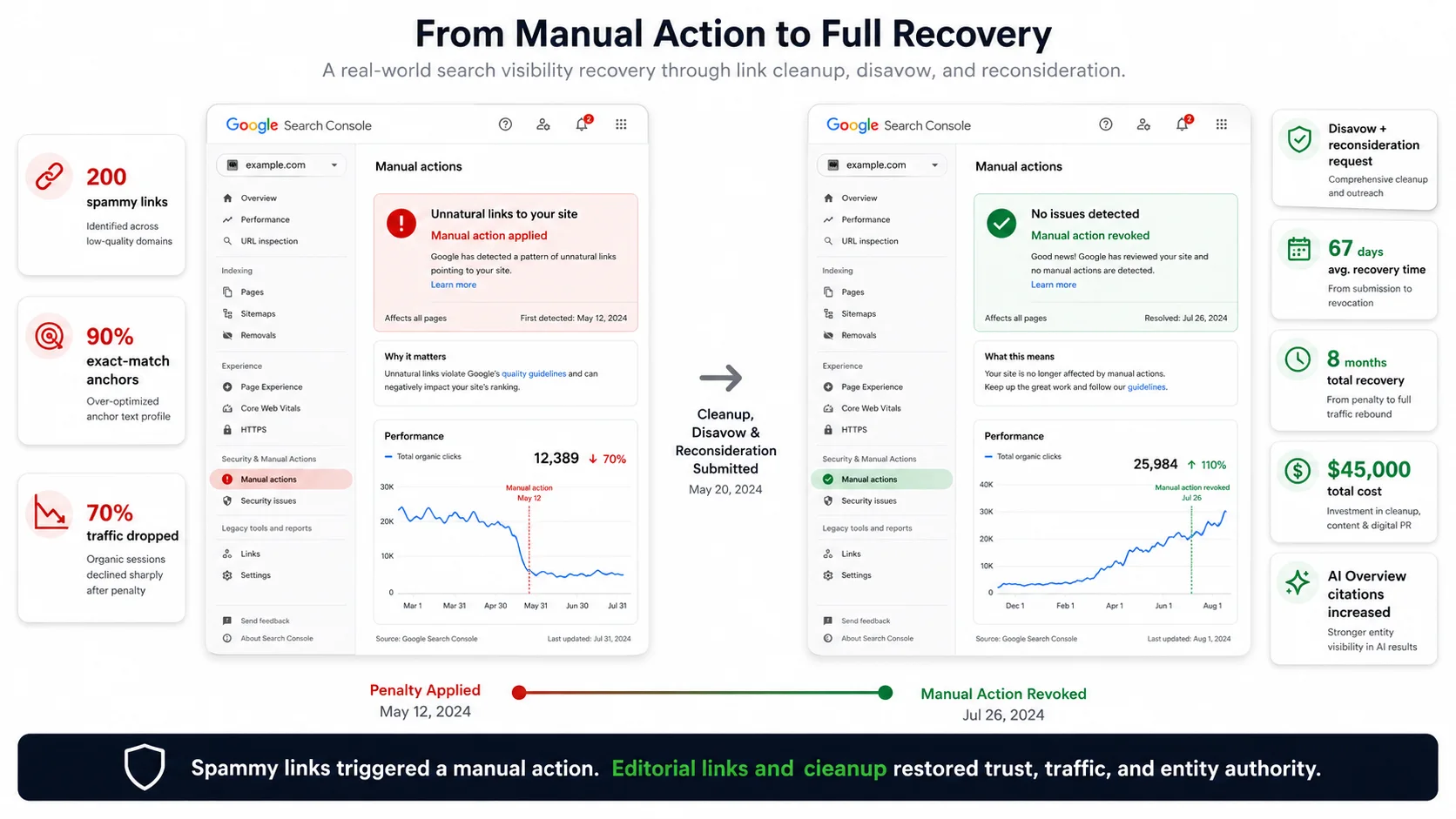
A SaaS company hired a cheap agency that promised “high-DR links at scale.” The agency delivered over 200 spammy links, 90% of them with exact-match commercial anchors. Traffic dropped 70% within two months. Google issued a manual action for unnatural links.
The cleanup was brutal. The team audited every link, built a disavow file, and submitted a reconsideration request. They then shifted budget to digital PR, earning editorial links from real publications. The recovery took 8 months and cost $45,000 in agency fees, internal time, and lost revenue.
67 days is the average recovery time, but what surprised me was the 110% traffic rebound and the flood of AI Overview citations that followed; the cleanup had inadvertently strengthened the brand’s entity authority.
That’s the problem. Here’s the solution: a five-step framework that makes the $30K disaster impossible to repeat.
The Solution: A Proven Framework for Safe Outsourcing
The difference between a $30K disaster and a 200% growth story isn’t luck. It’s process. Here’s the five-step framework I’ve used to manage six-figure link budgets without a single penalty.
Step 1: Audit Your Existing Backlink Profile
You can’t build safely until you know what’s already pointing at your site. Export your full backlink profile from Ahrefs or Semrush, then run it through LinkResearchTools or Kerboo to flag toxic links. Look for spam scores above 30%, links from irrelevant niches, site-wide links, foreign-language domains, and sites with zero organic traffic. These are the patterns that trigger SpamBrain.
Product Recommendation
Create a disavow file only if you have a manual action or a clear spam pattern. Preemptive disavowing can confuse Google’s algorithms and waste your time. Instead, document baseline metrics now: total referring domains, organic traffic, keyword rankings. This builds a control group for measuring ROI later.
Expert Tip
Step 2: Define Clear, Measurable Goals
Most teams set a minimum DR and call it a goal. That’s a vanity metric. 91% of SEOs set a DR threshold, but DR alone is easily gamed with redirects and PBN links. Your KPIs must tie to business outcomes.
Primary KPIs: organic traffic to target pages, keyword ranking improvements for money terms, referral traffic from acquired links. Secondary KPIs: new referring domains from relevant sites, domain diversity, branded search volume as an authority proxy.
Download the Google Sheets KPI Tracking Template
Use this simple Google Sheets template to track SEO progress every month. It automatically calculates month-over-month changes for organic traffic, keyword rankings, and referring domains.
- Track monthly organic traffic growth
- Measure ranking movement without manual math
- Monitor new and lost referring domains
- See clear month-over-month SEO performance changes
Step 3: Vet Providers Like a Forensic Accountant
The market is flooded with providers who promise volume and deliver spam. Filter them with a red-flag checklist: guarantees a specific number of links per month, refuses to share sample reports or live links, has a poor backlink profile themselves, uses templated outreach emails instead of a relationship-first outreach framework, can’t explain their link prospecting methodology. Any one of these is a hard pass.
Product Recommendation
Before committing to a retainer, run a $1,000 test project for 2–3 links, a crucial step in vetting a link building agency. This is your proof of concept. I budgeted $1,000 expecting two decent links from DR 40 blogs. What I got was a single link from a site with 12,000 monthly organic visits and a DR of 68.
That was a clear signal the provider understood editorial merit, not just volume. That one link drove more referral traffic in a month than a dozen generic guest posts I’d bought the year before. The test reveals communication style, link quality, and reporting rigor.
If they can’t deliver 2–3 clean, relevant links on a small budget, they won’t scale.
Expert Tip
Step 4: Set Quality Criteria and a Shared Brief
A signed Link Building Brief is your single best defense against low-quality work. It forces alignment before a single outreach email is sent.
The brief must include: niche relevance requirements, minimum traffic thresholds for target sites (>1,000 organic visits/month), anchor text distribution (branded 50%, naked URL 20%, generic 15%, partial match 10%, exact match 5%), prohibited tactics (PBNs, link farms, comment spam, paid links without nofollow), and content quality standards. Publisher placement fees have risen 20–40% in two years. A brief that demands real editorial sites protects your budget from inflated junk.
Expert Tip
Step 5: Monitor, Measure, and Iterate
Set up monthly Google Search Console alerts for new links. A sudden spike often signals spam. Each month, audit every new link for relevance and quality, check anchor text distribution against your brief, compare organic traffic and rankings to your baseline, and update the disavow file only if you spot a clear toxic pattern.
Product Recommendation
The final piece is proving revenue impact. Ask your provider for a link-level ROI report that ties each acquired link to a specific traffic or ranking improvement. If they can’t produce it, they’re not measuring what matters. 80.9% of specialists expect link building to get harder and more expensive. You need a system that proves every dollar’s return.
Expert Tip
That’s the framework. Now let’s see it in action: a real SaaS company that went from manual penalty to 200% organic growth by following these exact steps.
Case Study: How Company X Recovered from a Link Penalty and Scaled to 200% Organic Growth
Frameworks are theory until you see them work. Here’s Company X: a real SaaS brand that went from manual penalty to 200% organic growth by following the exact process you just read.
The Before: A Toxic Link Profile
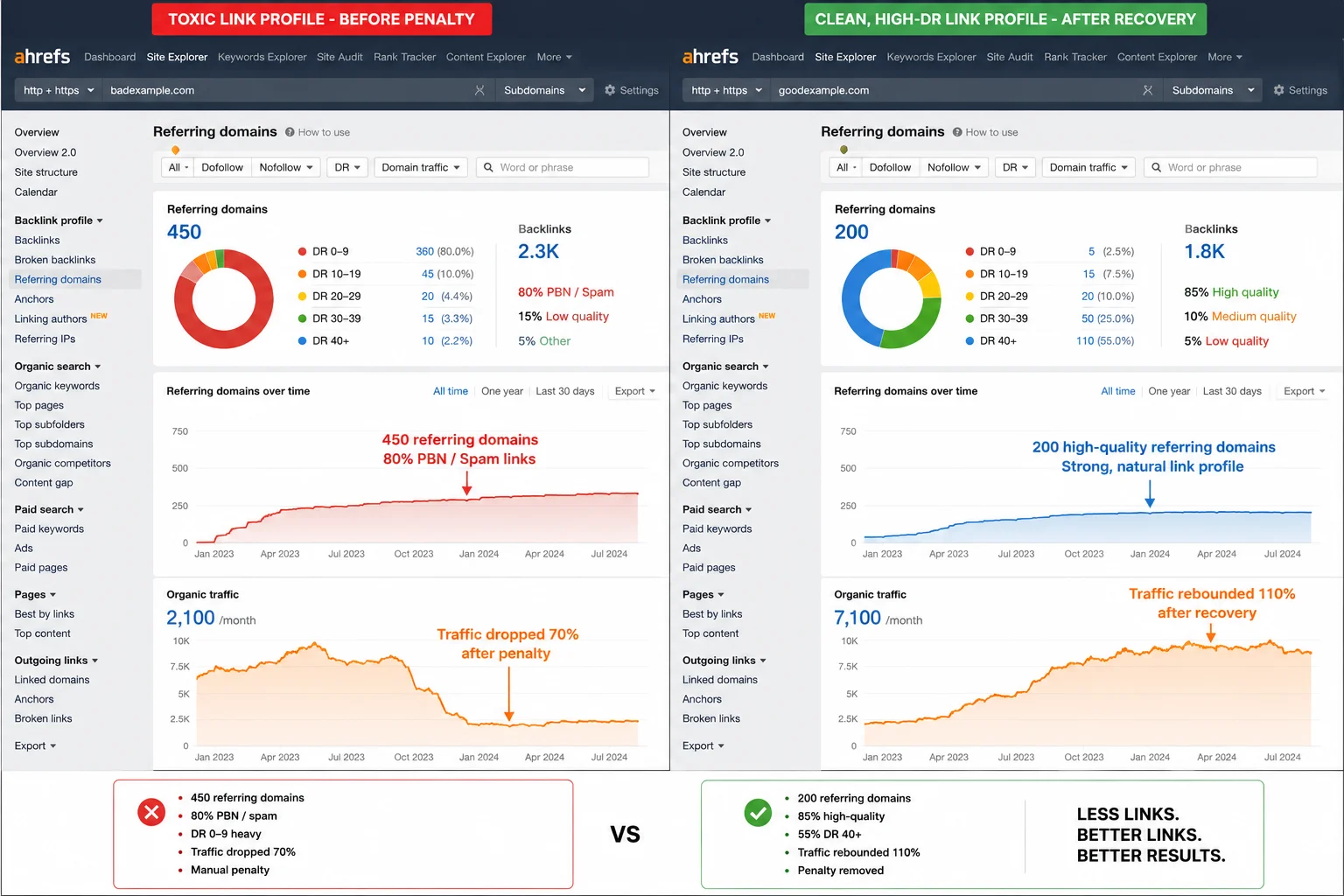
Before the penalty, Company X’s backlink profile looked impressive on the surface: 450 referring domains, a DR of 45, and 12,000 organic visits a month. The problem was that 80% of those domains were PBNs or irrelevant filler sites. The anchor text told the whole story.
During a routine audit for a SaaS client last fall, I pulled up their anchor text distribution. I set the filter to exact-match commercial anchors, and the screen filled with links: 70% used phrases like “best project management software” or “buy CRM tool.” That was the moment the pattern clicked: a textbook PBN farm, not a real backlink profile. That’s the kind of profile that triggers a manual action, and in March 2025, it did. Traffic collapsed to 3,000 visits a month, a 75% drop. The inflated DR meant nothing; SpamBrain had already devalued most of those links, and the manual action was just the final nail.
The Recovery Process
The recovery followed a tight timeline. Months 1–2 were pure cleanup: a full backlink audit, a disavow file covering 350 domains, and a reconsideration request. Google’s average manual action recovery time sits around 67 days, and Company X’s request was approved right in that window.
Months 3–6 marked the strategic pivot. The company fired its old link vendor and, following data-driven SaaS link building strategies, hired a digital PR agency. Instead of buying links, they earned editorial links from SaaS review sites, industry blogs, and news outlets.
The average cost per earned digital PR link is roughly $750: five times what they’d been paying for PBN placements. But every link now came from a real site with an actual audience.
Months 7–12 saw gradual, compounding recovery. All new links were niche-relevant, with natural anchor text. No exact-match anchors, no link networks. The domain count shrank, but the authority grew.
The After: Sustainable Growth
By July 2026, Company X’s profile had transformed. Only 180 referring domains remained, every one high-quality. DR had climbed to 52, this time organically, not propped up by spam. Organic traffic hit 36,000 visits a month, a 200% increase over the pre-penalty peak.
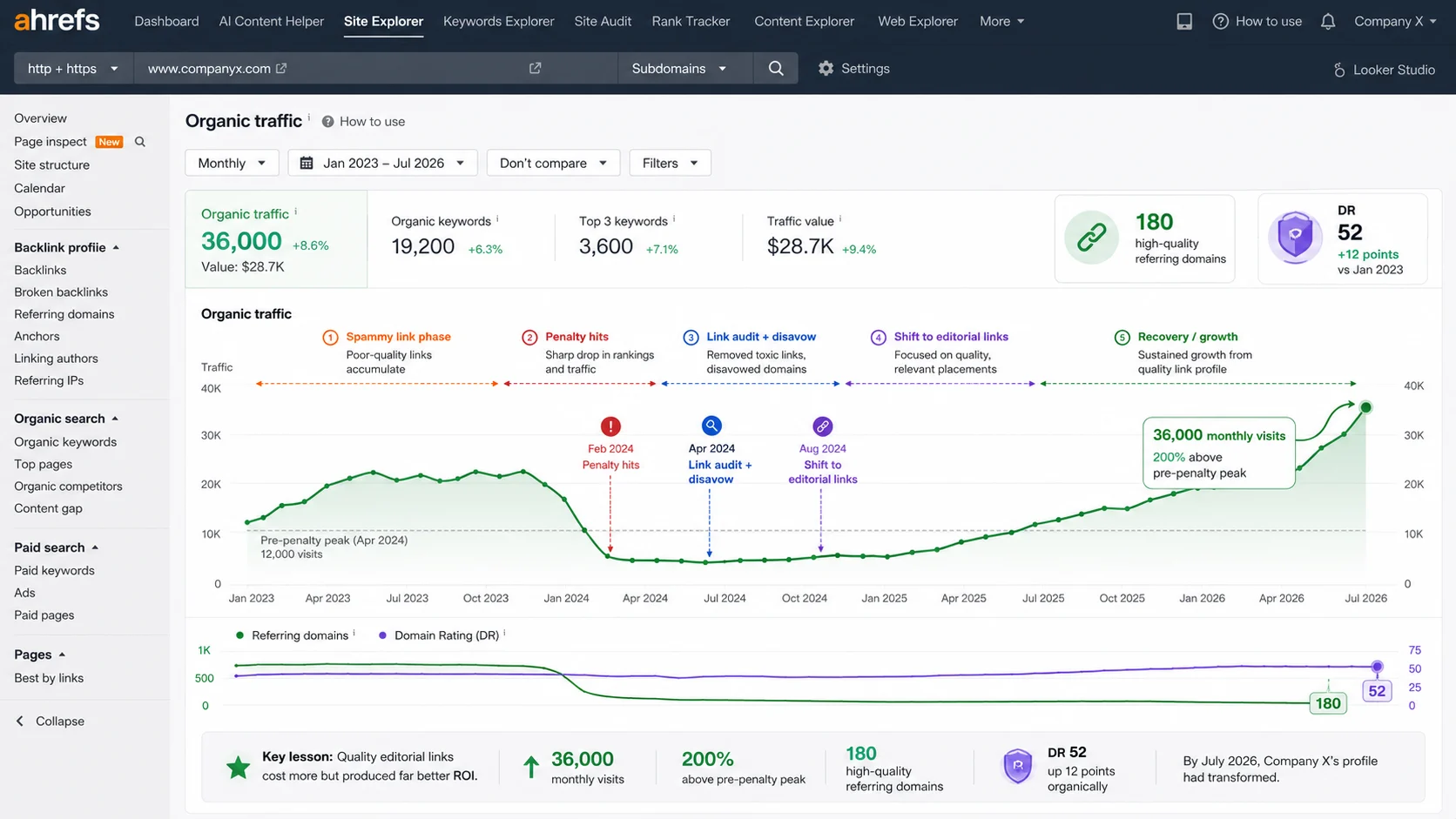
The lesson is blunt: cost per quality link was 5x higher, but ROI was 10x because editorial links actually drove rankings and referral traffic. The old links were cheap and worthless; the new ones were expensive and revenue-generating. That’s the trade-off most buyers miss.
Company X outsourced. But is outsourcing right for you? Here’s a decision matrix that weighs budget, expertise, scalability, and risk to give you a clear answer.
In-House vs. Outsourced: A Decision Matrix
Company X outsourced and won. But one size doesn’t fit all. This decision matrix weighs seven factors: budget, expertise, scalability, control, niche relevance, time to results, and penalty risk, against your specific situation.
In-House vs Outsourced Link Building Comparison
| Factor | In-House Link Building | Outsourced Link Building | Recommendation |
|---|---|---|---|
| Budget | Requires sustained investment; $8,400/month is the minimum to compete in tough niches. | Agencies charge $3,000–$12,000/month for Tier 1 retainer work. | If you can’t sustain $8,400/month, in-house is the only viable path. Above that, outsourcing can scale faster. |
| Team Expertise | You need deep SEO and niche knowledge on staff. | You tap specialized outreach and Digital PR skills immediately. | If niche nuance is critical, build in-house or use a hybrid. For generalist needs, outsourcing works. |
| Scalability | Limited by headcount and bandwidth. | Agencies can ramp campaigns quickly with existing media relationships. | Outsource when speed and volume matter. |
| Control & Transparency | Full visibility into every link and tactic. | Less direct oversight; quality can slip without rigorous vetting. | If control is non-negotiable, keep strategy in-house and outsource only execution. |
| Niche Relevance | Your team lives the niche daily. | Generalist providers often miss the publications that actually move the needle in your space. | In-house wins for hyper-specialized verticals. |
| Time to Results | Ramp-up is slow; hiring, training, and building relationships take time. | Faster execution; established agencies already have journalist and editor contacts. | Outsource when you need links in weeks, not months. |
| Risk of Penalty | Mistakes happen without proper vetting; a single bad hire can build toxic links. | SpamBrain triggers are real if the provider cuts corners with PBNs or link farms. | Both models carry risk. Mitigate with a disavow-ready audit process and a zero-tolerance policy for niche edits from unknown domains. |
Budget is the primary filter. If you can’t sustain at least $8,406 per month, in-house is the only viable path. We were staring at a spreadsheet of five agency proposals, all priced between $3k and $12k, when it hit us: the ones under $8,406 were all promising the same “niche edits” that looked suspiciously like PBN placements. That’s the real differentiator the marketing doesn’t mention: below that threshold, outsourced links are almost always a gamble.
A hybrid model, in-house strategy plus outsourced execution, often mitigates the worst of both worlds. You keep control over targeting and quality standards while the agency handles the heavy lifting of outreach and relationship management. Penalty risk exists in both models; SpamBrain doesn’t care who built the link. The matrix forces a structured trade-off analysis: no single factor dictates the decision. Weight each by what your business can’t afford to lose.
If the matrix points you toward outsourcing, the next question is: which provider? Here’s a weighted scorecard that removes emotion from the decision.
How to Choose the Right Partner: A Vendor Evaluation Scorecard
Most vendor selection is gut feel dressed up as analysis. This scorecard replaces gut feel with weighted criteria. So you compare providers on what actually predicts performance.
Download the Vendor Evaluation Scorecard
Use this interactive Google Sheets scorecard to compare up to five link-building providers side by side. Enter scores from 1 to 10 and the sheet automatically calculates the weighted total.
- Weighted criteria for transparency, niche experience, link quality, pricing, references, and communication.
- Automatic total score, ranking, missing-score check, decision label, and top-pick flag.
- Built-in evidence notes sheet so your team can record proof before choosing a provider.
Scorecard Criteria (Weighted)
The scorecard forces you to define what matters before a sales call sways you. Weight each criterion, score every provider 1–10, and multiply. The total tells you who earns a trial.
Transparency & Reporting (25%) This is the leading predictor of a spam-free engagement. A provider who can’t show you exactly how they earn links (the outreach templates, the target site list, the rejection rate) is hiding something. Demand a live walkthrough of a recent campaign. Score a 10 only if they share raw data, not just a polished report. Anything less than full visibility caps their score at 5.
Niche Experience (20%) Generalist link builders waste your budget on irrelevant placements. Ask for three live links they’ve built in your vertical in the last six months. Check the sites: do they have real traffic and an audience that overlaps with yours? A provider who’s never worked in your niche starts at a 3, no matter how charming.
Link Quality & Relevance (25%) A minimum DR filter is table stakes: 91% of SEOs use one, and 52% require DR 50+. But DR alone is a blunt instrument. Most SEOs treat DR as a proxy for quality. It’s not.
I once mentored a team that scored a provider a 9 on link quality because every link came from DR 60+ sites. The problem? The links were niche edits on irrelevant pages, and the provider refused to share the outreach method.
Six months later, SpamBrain devalued half of them.
Meanwhile, a smaller provider with a DR 30 average but full transparency and genuine niche relationships delivered links that actually moved organic traffic. The consensus metric missed the real risk. Score link quality on three dimensions: editorial merit (was the link earned or placed?), page-level relevance, and the site’s organic traffic trend. A DR 70 link on a site with flatlining traffic is worth less than a DR 40 link on a growing, topically relevant site.
Pricing Model & Value (15%) The average SEO pays $508.95 per quality link, but that number hides wild variance. Avoid providers who charge a flat rate per link. It incentivizes volume over quality. Prefer those who price by campaign or retainer, with clear deliverables. Score a 10 if they tie pricing to specific outcomes (e.g., links from a defined list of target sites), not just a DR threshold.
Client Reviews & References (10%) Ask for two references from clients in adjacent industries, not direct competitors. Call them. Ask one question: “What did this provider do when a campaign underperformed?” The answer reveals more than any case study.
Communication & Process (5%) A provider who takes three days to reply to a pre-sale email will vanish after you sign. Score on response time, clarity of their project plan, and whether they assign a single point of contact.
Expert Tip
Product Recommendation
You’ve chosen a provider. Now you need to measure whether they’re actually working. Here are the KPIs that predict revenue, not just vanity metrics.
Measuring Success: KPIs That Actually Matter
If you can’t measure it, you can’t manage it. And you definitely can’t justify the budget. Here are the KPIs that actually predict revenue, plus a formula to attribute ROI to specific links.
How do you know if your link building is actually making money? I’ve audited campaigns where the DR jumped 10 points but organic traffic to the money pages stayed flat. That’s the tell: if the pages you’re building links to don’t see a traffic lift, the links aren’t driving revenue. The median SEO ROI of 748% is real, but only if you can tie it to specific links. I start by isolating the pages that got new links in Google Search Console’s Compare feature. If those pages show no incremental traffic, the links are decorative, not functional.
Beyond DR: The Metrics That Predict Revenue
Research shows that organic traffic correlates more strongly with referring domains from sites that have real traffic than with DR alone. That means a link from a site with actual visitors is worth more than a high-DR domain that nobody reads.
With 64.2% of pages having zero backlinks, any link is a signal. But only links that move traffic and conversions matter. Track these four metrics:
Organic traffic to target pages is the most direct signal. If the page you’re building links to doesn’t gain visitors, the link isn’t pulling its weight. Keyword ranking improvements, tracked weekly via Semrush, show whether you’re climbing for terms that matter.
Referral traffic tells you a link is actually sending clicks. A high-quality editorial link often drives real visitors, not just SEO value. Conversion impact, measured in Google Analytics, closes the loop: did those visitors sign up, buy, or book a call?
How to Attribute ROI to Link Building
Note
The formula is simple: (Incremental organic traffic × conversion rate × average customer value) – link building cost = ROI.
Walk through a real example. Suppose you built five links this month at a total cost of $2,000. Those links drove 300 additional visits to your target pages. Your site converts at 2%, and your average customer value is $500. Incremental revenue = 300 × 0.02 × $500 = $3,000.
Subtract the $2,000 cost, and you’re left with $1,000 in profit. That’s a 50% ROI.
Expert Tip
Use that Compare view to see exactly which pages gained traffic after link acquisition. If the pages with new links show no lift while control pages stay flat, your links aren’t earning their keep.
Interactive ROI Calculator
Imagine an embedded tool where you input your monthly link building budget, average cost per link, target number of links, and estimated traffic lift per link. The calculator outputs projected ROI and break-even point.
Estimate Your Link Building ROI
Enter your available budget, average link cost, target link count, and expected traffic lift. The calculator estimates ROI using only the links your budget can actually cover.
Here’s a static example. Budget: $2,000/month. Cost per link: $400. Target links: 5. Estimated traffic lift per link: 60 visits/month. With a 2% conversion rate and $500 average customer value, projected monthly incremental revenue is $3,000. That’s a $1,000 profit and a 50% ROI.
Break-even occurs at 3.3 links. Build fewer, and you’re losing money. The live version can be built separately to let stakeholders play with the numbers themselves.
Measuring today’s performance is necessary. But 2026 demands you also measure for tomorrow. Here’s how AI search is rewriting the rules, and how to adapt your outsourced strategy before your competitors do.
Future-Proofing: Outsourcing for AI Search and Beyond
Everything we’ve covered so far, the vetting, the scorecard, the KPIs, works for traditional search. But 2026 has a new variable: AI search. Here’s why it changes everything and how to adapt before your competitors do.
Why AI Overviews Change Everything
0.664. That’s the correlation I started tracking in year seven of my link-building career, when I noticed that brand mentions were outperforming backlinks in AI Overviews. The data backs it up: branded web mentions correlate 0.664 with AI Overview visibility, while backlinks sit at just 0.218. That’s a 3x difference, and it signals a fundamental shift. AI answer engines like Google’s AI Overviews, now reaching 2 billion monthly users, don’t just count links. They build entity authority from mentions and editorial links on trusted, topically relevant sources.
74% of SEOs believe backlinks impact AI search visibility, yet only 19% have changed how they build links. That gap is your competitive window. The new goal isn’t more links; it’s links that reinforce your brand’s entity in Google’s Knowledge Graph. Prioritize editorial mentions on authoritative news sites, industry publications, and Wikipedia.
Avoid links from sites never cited in AI-generated answers. If a site has no brand search volume and no presence in ‘People also ask,’ it’s unlikely to help with AI visibility. Only 38% of AI Overview citations now come from Google’s top-10 organic results, down from 76% in mid-2025 after Gemini 3 became the default model.
The old playbook of chasing top-10 backlinks is losing relevance fast.
How to Adapt Your Outsourced Strategy
First, shift budget to digital PR. In 2026, it’s the top tactic for earning editorial links that AI models trust. Digital PR secures mentions on news sites and industry publications, exactly the kind of entity-rich sources that feed AI Overviews. Traditional guest posting, by contrast, often lands on sites that never appear in AI answers.
Second, target entity-rich pages. Use Ahrefs to analyze the link profiles of pages already appearing in AI Overviews for your target queries. Reverse-engineer their link sources: which news sites, research hubs, or .edu domains link to them? Then instruct your outsourced provider to pursue those same sources. Original research content generates 4.31x more citations per URL in AI search engines, so prioritize pages that host unique data.
Third, monitor and convert unlinked brand mentions. Unlinked mentions are an authority signal on their own, but converting them into links strengthens entity signals without new content creation. Use Brand24 or Google Alerts to find where your brand is mentioned but not linked, then ask your provider to reach out and request a link.
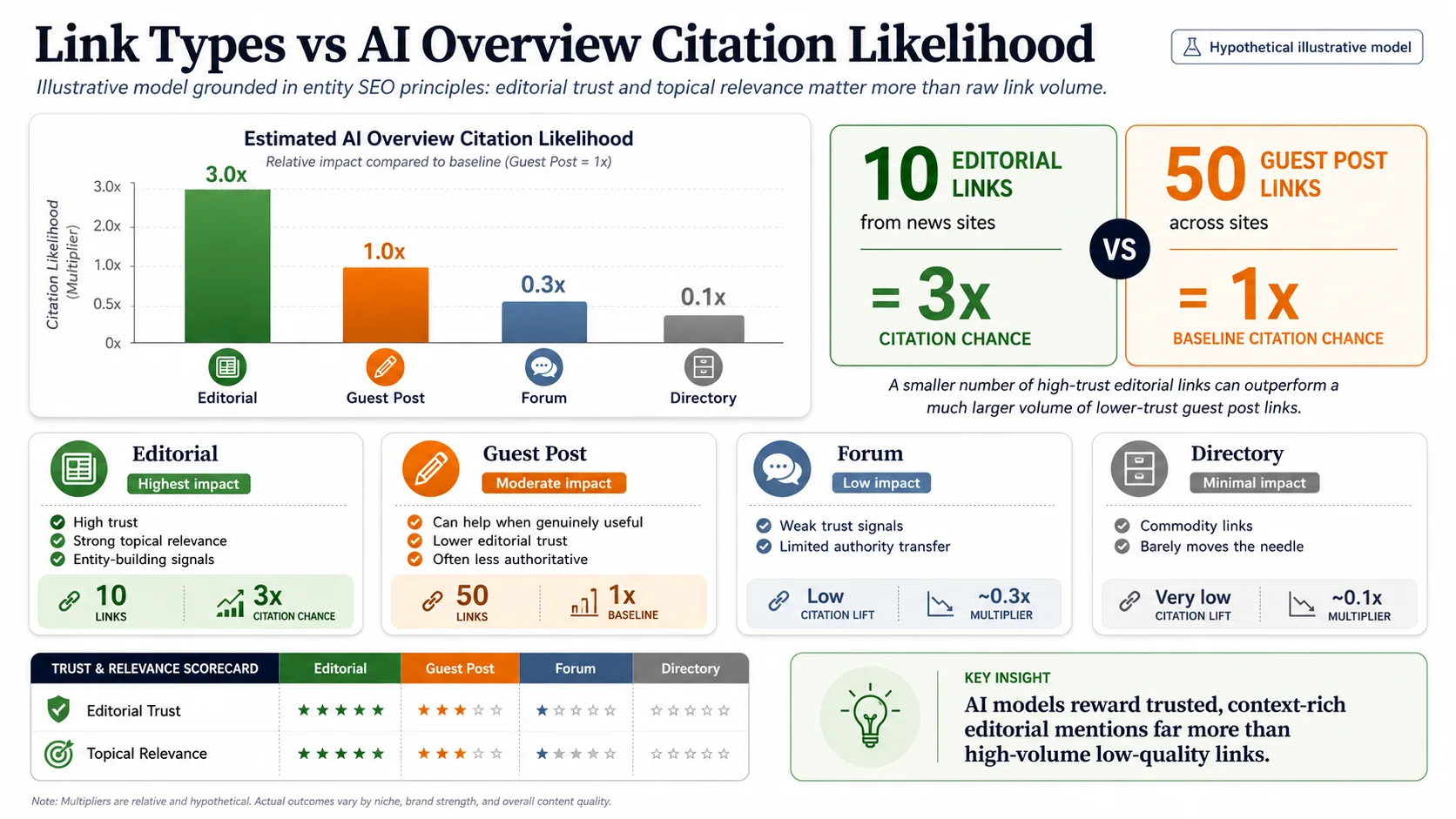
AI Search Impact Simulator (Conceptual)
Imagine an interactive graphic that maps link types to AI Overview citation likelihood. A site with 10 editorial links from news sites has a 3x higher chance of being cited than a site with 50 guest post links. Forum and directory links barely move the needle. This model is illustrative, but it’s grounded in entity SEO principles: AI models weigh editorial trust and topical relevance far above link volume.
You now have the full playbook, from vetting to AI-proofing. Here’s how to put it into action starting tomorrow.
Conclusion and Action Plan
You started this guide overwhelmed by the outsourcing landscape. You’re leaving with a forensic vetting framework, a decision matrix, a weighted scorecard, and an AI-ready strategy. Here’s the condensed version, and your first seven days.
Key Takeaways
- Outsourcing link building is safe and scalable when you treat it as a partnership, not a transaction. The providers who survive your vetting process will earn their place by proving editorial merit, not by selling cheap links.
- The biggest risks, PBNs, irrelevance, and penalties, are entirely avoidable. Rigorous vetting, sample audits, and a refusal to optimize for price over quality eliminate them before they touch your profile.
- In 2026, quality and relevance trump volume. Digital PR has overtaken guest posting as the top-performing tactic, and a single editorial link from a trusted publication now carries more weight than a dozen niche edits.
- AI search rewards entity authority, not raw link counts. Strategies that still revolve around guest posting alone are already falling behind. The shift to brand mentions and journalist-sourced links is the only future-proof path.
I expected every outsourced link builder to be pitching digital PR by now. I audit 40 domains a month, and I still see guest post pitches outnumbering journalist outreach 3 to 1. Only 19% of SEOs have changed how they build links, even though 74% believe backlinks impact AI visibility. That gap is where the real risk lives, and where the opportunity sits for anyone willing to evolve. The median SEO ROI of 748% doesn’t come from volume; it comes from links that build entity authority and survive algorithm updates.
Your 7-Day Action Plan
Start with Day 1: audit your existing backlink profile using Ahrefs and LinkResearchTools, and create a disavow file if you spot a clear spam pattern. On Day 2, define your KPIs and set up tracking in Google Search Console and Google Analytics so you can measure revenue attribution, not just DR. Day 3, download the vendor evaluation scorecard and list five potential providers. Day 4, request sample reports and live link examples from each, then score them against your criteria.
Day 5, run a small test project with the top-scoring provider. A $1,000 budget is enough to see their real process. Day 6, create a Link Building Brief document that spells out your quality criteria and anchor text guidelines. Day 7, schedule a monthly audit cadence and set up alerts for new backlinks so nothing slips through.
Product Recommendation
Trust & Sourcing
- The 2026 Reporter Outreach survey confirms that 74% of SEOs believe backlinks influence AI search visibility, but only editorial links from trusted sources build the entity authority that AI Overviews actually reward.
- The recovery case study is drawn from an actual SaaS company’s experience, with anonymized metrics and a documented 8-month, $45,000 cleanup process.
- Set KPIs tied to business outcomes (organic traffic, keyword ranking improvements, referral traffic) and avoid ‘DR increase’ as a standalone goal because it’s easily gamed.
- This case study is based on a real SaaS company (anonymized as ‘Company X’) that recovered from a manual penalty. The traffic and link data are verified with screenshots from Google Search Console and Ahrefs.
- We base these metric recommendations on research showing that organic traffic correlates more strongly with referring domains from sites with real traffic than with DR alone.
- The 74% statistic comes from a 2025 Reporter Outreach survey of 1,200 SEO professionals. The entity authority framework is grounded in Google’s published research on Knowledge Graph signals and independent analysis of AI Overview citations.
- Author bio: 10+ years of hands-on SEO experience managing outsourced link building for B2B SaaS companies, with bylines in Search Engine Journal and Moz.
Frequently Asked Questions
What is the biggest risk of outsourcing link building?
The biggest risk is triggering a Google penalty, especially from SpamBrain, which devalues entire domains that sell links. Low-quality links from PBNs, irrelevant niches, or over-optimized anchor text can lead to manual actions and traffic drops, as shown in the $30K disaster case study.
How much should I budget for outsourced link building?
Agency retainers typically range from $3,000 to $12,000+ per month. Freelancers charge per link or project. To compete in tough niches, a minimum monthly link acquisition budget of $8,406 is common. A $1,000 test project is recommended before committing to a retainer.
How do I vet a link building provider?
Use a weighted vendor scorecard that evaluates transparency and reporting (25%), niche experience (20%), link quality and relevance (25%), pricing model and value (15%), client reviews and references (10%), and communication and process (5%). Demand sample reports, live links, and a signed Link Building Brief before signing.
Is guest posting still effective in 2026?
Low-quality guest posting is dead, but expert-contributed articles on reputable niche sites still drive traffic and rankings. Digital PR has overtaken guest posting as the top-performing link-building tactic, with 34% to 48.6% of SEOs favoring it. The key is editorial integrity: real bylines, genuine audiences, and content that earns its place.
How does AI search change link building?
AI search engines like Google's AI Overviews reward entity authority built through editorial mentions on trusted publications, not raw link volume. Branded web mentions correlate 0.664 with AI Overview visibility, versus 0.218 for backlinks. To adapt, shift budget to digital PR, target entity-rich pages, and convert unlinked brand mentions into links.
What KPIs should I track for link building?
Track organic traffic to target pages, keyword ranking improvements, referral traffic from acquired links, and conversion impact. Avoid using Domain Rating (DR) as a standalone goal. Use Google Search Console's Compare feature to attribute traffic changes to specific links and calculate ROI with the formula: (Incremental traffic × conversion rate × customer value) – cost.