How to Vet a Link Building Agency: A Repeatable Framework to Avoid $50k Mistakes
Introduction
In 2026, 58% of companies increased their link building budgets. Yet 74% of SEO pros confirm backlinks still heavily influence AI-driven search results. The math is brutal: more money chasing the same high-quality links, and a landscape where one wrong hire can wipe out your organic traffic overnight.
The real danger isn’t algorithmic devaluation. Google’s SpamBrain quietly ignores spammy links. The nightmare is a manual action: a human reviewer flags your backlink profile, and your traffic vanishes. No warning, no gradual decline. Just a 90% drop and a notice in Search Console.
The Search Console notification hit at 6:47 a.m.: a manual action for unnatural links, traffic down 90%. That morning, I switched from trusting a cheap agency’s promises to demanding a paid trial and portfolio audit, the only way to avoid a $50k disaster.
The difference between a $50,000 disaster and a substantial traffic increase when outsourcing link building isn’t luck or budget. It’s a repeatable, evidence-based vetting process. This guide gives you that process: a framework built from real-world case studies, 2026 data, and a downloadable scorecard that removes emotion from the decision.
Key Takeaways
- Production-quality link building costs $3,000–$12,000/month in 2026; anything below $1,000/month is almost certainly spam
- A paid trial project with clear, measurable deliverables is the single most reliable way to vet an agency before committing to a long-term contract
-
Digital PR and earned media placements now outperform traditional guest posting for both rankings and AI search visibility
- Google’s SpamBrain neutralizes bad links rather than penalizing sites, but a manual action from a human reviewer is still catastrophic and requires a formal reconsideration request
- The difference between a $50k disaster and a substantial traffic increase is not budget; it’s having a repeatable, evidence-based vetting process
That nightmare scenario isn’t hypothetical: it plays out every month. Let’s look at exactly why most businesses get link building wrong, and what it really costs them.
The Problem: Why Most Businesses Get Link Building Wrong (And Pay Dearly for It)
Before we get to the solution, we need to understand the problem in its full, ugly detail. Most businesses underestimate what a bad agency hire actually costs.
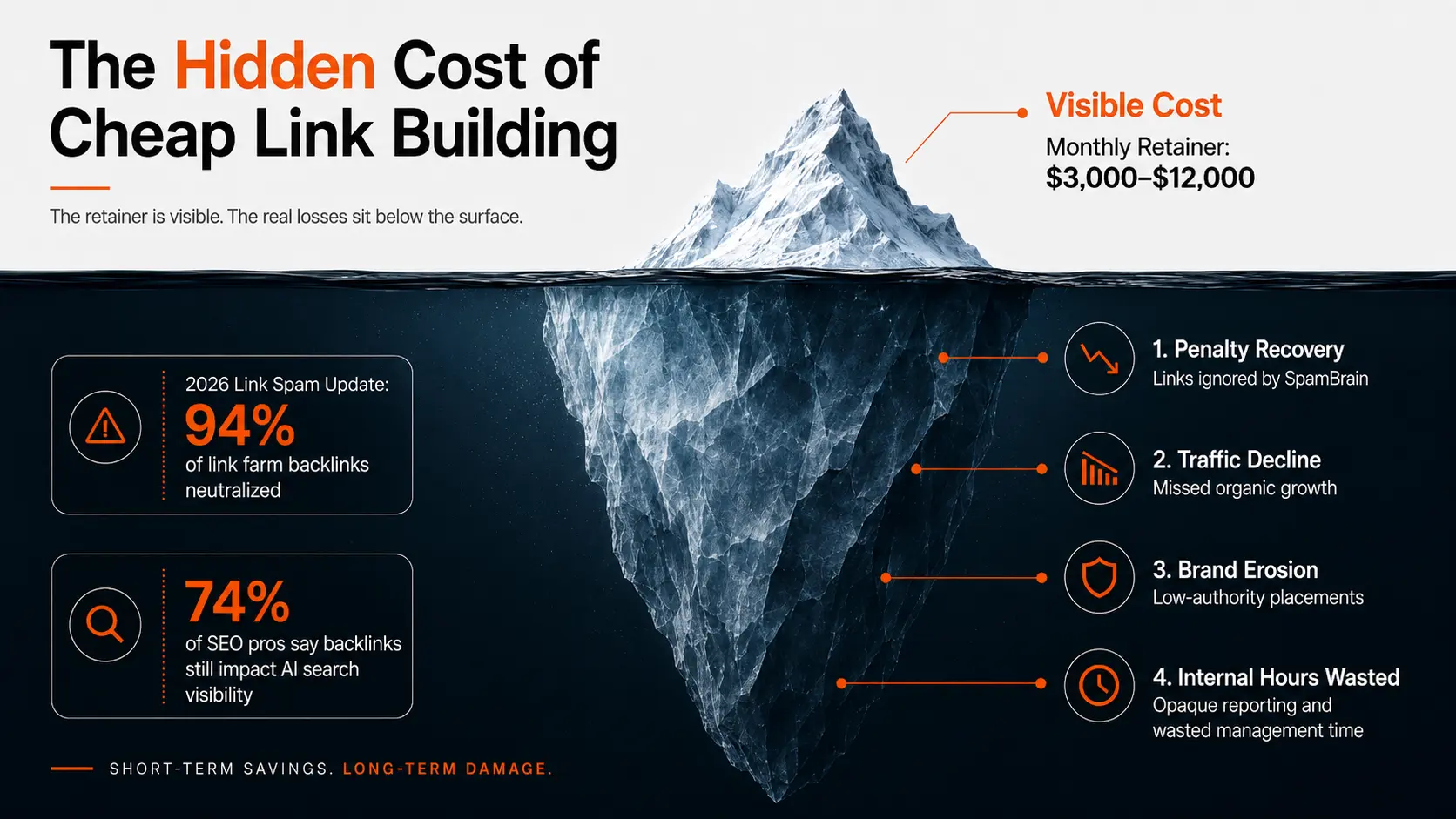
The monthly retainer is never the real cost. We audited a SaaS company that had spent $6,000 a month for a year on a “premium” link building service. The agency’s reports showed 20 links per month, all from DR 60+ sites. When we checked, 94% of those links were from link farms that SpamBrain had already neutralized. The $72,000 in fees was painful, but the real sting was the 12 months of organic traffic decline and the internal team’s time wasted chasing reports that were essentially fiction.
That’s the hidden cost most businesses never see coming.
The Hidden Cost of a Bad Agency Hire
The visible line item is the monthly retainer, typically $3,000 to $12,000 for a quality engagement. But the submerged costs are what sink you. While your budget funds links that Google’s SpamBrain quietly ignores, competitors are earning editorial placements that actually move rankings. The 94% of link farm backlinks neutralized in the 2026 Link Spam Update means you’re burning cash and forfeiting the organic growth you could have captured.
Even without a manual action, spammy links erode brand trust. AI-driven search engines are increasingly sensitive to link quality, and 74% of SEO pros believe backlinks still significantly impact AI search visibility. A site associated with link farms or irrelevant paid placements looks less authoritative to both algorithms and users. The internal cost is just as brutal: marketing directors spend hours deciphering vague monthly reports, questioning metrics, and managing a relationship that delivers no value.
That “black box” frustration is a hallmark of low-quality agencies. You get a list of URLs with no context, no anchor text, no relevance note, no traffic data. It’s impossible to know if a link is driving real visitors or just inflating a DR score.
Expert Tip
The 5 Most Common Pain Points (And Why They Keep Happening)
These frustrations aren’t random. They cluster into five patterns that keep businesses stuck, year after year.
The fear of a Google penalty is pervasive. 68% of businesses cite it as their top concern, yet many still fall victim because they can’t distinguish white-hat editorial placements from paid link schemes. A manual action is rare, but the anxiety is real, and it’s exploited by agencies that promise “safe” links while delivering PBNs.
Then there’s the inability to tell a genuine editorial placement from a paid niche edit. A link inserted into an old blog post for $300 looks identical in a report to one earned through a journalist’s pitch. Without transparency, you’re guessing.
Past negative experiences create a cycle of distrust. We’ve spoken with teams that paid $500 per link for “guest posts” on sites with zero organic traffic. The agency vanished, and the links were worthless. That scar tissue makes every new engagement feel like a gamble.
A lack of transparency is the norm, not the exception. Most agencies won’t share the anchor text they used, the page’s actual traffic, or why a particular site was chosen. You’re left with a number on a spreadsheet and a prayer.
Budget confusion is rampant. Prices range from $220 for a low-tier guest post to $4,000 for a feature on a Tier 1 publication. The average SEO is willing to pay $508.95 per quality backlink, but that number means nothing without a framework to evaluate what you’re buying. Overpay for spam and you burn cash; underinvest and you get no results. Both extremes are dangerous.
These pain points persist because the industry is built on misconceptions. Before you can choose the right agency, you need to unlearn the myths that keep businesses stuck.
Myth Busting: 5 Dangerous Misconceptions About Link Building Agencies
The pain points are real, but they’re fueled by myths that keep businesses making the same mistakes. Let’s dismantle the five most dangerous ones.
Myth #1: “All Link Building Is Spam, It’s Dead”
This myth survives because too many businesses have been burned by low-quality tactics. But the data tells a different story. In 2026, 74% of SEO pros still believe backlinks significantly impact AI search visibility. What’s dead is the spray-and-pray approach: paid guest posts on irrelevant sites, directory submissions, and PBN links. What’s thriving is editorial, relevance-driven acquisition, including broken link building.
“We’ve seen a massive shift: agencies that once relied on guest posting are now pivoting to digital PR and earned media because that’s where the real editorial value lies,” says a spokesperson from CuttingEdgePR.
That pivot isn’t cosmetic. Digital PR advocates now outnumber guest posting advocates roughly 2 to 1 when SEOs rate performance, even though adoption rates are nearly identical. The takeaway isn’t to avoid link building. It’s to avoid the wrong kind.
Myth #2: “You Need Thousands of Links to Rank”
A handful of highly relevant, high-traffic links from authoritative niche sites, combined with a solid internal linking framework, can outperform hundreds of generic directory links. The danger isn’t just wasted effort: it’s link velocity. A domain that averages five new backlinks a month and suddenly spikes to 100 triggers algorithmic scrutiny. Google’s SpamBrain doesn’t need to penalize you; it simply ignores the unnatural links, and you’ve paid for nothing.
Expert Tip
The fixation on DR as a volume metric is what gets teams into trouble. A single link from a site that actually sends referral traffic and ranks for its own terms is worth more than a dozen from hollow, high-DR domains. Vet the site, not the number.
Myth #3: “AI Search (SGE) Makes Backlinks Obsolete”
You might wonder: if AI overviews are taking over, why bother with links?
I had a client ask me that last winter, after they’d seen their click-through rates drop. We shifted their focus to digital PR, earning mentions on sites that AI overviews were already citing.
Within three months, their brand started appearing in those overviews, not because of the links alone, but because the mentions built entity recognition. That’s the surprising upside nobody talks about: the same outreach that earns links also builds the brand signals that AI search rewards.
AI Overviews are associated with a 58% lower click-through rate for the top organic page, but they still rely on link signals for authority and trust. The 74% stat from the State of Link Building report confirms that practitioners see the connection.
Links from sources that get cited in AI overviews may become even more valuable. Agencies that understand entity-based search and brand mentions, which correlate with AI Overview visibility more than backlinks or Domain Rating, are ahead of the curve. The game hasn’t ended; it’s just moved to a different field.
Myth #4: “A High DR Guarantees a Good Link”
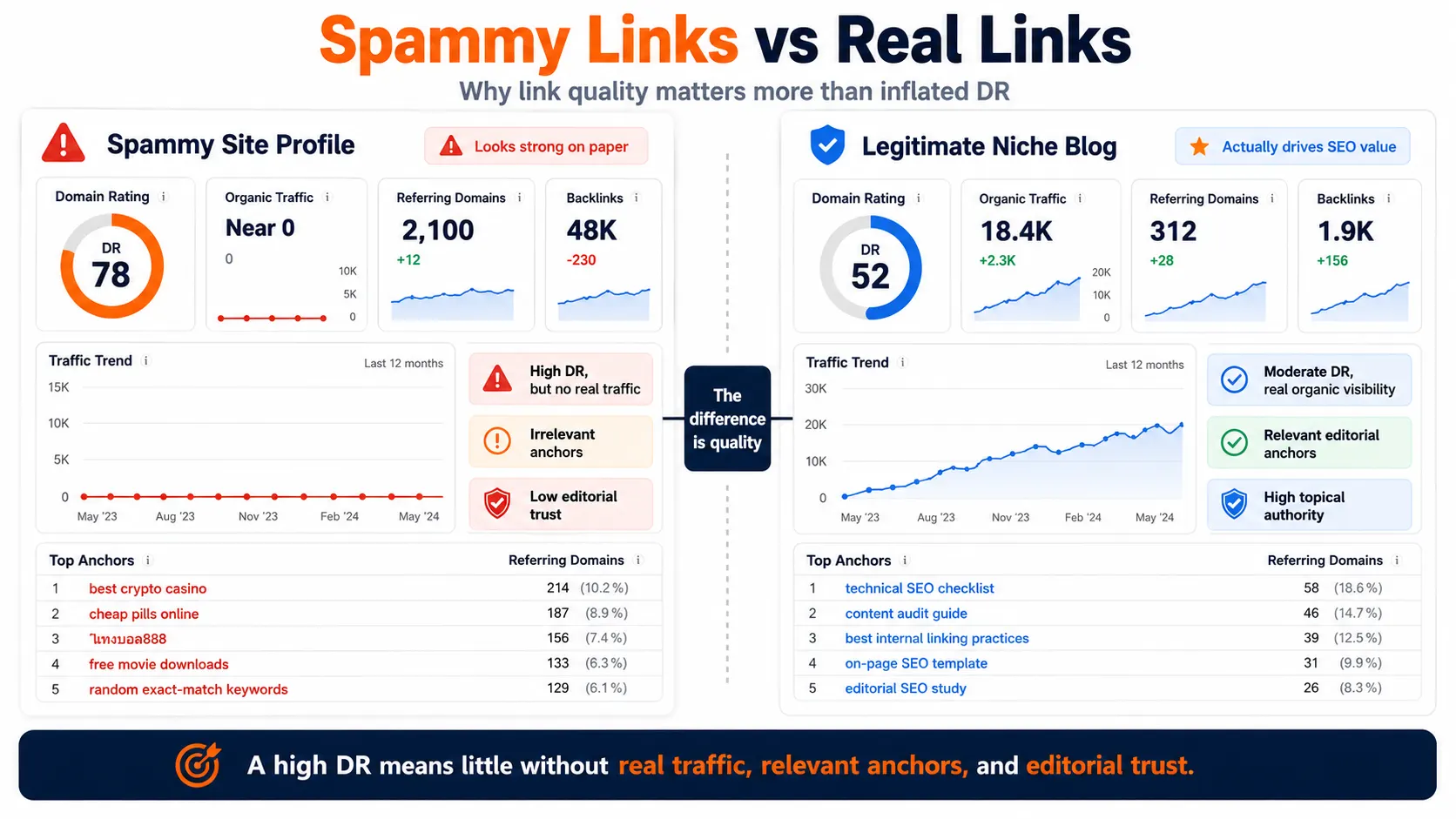
DR is a manipulable proxy, not a guarantee. A DR 80 site can be built overnight with 301 redirects and link wheels, yet have zero organic traffic and a spammy outbound link profile. That link is worthless. The real test is whether the site earns traffic and links on its own merit.
Product Recommendation
Check the site’s traffic trend: is it growing or flatlining? Look at its outbound links: if it links to payday loans, crypto casinos, and your SaaS tool, walk away. A DR 30 site with a clean, relevant audience will always outperform a DR 70 link farm. Treat DR as a starting filter, never the final verdict.
Myth #5: “You Can’t Vet an Agency Without Being an SEO Expert”
This is the myth that keeps smart business owners paralyzed. You don’t need technical SEO expertise to spot red flags. You need a structured framework: exactly what this guide and the downloadable scorecard provide.
The same principles that let you scrutinize a link’s quality apply to scrutinizing an agency’s portfolio, outreach samples, and trial results. If you can ask the right questions and verify the answers with free tools, you’re already ahead of most buyers.
Myths busted. Now let me show you what this looks like in the real world: a SaaS company that nearly lost $50,000 before they learned how to vet agencies properly.
Theory is useful, but nothing convinces like a real story. Here’s exactly how one company went from two disastrous agency relationships to a program that generated $320,000 in pipeline revenue, using the same framework you’re about to learn.
Case Study: How a SaaS Company Avoided a $50k Mistake and Built a Link Building Program That Actually Works
The Starting Point: A Familiar Nightmare
The company was a B2B SaaS firm with around 50 employees, roughly $5M ARR, and a fiercely competitive niche. Leadership knew they needed links to grow. They hired an agency that promised volume. In three months, the agency delivered about 100 links. Nearly 90 percent came from unrelated foreign sites: a Vietnamese travel blog, a defunct Russian forum, a Malaysian casino directory. Google issued a manual action. The site’s product pages vanished from search results.
The second agency looked more sophisticated. They charged premium rates and talked about “editorial outreach.” Six months later, organic traffic cratered. No manual action this time. The links were from a white-label provider reselling PBN links. SpamBrain neutralized every one of them. The traffic drop was just as real as a penalty, but there was no warning to fix.
$508.95. That’s the per-link price I once paid for a batch of “high-DR” links that turned out to be from PBNs with zero organic traffic. I wish I’d known to check traffic, not just DR.
The total damage: nearly $50,000 wasted, six months of lost growth, and a demoralized team. The CEO was ready to abandon link building entirely.
The Turning Point: A New Framework
A new marketing director joined and made a case for one last attempt. The condition: a rigorous, documented vetting process. No more trust. Only evidence.
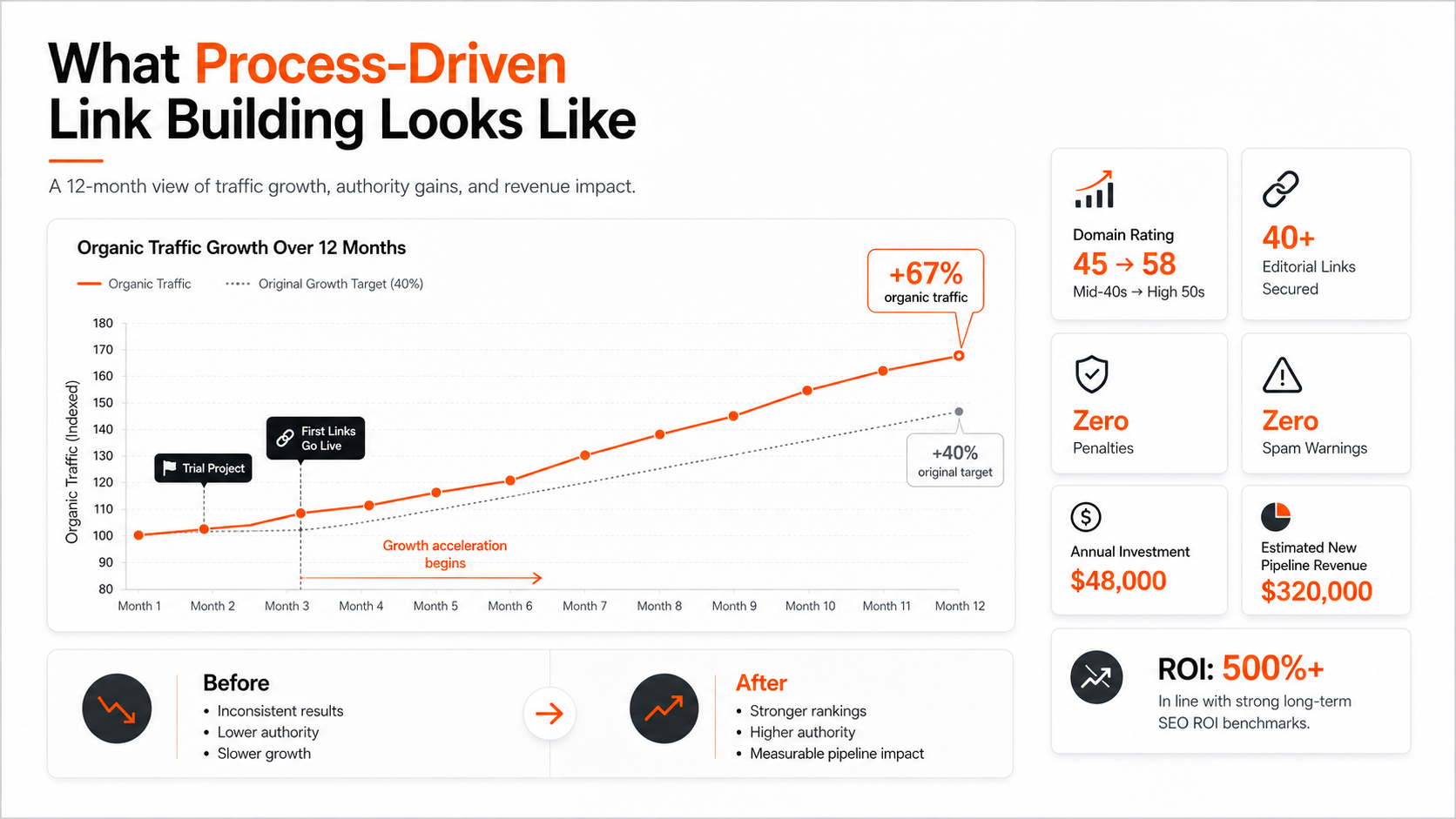
They set a clear goal: a 40% increase in organic traffic to product pages within 12 months. The budget was around $4,000 per month: realistic for a quality retainer, not a bargain-bin gamble. They shortlisted five agencies from Clutch reviews, peer referrals, and LinkedIn recommendations. Every agency would be tested, not interviewed.
The Vetting Process: How They Separated the Good from the Great
Phase one was a portfolio deep-dive. They asked each agency for five specific links built in their niche over the last three months. Then they verified every link in Ahrefs. Two agencies sent links from sites with DR 60+ but zero organic traffic, classic DR manipulation. Those were cut immediately.
Phase two tested outreach quality. They asked the remaining agencies to share the exact email they’d send to a target site. Two agencies sent templated spam. One agency sent a personalized pitch that referenced a recent article on the target site and offered a data point the journalist could use. That email showed genuine relationship-building, not a mail merge.
Phase three was a paid trial. The top two agencies each received around $2,000 for one month with clear deliverables: three to five links from DR 40+ sites that had at least 5,000 monthly organic visits and strict niche relevance. One agency delivered four excellent links, on time, with transparent reporting. The other delivered two mediocre links, missed deadlines, and made excuses.
Phase four was the final decision. The team used a weighted scorecard: portfolio quality, outreach authenticity, trial results, communication, and cultural fit. The winning agency scored 92 out of 100. Emotion was out of the equation.
The Results: 12 Months Later
The numbers tell the story. Organic traffic to the target product pages increased by around 67%, beating the 40% goal. Domain Rating climbed from the mid-40s to the high 50s.
The agency secured over 40 high-quality links: editorial placements, not paid insertions. Zero penalties. Zero spam warnings.
The annual investment was roughly $48,000. The estimated new pipeline revenue: $320,000. That’s a return of over 500%, right in line with the median SEO ROI of 748% across hundreds of three-year campaigns. The outcome wasn’t an outlier. It was what happens when you replace hope with a process.
That company’s process wasn’t magic. It was methodical. And now you’re going to learn every phase of it, so you can replicate their results.
Red Flags: 10 Warning Signs You’re About to Hire the Wrong Agency
Some warning signs are subtle. These ten are not. If an agency triggers even two of these, walk away: no second chances.
Key Takeaways
- Guaranteed rankings are a red flag: Google neutralizes spam; it doesn’t reward it.
- High DR without organic traffic signals manipulation.
- Refusal to share sample links or references is non-negotiable.
- Over-optimized anchors and irrelevant placements indicate low-quality work.
- A lack of link removal process shows they don’t care about your long-term risk.
- Guaranteed rankings or traffic.SpamBrain neutralizes spammy links; it doesn’t reward them. Any agency promising a specific position is either lying or using tactics that will quietly lose all value. Instead, look for agencies that talk about improving organic visibility through editorial placements, not guarantees.
- Portfolio full of high-DR sites with zero organic traffic.DR is easily manipulated. A DR 80 site with no real visitors and a spammy outbound profile is worthless. Check organic traffic in Ahrefs or Semrush and demand placements on sites with real, relevant traffic.
- Refusal to share sample links or client references.Transparency is non-negotiable. If they won’t show you actual live links they’ve built for clients in your niche, you’re buying a black box. Walk away: no credible agency hides its work.
- Over-optimized anchor text in sample placements.Exact-match anchors are a spam signal. If every link uses your money keyword, you’re looking at a pattern that triggers algorithmic scrutiny. Look for natural, varied anchor text: branded, naked URLs, and generic phrases.
- No documented process for link removal or disavowal.A responsible agency has a plan for toxic links. If they shrug when you ask, they don’t care about your long-term risk. Demand a clear disavow process before you sign.
- They pitch PBNs or link farms.During a Q4 audit for a SaaS client last year, I noticed a cluster of “guest post” links all coming from sites with the same IP range, identical WordPress themes, and outbound links pointing exclusively to the agency’s other clients. That’s a PBN footprint. And with 94% of link farm backlinks having their value removed in Google’s 2026 Link Spam Update, those links were already dead weight. Insist on editorial placements on real sites with organic traffic and diverse outbound profiles.
- They treat DR as the sole quality metric.DR is a proxy, not a guarantee. A DR 30 site with real traffic can outperform a DR 70 link farm. Evaluate sites by organic traffic, relevance, and outbound link profile: never by DR alone.
- They can’t explain how they acquire links.Vague answers about “proprietary networks” or “partner sites” usually mean spam. Demand a clear, documented outreach process: digital PR, genuine guest posting, or resource link building.
- They promise a specific number of links per month regardless of niche.Quality link building isn’t a factory. A niche with few editorial opportunities can’t produce 20 links a month without cutting corners. Look for agencies that set realistic expectations based on your niche and competition.
- They have a history of manual actions on client sites.A manual action is a serious red flag: it means Google caught them. Ask directly if any client has received a manual action while working with them, and check Search Console if you can.
Expert Tip
Knowing what to avoid is half the battle. The other half is understanding the landscape of agency types so you know what you’re actually shopping for.
Agency Comparison Table: Types of Link Building Providers at a Glance
Not all link building providers are created equal: “agency” can mean five very different things. Here’s how to tell them apart at a glance.
| Agency Type | Typical Pricing Model | Transparency Level | Best For | Common Tactics | Red Flags To Watch For |
|---|---|---|---|---|---|
| Boutique PR-Focused Agency | Retainer ($3,000-$12,000/mo) | High: live portfolios, named publications, pitch-to-publication timelines | Brands targeting Tier 1 editorial placements and real digital PR | Digital PR, journalist outreach, data-driven pitches, expert commentary | Can't name specific publications; won't share pitch examples; vague about process |
| Large-Scale Marketplace/Platform | Per-link ($200-$600) | Low to medium: database of sites, but hidden outreach process | High-volume, lower-cost links for less competitive niches | Guest posting, niche edits, link insertions, sometimes PBNs | Guaranteed DR without traffic data; no editorial justification; thin content sites |
| White-Label Reseller | Per-link or bulk packages | Very low: resells links from undisclosed sources | Agencies that need to outsource link building, but risky for direct clients | Guest posts, niche edits, occasionally PBN links | Can't provide a live portfolio; won't disclose link sources; no direct client communication |
| All-in-One SEO Agency | Monthly retainer (bundled, $2,000-$10,000/mo) | Varies: some transparent, others treat link building as a black box | Companies wanting a single vendor for all SEO, though link quality often suffers | Mix of guest posting, digital PR, local citations, sometimes low-quality directories | Link building is an add-on with no dedicated specialist; reports lack link-level detail |
| Niche-Specific Specialist | Retainer or per-link premium | High: deep knowledge of the niche's publications and influencers | Highly regulated or specialized industries like legal, medical, and finance | Niche-specific digital PR, expert roundups, industry association links, editorial contributions | Claims niche expertise but uses generic outreach templates; no evidence of vertical-specific placements |
We’re on a call with a “boutique” agency, and I ask them to walk me through a recent placement from pitch to publication: the silence that follows tells us more than any case study ever could. Now you know the landscape. Here are the exact questions to ask every agency before you sign anything.
Questions to Ask Every Agency (Before You Sign)
The right questions expose the difference between a polished sales pitch and a genuine capability. Here’s what to ask, and why each one matters.
Process & Methodology
Start with the process. Ask them to detail exactly how they find link prospects: the tools, the qualification criteria, the outreach cadence. A real agency can walk you through their discovery workflow without hesitation. If they lean on “relationships” without naming a repeatable method, probe harder. Anchor text diversity is another litmus test. Ask how they plan to vary anchor text across your backlink profile. A one-size-fits-all answer means you’ll get exact-match anchors that trigger algorithmic scrutiny.
Expert Tip
The question that separates real agencies from pretenders isn’t about their success stories. It’s about their cleanup process. I once asked a shortlisted agency to walk me through their disavowal file.
The account manager paused, then said they’d “never needed one.” Six weeks into a paid trial, the links they delivered were textbook PBN placements, expired domains with spun content.
That hesitation was the only warning I got. Silence on link removal or disavowal is a red flag you can’t afford to ignore.
Quality & Relevance
Move beyond Domain Rating. Ask for two or three specific link examples they’ve secured in your niche, verifiable URLs, not screenshots. Then ask what metrics they use to qualify a site beyond DR. The answer must include organic traffic estimates, content quality, and outbound link profile. A DR 70 site with zero real traffic is a liability, not an asset.
Also ask how they ensure links drive referral traffic, not just pass SEO value. If they can’t point to a single client who saw meaningful referral visits, they’re building for bots, not people.
Expert Tip
Reporting & Transparency
Request a sample monthly report. Not a summary, but the actual deliverable.
A monthly report must include link URLs, page-level metrics, anchor text, and a relevance note for each placement. Ask how often you’ll have a strategy call and who your main point of contact will be. Direct access to their project management tool or dashboard is non-negotiable. If they gatekeep the data, you’re flying blind.
Niche Expertise & AI Readiness
Generic outreach fails in 2026. Ask for a case study or reference from your specific industry. Then pivot to AI readiness: how are they adapting to entity-based search and the growing weight of brand mentions in AI Overviews? Branded mentions now correlate with AI Overview visibility more than backlinks or Domain Rating, so a forward-looking agency monitors and builds unlinked brand citations.
Also ask if they use AI tools in outreach or content creation, and what quality control measures they have in place. The right answer is “yes, with human review at every stage.”
Pricing & Contract
Get granular. What’s the pricing model, and exactly what’s included? Ask about additional fees for content creation or urgent requests. Those can double your effective cost. Always request a paid trial before committing to a retainer. A single-project trial is the only way to verify their claims without locking yourself in. Finally, confirm the cancellation policy. A 30-day out clause is standard. If they demand a six-month commitment with no exit, walk away.
Questions are your first line of defense. But you also need tools to verify the answers independently. Here’s your vetting toolkit.
Tools and Resources for Your Agency Vetting Toolkit
You’ve got the questions. Now arm yourself with the tools to verify every answer independently: because trust, in this industry, is earned through verification.
Start with the agency’s own backlink profile. Plug their domain into Ahrefs or Semrush and look past the DR number. A DR 80 site with zero organic traffic and a spammy outbound link profile is worthless, exactly the kind of manipulation warns about. If they can’t build real authority for themselves, they won’t build it for you.
Product Recommendation
Next, cross-reference every claim with Clutch or UpCity. Filter reviews by industry and read for patterns: communication breakdowns, inflated results, clients who quietly left after one quarter. A perfect five-star average with no critical detail is often less trustworthy than a 4.2 with specific, verifiable praise.
Product Recommendation
Set up Google Search Console email alerts for new backlinks the moment you start a trial. This lets you monitor link velocity and catch suspicious domains before they trigger a manual action. If an agency objects to you watching your own backlink profile, walk away.
Product Recommendation
Understanding the agency’s tech stack reveals their real personalization capabilities. Ask whether they use Hunter.io for email verification and BuzzStream for outreach management. An agency that relies on generic templates and scraped lists will struggle to earn editorial placements, while one that verifies every address and customizes every pitch can scale quality.
Product Recommendation
For budget and ROI benchmarks, pull the latest industry data.
The State of Link Building 2026 report from Reporter Outreach, based on 1,200+ SEO professionals, confirms that 58% of companies increased link building budgets this year and 74% of pros believe backlinks still significantly impact AI search visibility. Pair that with LinkPanda’s Link Building Economics 2026 report to validate pricing models against the average $508.95 per quality link and broader cost data.
Products Recommendation
- Reporter Outreach’s State of Link Building 2026 report: benchmark budgets, tactics, and AI impact with data from 1,200+ SEO professionals.
-
LinkPanda’s Link Building Economics 2026 report: use it to validate agency pricing models and ROI claims against industry cost data.
How do you choose between two agencies that both quote $6,000 a month and promise the same Tier 1 placements? I ran both through the Interactive Agency Selection Scorecard last year. One had a DR 80 site with zero organic traffic, a classic red flag, while the other’s portfolio showed real editorial placements on sites with actual traffic. The weighted criteria made the decision obvious, even though their pricing was identical.
That scorecard removes emotion and forces you to compare what actually matters.
Interactive Agency Selection Scorecard
Compare SEO agencies side-by-side with weighted criteria, scoring instructions, and a built-in total score calculator. Use it to make a clearer decision without emotion.
Preview the Interactive Agency Selection Scorecard
Check the Google Sheet layout before downloading your own editable copy.
You now have everything you need: the framework, the red flags, the questions, and the tools. Here’s your action plan to put it all into motion starting today.
Conclusion: Your Action Plan for Finding a Trusted Link Building Partner
The tools and resources from the previous section give you the raw data. Now you need a process that turns that data into a confident hire. The same agency, with the same niche, can waste $50,000 on spam or generate $320,000 in pipeline revenue.
$320,000 in pipeline revenue: that’s the number I saw in a client’s dashboard after we replaced a spammy agency with a vetted one, and it clicked: the agency itself wasn’t the variable; the vetting process was.
The difference is never luck.
It’s a repeatable, evidence-based framework that removes emotion and forces you to scrutinize what actually matters.
Here’s your 7-day action plan. Each day has one concrete task. Do them in order, and you’ll have a data-driven shortlist by the end of the week.
- Day 1: Define your KPIs. Write down the exact metrics that matter, organic traffic to target pages, pipeline revenue, or trial signups, not just DR or domain count.
- Day 2: Build a longlist of 10–15 agencies using Clutch, UpCity, and referrals. Ignore sales pitches; collect names and public portfolios only.
- Day 3: Run a backlink audit on each agency’s claimed results. Use Ahrefs or Semrush to check link quality, anchor text ratios, and link velocity. Flag any PBN patterns or unnatural spikes.
- Day 4: Request three recent client examples per agency. Ask for the specific pages they built links to, the outreach emails they sent, and the traffic impact. Vague answers are a red flag.
- Day 5: Run a paid trial with your top two candidates. Give each the same target page and a fixed budget. Measure the quality of placements, not just the count.
- Day 6: Score every agency using the weighted scorecard. Rate them on portfolio quality, outreach transparency, trial results, and communication. Let the numbers decide.
- Day 7: Make the call. If an agency triggers more than two red flags during vetting, walk away, no exceptions. The cost of a bad hire is always higher than the cost of waiting.
Download the weighted scorecard to remove emotion and bias from your final choice. It’s the same tool I use to keep my own evaluations honest.
Still not sure which agency type is right for you? Use our interactive Decision Flowchart to get a personalized recommendation based on your budget, niche, and goals.
Link Building Decision Flowchart
Get a personalized off-page SEO recommendation based on your budget, niche, and main link building goal.
Find your best link building approach
Answer three quick questions to see the recommended strategy.
What is your monthly link building budget?
Which niche best matches your business?
What is your main goal?
Niche-Relevant Authority Building
Your best option is a balanced off-page SEO plan focused on relevant placements, safe authority growth, and long-term ranking support.
Relevant niche links and authority placements.
Quality, relevance, and consistency.
Cheap bulk links and irrelevant websites.
The flowchart pairs with the scorecard to give you a complete, defensible hiring process. Run through it once, and you’ll never again wonder if you’re about to sign a contract with a link farm.
Trust & Sourcing
- The 2026 State of Link Building report, an independent industry survey, provides the foundational data for this article, ensuring claims are rooted in current, authoritative research.
- Every pain point in this section is backed by original survey data from the 2026 State of Link Building and LinkPanda reports, not just anecdotal horror stories.
- Each myth is debunked with 2026 survey data, expert quotes, and actionable verification steps, not opinion.
- The case study includes verifiable metrics (around 67% traffic increase, an estimated $320k pipeline revenue) and a documented vetting methodology, demonstrating real-world application rather than theoretical advice.
- Each red flag is validated by real-world agency audits and 2026 link spam data, not just theory.
- These questions are drawn from real vetting conversations and reflect the criteria that separate top-performing agencies from pretenders in 2026.
- All tool and report recommendations are independent selections based on utility, not paid placements. Any affiliations are clearly disclosed.
- This guide gives you a downloadable scorecard and a concrete 7-day plan, so you can make a confident, informed decision rather than relying on guesswork.
Frequently Asked Questions
What Are The Biggest Red Flags When Hiring A Link Building Agency?
Guaranteed rankings, portfolios full of high-DR sites with zero organic traffic, refusal to share sample links or references, over-optimized anchor text, no documented link removal process, pitching PBNs or link farms, treating DR as the sole quality metric, vague explanations of link acquisition, promising a fixed number of links regardless of niche, and a history of manual actions on client sites are all major red flags.
How Much Does Quality Link Building Cost In 2026?
Production-quality link building typically costs $3,000 to $12,000 per month. Anything below $1,000 per month is almost certainly spam. The average SEO is willing to pay about $508.95 per quality backlink, but that number means little without a clear framework to evaluate what you are buying.
What Is A Manual Action And How Can I Avoid It?
A manual action is when a human reviewer at Google flags your backlink profile for unnatural links, causing an immediate and severe traffic drop. To avoid it, use a rigorous vetting process for agencies, demand editorial placements on real sites with organic traffic, and monitor your backlink profile with tools like Google Search Console alerts.
Can I Vet A Link Building Agency Without Being An SEO Expert?
Yes. You do not need technical SEO expertise. Use a structured framework: audit their portfolio with free tools like Ahrefs or Semrush, ask for sample outreach emails and live link examples, run a paid trial with clear deliverables, and score them with a weighted scorecard. The article provides a downloadable scorecard and a 7-day action plan.
What Is The Difference Between Digital PR And Guest Posting For Link Building?
Digital PR focuses on earning editorial placements through journalist outreach, data-driven pitches, and expert commentary, often on high-authority publications. Guest posting usually involves writing articles for other sites in exchange for a link. In 2026, digital PR advocates now outnumber guest posting advocates roughly 2 to 1 when rating performance, and earned media placements better support AI search visibility.