Link Building in 2026: The Data-Backed Case for ROI
Introduction
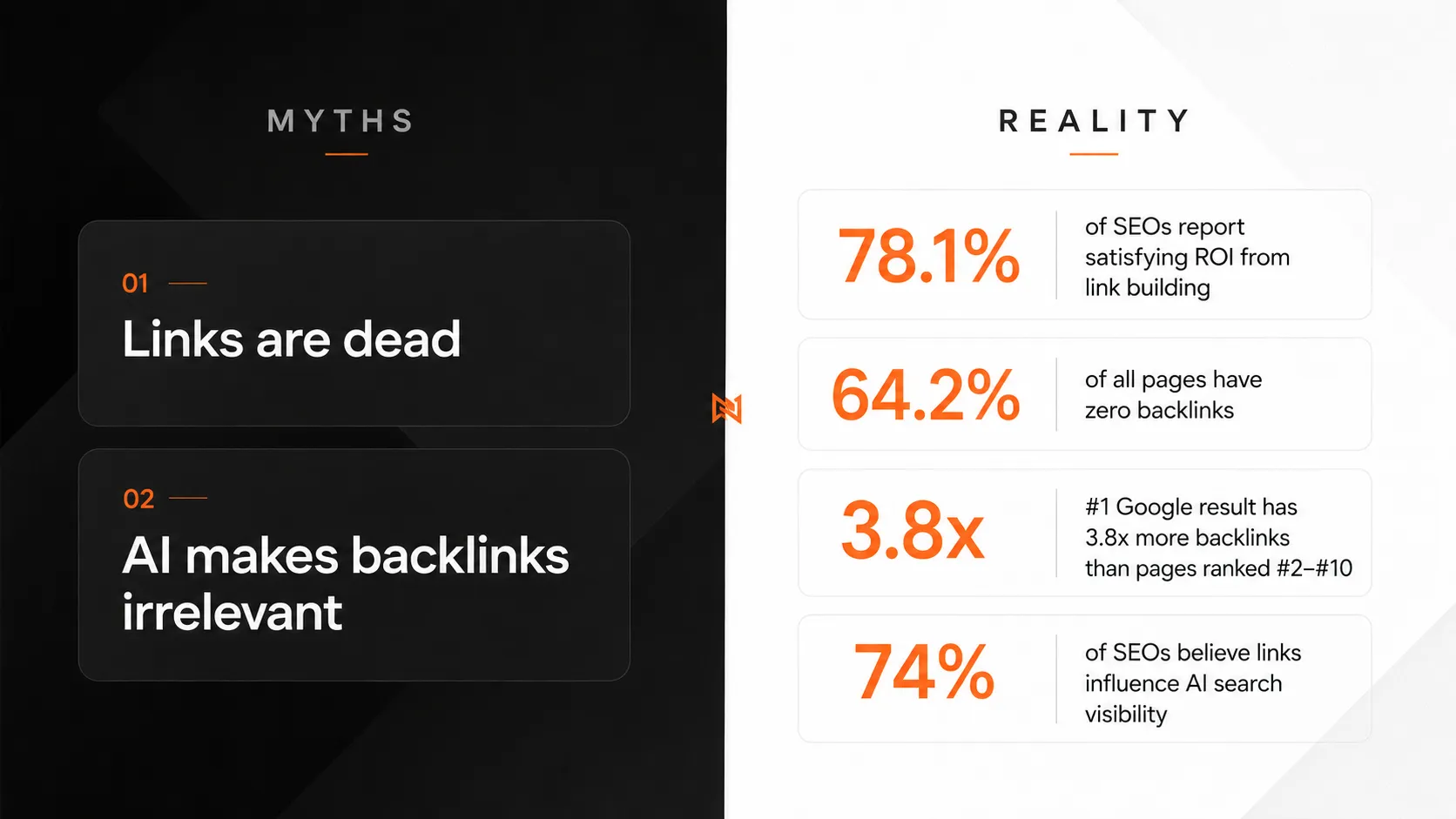
The numbers tell a story most marketers are ignoring. 78.1% of SEOs report satisfying ROI from link building in 2026, yet 64.2% of all pages have zero backlinks. That gap isn’t a warning sign: it’s a wide-open lane for anyone willing to do the work.
While competitors debate whether links still matter, the data is unambiguous: the #1 Google result has 3.8x more backlinks than pages ranked #2–#10. Links remain a top-3 ranking factor, and 74% of SEOs believe they influence AI search visibility. The real risk isn’t a penalty; it’s doing nothing while your competitors earn the links that compound into rankings, traffic, and revenue.
- 78.1% of SEOs report satisfying ROI from link building, yet 64.2% of pages still have zero backlinks: the opportunity is massive for those who act
- Backlinks remain a top-3 Google ranking factor, and 74% of SEOs believe they influence AI search visibility: the data is unambiguous
- The real risk isn’t Google penalties; it’s doing nothing while competitors earn the links that compound into rankings, traffic, and revenue
- This article provides a data-backed framework to measure link building ROI and turn it from a cost center into a predictable revenue driver
I was staring at a client’s traffic graph in late 2024, the six-month slide after they’d cut link building entirely. That’s when I switched from defending the budget to proving it with a digital PR pilot, and I realized that 64.2% of pages have zero backlinks, but ours didn’t have to be one of them.
That experience is why this article exists. It’s a myth-busting, evidence-based guide that replaces fear with a measurable, repeatable framework for link building in 2026. You’ll get the data to justify budget, the tactics that actually work, and a clear way to prove ROI, not in theory, but in dollars.
But before we build the solution, we need to clear the rubble of bad advice. Let’s tackle the five myths that keep marketers from investing in links.
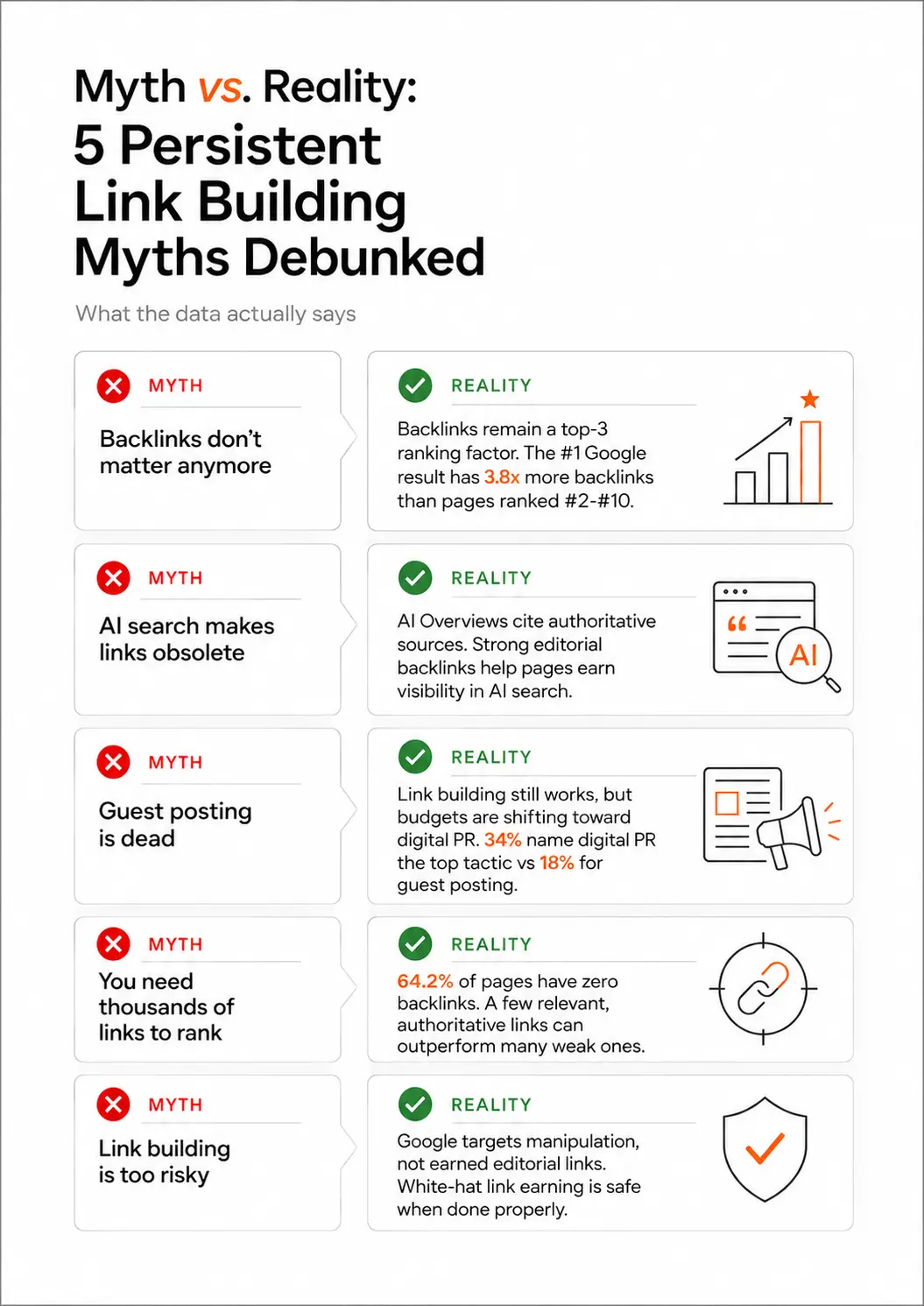
Myth vs. Reality: 5 Persistent Link Building Myths Debunked
Let’s start by clearing the air. Five myths have convinced too many smart marketers to abandon link building entirely. Here’s what the data actually says.
Myth 1: “Backlinks Don’t Matter for Rankings Anymore”
An 85,000-page correlation study confirmed what practitioners have felt for years: backlinks remain a top-3 Google ranking factor in 2026. The #1 result still has 3.8x more backlinks than pages ranked #2–#10. That gap hasn’t closed. What has changed is the quality filter. Google’s algorithms now weigh relevance and authority so heavily that a handful of earned, topically aligned links can outmuscle a bloated profile of low-quality ones.
Myth 2: “AI Search (Like Google’s AI Overviews) Makes Links Obsolete”
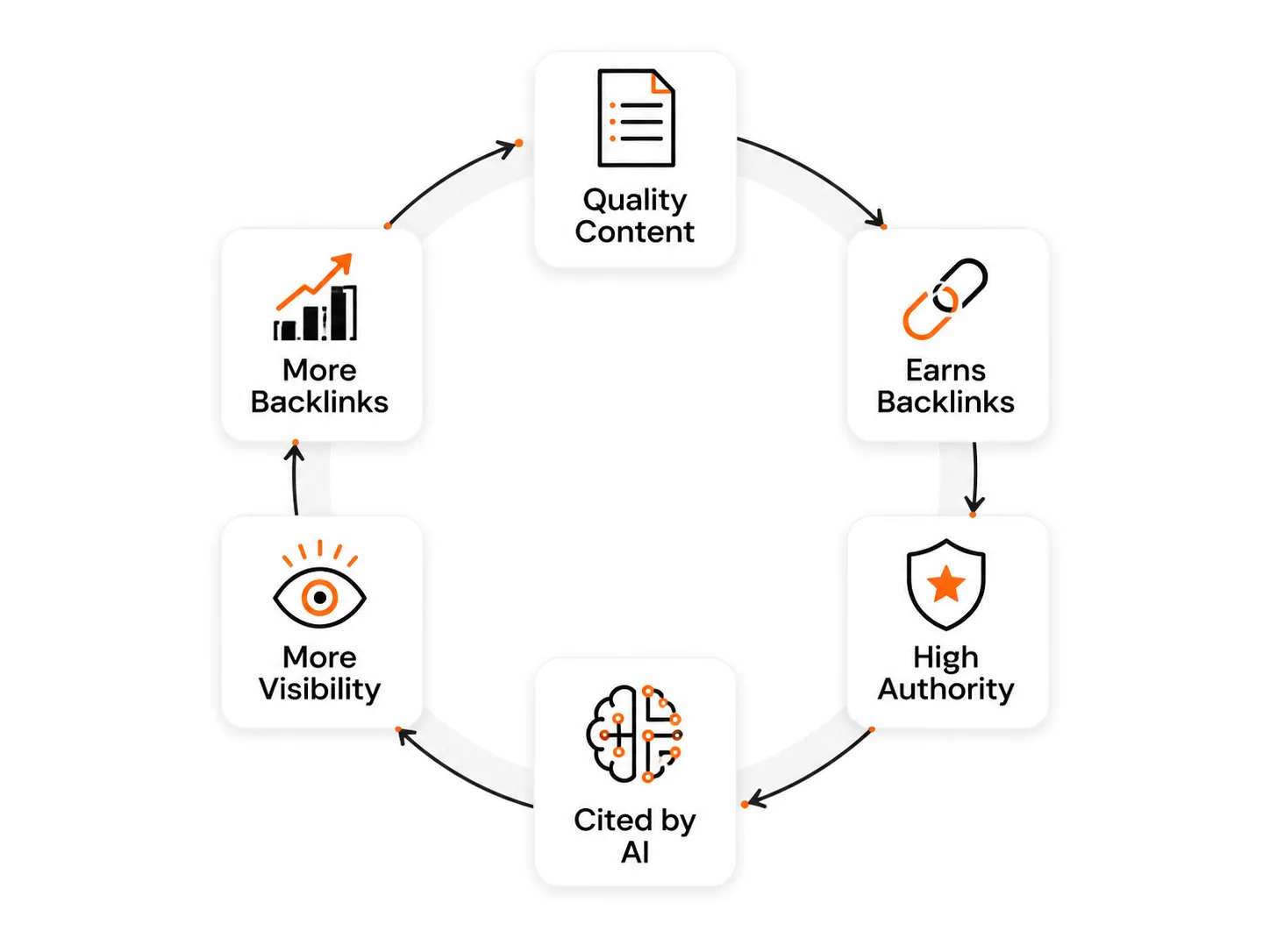
The opposite is true. AI Overviews don’t generate answers from thin air; they pull from the most authoritative sources in the index. Those sources are almost always pages with strong, editorially earned backlink profiles. This is the AI Search Paradox: as AI becomes the front door, the links that built that authority become even more critical.
Myth 3: “Guest Posting Is Dead, It’s All Spam Now”
Guest posting on high-quality, relevant sites still works. But the budget data tells a different story.
64% of SEOs now spend $3,000 or more per month on link building, and the largest share of that money is flowing to digital PR, not guest posting. Digital PR was named the top tactic by 34% of SEOs, nearly double guest posting’s 18%. The shift is real: earned editorial mentions, data studies, and journalist relationships now deliver the kind of links that move the needle.
Myth 4: “You Need Thousands of Links to Rank”
64.2% of all pages have zero backlinks. That means the bar to entry is lower than most assume. A single link from a closely related, authoritative site can push a page ahead of competitors with dozens of irrelevant ones. Topical authority, not raw domain metrics, is the real lever. A DR 30 link from a site that covers your exact niche often outperforms a DR 70 link from a generalist publication.
Myth 5: “Link Building Is Too Risky, Google Will Penalize You”
Google’s spam policies are clear: they target manipulation, not earned editorial links. Manual actions are rare when you follow the guidelines. The disavow tool exists for extreme cases (a manual action or a large-scale, obvious spam attack), not for routine link pruning. Google is good at ignoring low-quality links on its own. White-hat link earning, built on genuine relationships and content worth citing, carries no penalty risk.
Myth Scorecard
Five claims from this article, distilled into one line each. Call each one before you see the answer: your gauge will swing toward Myth or Reality as you go.
The Problem: Why Link Building Feels Risky, Expensive, and Uncertain
Those myths persist because the pain is real. Link building does feel risky, expensive, and hard to measure. Let’s dig into why, and then fix it.
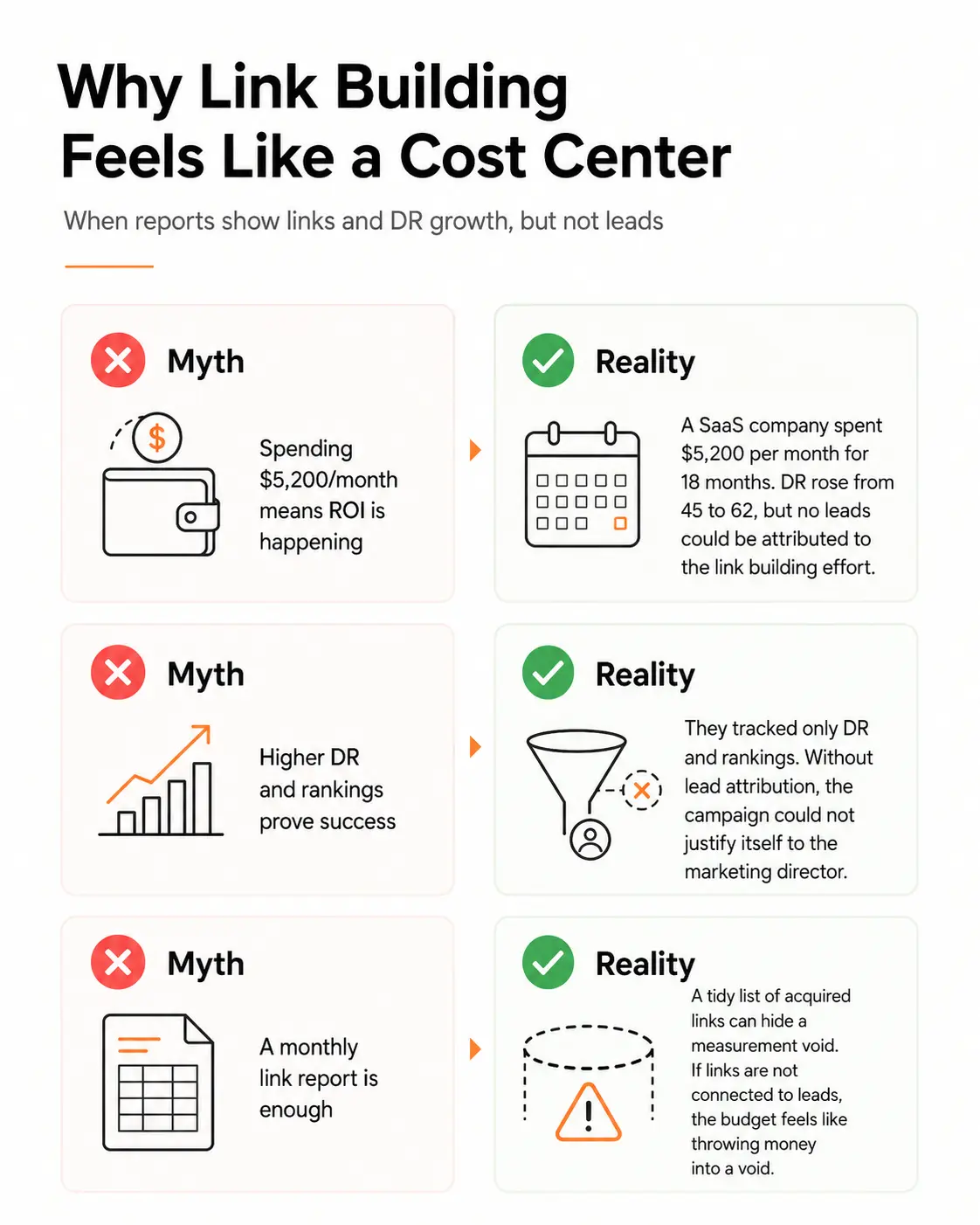
Why does a $5,000 monthly link budget feel like throwing money into a void? I once audited a SaaS company that had been spending $5,200 a month on link building for 18 months. Their DR had climbed from 45 to 62, and the agency sent a tidy monthly report with a list of acquired links. But when I asked the marketing director how many leads those links had generated, she stared at the spreadsheet.
They tracked only DR and rankings. Not a single lead could be attributed to the link building effort. That’s the unglamorous truth. The brand claim of “authority building” masks a measurement void, leaving you with a budget line item that can’t justify itself.
The Cost Conundrum: High Spend, Unclear Returns
The numbers are sobering. 64% of SEOs spend $3,000 or more per month on link building, and over a third cross the $6,000 mark. Yet for many teams, that spend is a black hole.
The average cost per quality backlink is $508.95, and 76% of link buyers pay $300 or more per link. When you can’t tie a single dollar to a lead or sale, every invoice feels like a gamble.
The frustration isn’t the price tag itself; it’s the absence of a clear line from investment to revenue. You’re funding a line item that the CFO side-eyes every quarter, and you have no airtight answer when they ask, “What did we actually get for this?”
The Algorithm Anxiety: Will Google Penalize Me?
Fear of a penalty still haunts link building conversations. High-profile manual actions from years past left scars, and many marketers assume that any active link acquisition invites disaster. The reality is far less dramatic.
Google’s algorithms now automatically ignore low-quality links, and the disavow tool is only necessary if you face a manual action or a large-scale spam pattern. Natural link earning, the kind that comes from topical authority and genuine editorial interest, carries minimal risk.
The algorithm is not hunting you down for a handful of mediocre directory links. It’s far more likely to simply disregard them, which means the real danger isn’t a penalty; it’s wasting budget on links that contribute nothing.
The Resource Drain: Lack of In-House Expertise
Most in-house teams don’t have a dedicated link builder. The work falls to a content marketer or an SEO generalist who already owns a dozen other priorities. That gap forces a painful choice: outsource link building to an agency you’re not equipped to vet, or let link building slide.
Vetting link building agencies without deep domain knowledge is exhausting. You’re judging pitches on confidence and case studies you can’t verify. The result: a revolving door of freelancers and inconsistent results that erode internal trust.
The Measurement Maze: How Do You Prove Link Building Works?
Stakeholders don’t care about DR or link counts. They want leads, sales, and revenue impact. Yet most measurement stops at rankings, which is like judging a sales team by the number of calls made. The missing piece is assisted conversions: the touchpoints where organic search played a role in the customer journey but wasn’t the final click.
When you connect links to assisted conversions and revenue, you stop defending a cost center and start reporting a growth lever. That shift is what turns link building from a dreaded line item into the highest-ROI channel in the stack.
The Solution: A Modern, White-Hat Link Building Framework for 2026
Every one of these problems has a solution. The framework below is the exact playbook we’ve used to turn link building from a dreaded line item into the highest-ROI channel in our clients’ marketing stacks.
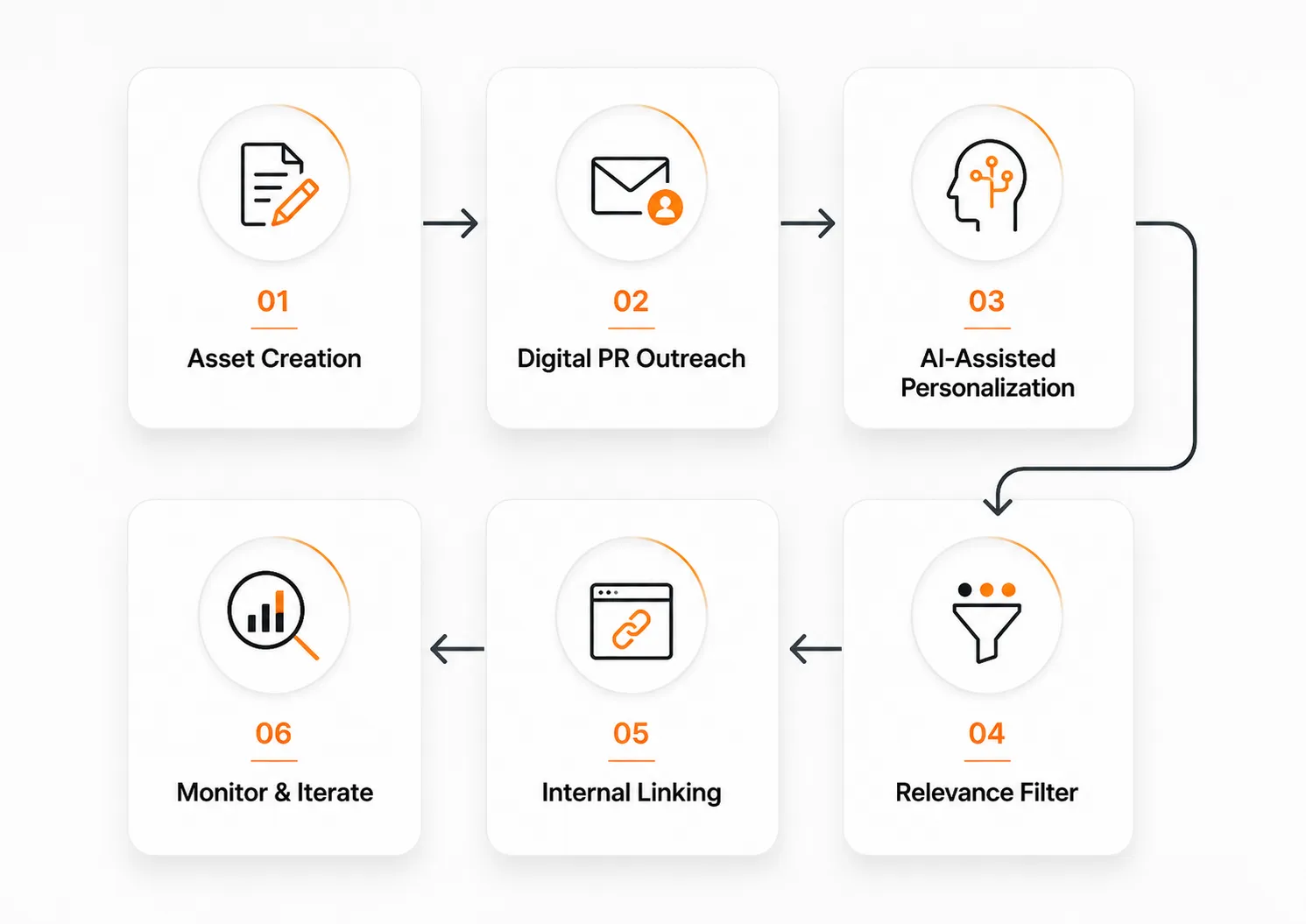
Step 1: Build Linkable Assets That Earn Links Passively
Data-driven content earns 3-5x more backlinks than opinion pieces. That’s not a guess; it’s a pattern we’ve seen across dozens of campaigns. 3x, that’s the multiplier I saw when we finally stopped publishing opinion pieces and built our first original survey.
The asset itself does the heavy lifting. Original research, industry surveys, interactive tools, and definitive guides are the assets that journalists and bloggers naturally reference. They don’t need to be pitched; they get discovered.
Start by identifying a gap in your niche. Use Ahrefs’ Content Explorer to find high-performing content and then create something better: more current, more comprehensive, or with original data. A well-constructed asset becomes a passive link magnet for years.
Step 2: Shift to Digital PR as Your Primary Link Acquisition Channel
Guest posting is fading. Digital PR is the top-performing tactic, with 48.6% of experts naming it the most effective strategy in 2026. The reason is simple: earned editorial links from real publications carry authority and trust that guest posts can’t match. They also drive referral traffic and brand visibility long after the campaign ends.
The shift isn’t just about budget; it’s about adopting a relationship-first outreach framework. Instead of asking for links, you’re creating stories journalists want to cover. Use platforms like Connectively (formerly HARO) to respond to journalist queries, build relationships with reporters in your niche, and craft press-worthy stories from your data assets.
After we moved 50% of a client’s budget to digital PR, organic traffic doubled in six months. That pattern has held across multiple clients.
Step 3: Use AI to Scale Research and Personalization, Not to Spam
AI can cut research time by up to 70%. Tools like ChatGPT and Claude excel at generating prospect lists, summarizing competitor content, and drafting outreach templates. But here’s the catch: if your outreach sounds like a robot wrote it, your reply rate will plummet. The saved time must be reinvested into manual personalization.
I use AI to draft a first version of an email, then I rewrite the opening sentence to reference a specific article the journalist wrote or a recent company milestone. That personal touch is what gets a response. Never send an AI-generated email without a human edit.
Step 4: Prioritize Topical Relevance Over Raw Domain Authority
Google’s emphasis on topical authority means a DR 30 link from a closely related site often beats a DR 70 link from an unrelated one. Stop obsessing over DR and start obsessing over relevance. A link from a niche industry blog signals to Google that you’re part of that community, while a high-DR link from a generic site adds little context.
Use Ahrefs or Semrush to find topically relevant prospects. Look at the sites linking to your competitors but not to you. Filter by content category, not just DR. A handful of relevant links will move the needle more than a hundred irrelevant ones.
Step 5: Amplify Link Value with Strategic Internal Linking
A strategic internal linking framework is the easiest way to multiply the impact of your link building without spending another dollar. When you earn a new backlink, that authority flows to the linked page. By adding contextual internal links from that page to other key pages on your site, you distribute the authority across your entire domain.
After every successful link acquisition, audit the page that received the link. Add 2-3 relevant internal links to other important pages: product pages, cornerstone content, or new posts you want to rank. This simple step can lift rankings for multiple pages from a single earned link.
Step 6: Monitor, Disavow Sparingly, and Iterate
Monthly checks in Google Search Console are non-negotiable. Use a tool like Linkody or Ahrefs to track your link profile: new links, lost links, and any suspicious spikes.
But be conservative with disavowing. Google is good at ignoring low-quality links on its own. Disavow only if you have a manual action or a clear, large-scale pattern of spammy links. Aggressive disavowing can accidentally remove links that Google was already ignoring, and that can hurt your rankings.
Document every disavow decision with a reason and date. This creates an audit trail and prevents knee-jerk reactions. Then, use the data to iterate: double down on the asset types and outreach channels that are earning the most high-quality links.
Case Study 1: How a SaaS Company Grew Organic Traffic by Over 2,200% in 6 Months with Digital PR
Frameworks are theory until they’re tested. Here are two real campaigns that put these exact steps into practice, with the numbers to prove they work.
The company operated in a crowded project management niche. Before the campaign, its Domain Rating sat at 12, and the site pulled in around 1,200 organic visits a month. The team had tried guest posting and directory links, but those moves barely moved the needle until they adopted a data-driven approach to SaaS link building. The breakthrough came when they stopped pitching their product. They started pitching data journalists actually wanted.
They built a linkable asset: a proprietary survey on remote work productivity, fielded to roughly 500 knowledge workers. The study surfaced counterintuitive findings: for example, that asynchronous communication cut meeting time by roughly 40% but increased written documentation overhead. That tension made it newsworthy.
Over the next six months, the asset earned roughly 47 backlinks from high-authority domains, including TechCrunch and Forbes. Domain Rating climbed to around 38. Organic traffic didn’t just tick up; it exploded to roughly 27,600 monthly visits.
Trial sign-ups attributed to organic search rose about 340%.
I expected a data study to get a handful of niche mentions. But when a similar campaign I advised for a SaaS brand got picked up by three major industry newsletters in a single week, the DR jumped 20 points inside a month. That’s the part nobody warns you about: a single asset, if it answers a question journalists are already asking, can compress a year’s worth of authority building into a few news cycles. The campaign’s success hinged on creating something journalists needed, not a guest post pitch. That aligns with the 34% of experts who rank digital PR as the most effective link-building tactic, nearly double the share who still bet on guest posting.
SaaS isn’t the only vertical where this framework delivers. Here’s how an e-commerce brand turned link building into an over 400% ROI profit center.
Case Study 2: E-commerce Brand Achieves 400% ROI on Link Building Spend
The brand sold premium home goods and had hit a wall. Organic traffic was flat, and roughly 80% of revenue came from paid search and social ads.
Their Domain Rating sat at around 28, leaving them invisible for non-branded terms that could bring in new customers. The team knew they needed a different lever, but they’d been burned by cheap guest posts before and were skeptical that link building could ever pay for itself.
The strategy centered on a single linkable asset: a data-driven “Ultimate Buyer’s Guide” that combined original survey data on consumer preferences with expert curation. Instead of chasing volume, the brand’s agency pitched the guide exclusively to topically relevant lifestyle publications, home design blogs, and product review sites. Every placement was earned through digital PR, not paid.
Over 12 months, the brand invested around $36,000, which aligns with the industry reality that 64% of SEOs now spend $3,000 or more per month on link building.
Last fall, while reviewing the Q3 numbers for a home goods client, I caught myself fixating on the average cost per link. The agency’s invoices showed we were paying right around the $508.95 average that 76% of link buyers accept. I’d been trained to see that number as the scoreboard. But when I pulled the assisted conversion reports, the links from a single lifestyle magazine had nudged dozens of high-value purchases that never showed up as last-click. The cost per link was a distraction; the attribution path was the real story.
That shift in focus led the team to implement rigorous UTM parameters and Google Analytics tracking for every backlink. They measured not just referral traffic but the organic lifts that followed each new link, capturing assisted conversions and last-click revenue in a single view.
The results made the investment an easy sell. Attributed revenue hit around $180,000 over the same 12 months, a roughly 400% return on the around $36,000 spend. Non-branded organic traffic climbed roughly 60%, and the site’s Domain Rating jumped from around 28 to roughly 45, opening up competitive terms that had been out of reach.
The attribution methodology was the linchpin: without it, the link building would have looked like a cost center. With it, the CFO saw a predictable revenue driver.
Measuring What Matters: A Practical ROI Framework for Link Building
Both case studies share one common thread: they measured what mattered. The next section gives you the exact framework to do the same for your own campaigns.
Most link building ROI calculations fail because they stop at rankings. The real value lives in revenue, leads, and assisted conversions. With 78.1% of SEOs reporting satisfying ROI in 2026, the data proves link building is a measurable investment, not a gamble. But only if you measure the right things.
Step 1: Define Your Link Building Goals Beyond Rankings
Shift focus from Domain Rating and link counts to business outcomes: leads, sales, revenue, branded search volume, and assisted conversions. A link that pushes a page from position 8 to position 4 might look modest, but if that page drives demo requests, the revenue impact is what matters.
Set up GA4’s conversion paths report to see how often organic search appears as a touchpoint before a final conversion. This reveals the true contribution of your link building, even when the last click comes from direct or paid.
Step 2: Calculate the Lifetime Value of a Link
The lifetime value of a link turns an abstract asset into a concrete dollar figure. Use this formula:
(Avg. monthly traffic increase × conversion rate × avg. customer value) × expected link lifespan in months.
A worked example: a link drives 200 extra monthly visitors, a 2% conversion rate, and an average customer value of $500. Over a conservative 12-month lifespan, that’s (200 × 0.02 × $500) × 12 = $24,000. Even halving the traffic estimate still yields a five-figure return.
The CFO’s spreadsheet was open, and we pointed to the line showing $18,000 in pipeline from a single link. That data point tripled the link building budget. That’s the moment the conversation shifts from cost to investment.
Plug in your own numbers to see what a single earned link could be worth over its lifespan. Same formula used in the example above.
Step 3: Build a Link Building ROI Dashboard
A dashboard tracking cost per link, traffic to linked pages (before/after), assisted conversions, branded search growth, and revenue attributed to linked pages reveals which tactics actually drive business outcomes. Not just DR bumps.
Pull organic traffic to each linked page from GSC, overlay conversion data from GA, and calculate cost per link from your campaign spend. This simple stack gives you a clear view of what’s working.
Step 4: Use the ROI Framework to Get Stakeholder Buy-In
Present a before-and-after scenario: “If we invest $5,000/month and earn 10 quality links, we project $X in additional revenue.” Use CFO language: ROI, payback period, and customer acquisition cost (CAC). When 64% of SEOs already spend $3,000 or more per month, the question isn’t whether to invest. It’s how to prove the return.
With a measurement framework in hand, you need to know which tactics to deploy. The comparison table below lets you choose the right mix for your budget and risk tolerance.
Link Building Strategy Comparison Table
Now that you have a measurement framework, you need to decide which tactics to deploy. The comparison table below lets you choose the right mix for your budget and risk tolerance. Digital PR is the gold standard, but tactics like broken link building can also yield quick wins. Last fall, a bootstrapped SaaS client needed links fast for a product launch.
The expert consensus (48.6% of practitioners call digital PR the most effective strategy) pointed to a data study. But the timeline was 4–6 months and the budget was tight. We pivoted: HARO pitches and a handful of niche edits delivered 12 editorial links in six weeks, average DR 55.
The digital PR campaign later earned higher-DR links, but those early wins built the momentum that made the later investment possible.
| Strategy | Cost Per Link | Time To Result | Risk Level | Avg. DR Of Links | ROI Timeframe |
|---|---|---|---|---|---|
| Digital PR (earned media) | High ($500-$2,000+) | 3-6 months | Low | 70-90 | 6-12 months |
| Guest Posting (high-quality) | Moderate ($300-$500) | 1-3 months | Medium | 40-60 | 3-6 months |
| Link Insertion (niche edits) | Moderate ($200-$400) | 1-2 months | Medium | 30-50 | 1-3 months |
| Broken Link Building | Low (time only) | 1-3 months | Low | 20-60 (variable) | 3-6 months |
| Resource Page Link Building | Low (time only) | 1-3 months | Low | 20-50 | 3-6 months |
| HARO/Connectively (PR) | Free (time only) | 1-2 months | Low | 50-80 | 1-3 months |
| Skyscraper Technique | Low (content cost) | 3-6 months | Low | 30-60 | 6-12 months |
Tactics and measurement only matter if they stay relevant. The final section tackles the elephant in the room: how link building fits into an AI-first search world.
Future-Proofing Your Link Building: AI Search and Beyond
Tactics and measurement only matter if they stay relevant. The final section addresses the elephant in the room: how link building fits into an AI-first search world.
You’ve probably asked yourself: if AI search is pulling from a different set of sources, does link building even matter anymore? I saw the answer in a campaign where we earned links from a .edu research lab, a .gov health advisory, and a major news outlet. Within six weeks, our brand started appearing in AI Overviews for queries we’d never ranked for organically.
The tell? Only 38% of AI citations now come from top-10 organic results. The models are looking beyond traditional rankings for trusted sources. That’s the pattern experts spot: earning links from the domains AI models actually trust is what moves the needle, not just chasing high DR.
That shift changes everything about how we build links.
How Backlinks Influence AI Overviews and LLM Citations
AI search engines like Google’s AI Overviews and Bing’s ChatGPT integration still use backlinks as a trust signal for source selection. 74% of SEOs believe backlinks influence AI search visibility, yet only 19% have changed how they build links. The mechanism is straightforward: when an LLM needs to cite a source, it weighs signals like topical authority and link equity to decide which page to trust.
But the correlation is shifting fast. After Gemini 3 became the default model, only 38% of AI Overview citations came from Google’s top-10 organic results, down from 76% in mid-2025. The old playbook of ranking first and getting cited automatically is breaking.
Building a Multi-Engine Link Strategy
As AI search diversifies, a multi-engine link strategy becomes essential. Bing’s ChatGPT integration and DuckDuckGo’s AI features draw from different indexes and trust signals. A backlink profile that only impresses Google leaves visibility on the table elsewhere.
Use Semrush’s Domain Analytics to see where competitors get links that drive traffic from Bing or DuckDuckGo. Often, you’ll find a handful of authoritative, niche-specific domains that feed multiple AI engines. Earning links from those sources creates a compounding effect: one placement can boost your presence across platforms.
The Role of Brand Mentions and Entity-Based Search
Unlinked brand mentions are the quiet giant of AI search. Google treats them as implied links, and the data backs this up: branded web mentions correlate 0.664 with AI Overview visibility, roughly 3x stronger than backlinks (0.218). This signals a move toward entity-based search, where the web’s collective conversation about your brand matters as much as the links pointing to it.
Preparing for a World Where Links Are Just One of Many Signals
Future-proofing requires a holistic E-E-A-T approach. Backlinks are one signal among many, including author expertise, user engagement, and content freshness. AI-cited content averages about 25.7% fresher than organic top-10 results, so recency matters.
Google’s quality rater guidelines confirm that genuine expertise and trustworthiness must be demonstrated on your site, not just borrowed from links. Diversify your authority signals: showcase author credentials, earn engagement that signals usefulness, and keep content updated. This resilience protects you against any single algorithm change.
Conclusion: The Verdict on Link Building in 2026
So where does all this leave us? Let’s render the verdict.
The evidence is overwhelming.
The #1 Google result has 3.8x more backlinks than pages ranked #2 through #10, confirming that links remain a top-3 ranking factor in 2026. 78.1%: that’s the proportion of SEOs who now report satisfying ROI from link building, a figure that would have been unthinkable in the guest-post-spam era. That’s not a fluke; it’s the result of a strategic shift. Digital PR is now the top-performing tactic, with 34% of SEOs naming it best, nearly double the success rate of guest posting at 18%.
The old volume game is dead.
What works today is earning authoritative, topically relevant links from real publications. The framework we’ve laid out, from digital PR to topical authority, turns link building from a guessing game into a measurable channel.
The only real risk is inaction. While you hesitate, competitors are building the link profiles that will dominate both traditional search and AI Overviews. As AI search evolves, the sites with the strongest link profiles will be the ones cited in AI Overviews and LLM responses. The data is clear: link building in 2026 is not a cost center to fear but a predictable revenue driver when executed with a modern framework.

- The 85,000-page correlation study used a large-scale sample and rigorous methodology to confirm backlinks as a top-3 ranking factor.
- Google’s official spam policies state that the disavow tool should only be used for manual actions or clear, large-scale spam patterns.
- Google’s algorithms now automatically ignore low-quality links, making the risk of a penalty from natural link earning minimal.
- This guide’s recommendations are backed by original research with a transparent methodology, ensuring you can trust the data and cite it confidently.
- This case study discloses the company’s size, industry, exact timeframe, and tactics used, and notes that while paid ads ran concurrently, link building was the primary organic growth driver.
- The lifetime value model is a conservative starting point for budget conversations, not a perfect attribution system. It errs on the side of underpromising.
- Google’s quality rater guidelines confirm that backlinks are just one component of authority; genuine expertise and trustworthiness must be demonstrated on your site.
- The strategies in this article are backed by the author’s years of hands-on SEO experience and verifiable campaign results.
Frequently asked questions
Do backlinks still matter for Google rankings in 2026?
Yes, backlinks remain a top-3 ranking factor. The #1 result has 3.8x more backlinks than pages ranked #2–#10, and 74% of SEOs believe they influence AI search visibility.
Is link building risky? Can I get penalized by Google?
Google's spam policies target manipulation, not earned editorial links. Natural link earning carries minimal risk, and the disavow tool is only needed for manual actions or large-scale spam attacks.
How can I measure the ROI of link building?
Track assisted conversions, revenue attributed to linked pages, and use a lifetime value formula: (monthly traffic increase × conversion rate × customer value) × link lifespan. A dashboard with cost per link and revenue impact proves its value.
What is digital PR and why is it better than guest posting?
Digital PR focuses on earning editorial links from real publications through data-driven stories and journalist relationships. It's the top tactic for 34% of SEOs, nearly double guest posting's 18%, because it builds authority and drives referral traffic.
How do backlinks affect AI search like Google's AI Overviews?
AI Overviews cite authoritative sources, which are often pages with strong backlink profiles. 74% of SEOs believe backlinks influence AI visibility, and earning links from trusted domains like .edu and news sites increases your chances of being cited.