
Introduction: The Allure and Danger of PBNs
In the competitive world of SEO, the promise of quick ranking wins can be incredibly tempting. When growth feels slow, and competitors seem to leap ahead overnight, it’s easy to get drawn toward shortcuts that claim to deliver instant authority. This is where whispers of Private Blog Networks (PBNs) begin circulating. They are often positioned as a fast track to stronger backlinks, higher rankings, and rapid visibility, especially for brands under pressure to show results.
But this temptation is exactly where many SEO strategies start to go wrong. PBNs clearly break the rules, and the confusion around them has cost businesses a lot. I’ve seen brands spend a lot of money on what they thought was “smart link building,” only to see their rankings drop, get hit with penalties, and spend months trying to fix it. The real danger is how well PBNs are hidden. To someone who is not experienced, they can look like real blogs or normal outreach links, making it hard to tell the difference between honest SEO and tricks that break Google’s guidelines.
This uncertainty keeps site owners and marketers always worried. Is a link helping your site, or is it putting your whole website at risk? Are you building trust, or are you setting yourself up for a penalty later? These questions matter even more now that Google’s systems are smarter than ever and care more about trust, usefulness, and being real.
This guide is here to clear up that confusion. Based on real experience with SEO and outreach, it will give you a simple, straightforward look at what PBNs really are, why they are seen as a risky and rule-breaking method, and how to spot their signs before they hurt your site. Even more, you’ll learn how to trade risky shortcuts for honest ways to build links that last. The goal is not just to get higher rankings, but to build a link profile that Google trusts and that helps your site grow for the long term.
What Is a Private Blog Network (PBN)?
A Private Blog Network (PBN) is a group of websites made and run by one person or company, with one main goal: creating links to a target website (often called a “money site”) to manipulate search engine rankings. These links are not earned in a natural way. They are put there on purpose to boost authority and affect Google’s algorithm, rather than providing real value to users.
The Basic Structure of a PBN
Most PBNs are made using expired domains that once belonged to real websites and already have links, signs of authority, and trust in Google’s system. After getting these addresses, they are set up again with new content and used only to link to the money site.
To avoid detection, PBN operators attempt to make each site appear independent by:
- Using different hosting providers or IP addresses
- Registering domains under varied or masked ownership details
- Publishing content that loosely resembles real blogs
Despite these efforts, all sites remain centrally controlled and serve the same artificial purpose.
The Core Purpose Behind/npm
The goal of a PBN is to create fake authority, not earn it. Instead of getting links by making good content, reaching out, or using online PR, PBNs try to take a shortcut by sending “link juice” straight to a money site. This breaks Google’s rules and its Webmaster Guidelines.
From Google’s point of view, these links are misleading because they appear to be real recommendations that aren’t.
How PBNs Try to Look Legitimate
On the surface, many PBN sites are designed to resemble genuine niche blogs. You may see:
- Blog-style layouts
- Basic informational articles
- Occasional outbound links to authority sites for camouflage
However, this fake appearance usually falls apart when you look more closely. The content is often short, basic, only loosely related to different topics, or written just to hold links. Signs of real interest, like real visitors, social sharing, and people knowing the brand, are usually missing.
The Artificial Nature of PBN Links
Unlike real backlinks, PBN links are put there on purpose, not earned. They are there no matter how good, useful, or relevant the content is. Because the person who owns the linking site and the site getting the link is the same, there is no outside review. This fake pattern is exactly what Google’s systems and human reviewers are made to find and stop.
PBN Link vs. Legitimate Link: A Clear Comparison
| Characteristic | PBN Link | Legitimate Link |
| Source Intent | Created specifically to manipulate rankings | Earned through genuine editorial choice or as a useful reference |
| Relevance | Often forced, loosely related, or generic | Closely aligned with the content topic and user intent |
| Content Quality | Thin, low-value, spun, or duplicated content | Original, well-researched, informative, and user-focused |
| Anchor Text | Heavy use of exact-match or keyword-rich anchors | Natural mix of branded, contextual, long-tail, and URL anchors |
| Domain History | Expired domains, sometimes with spammy or penalized pasts | Active domains with a clean, consistent, and trustworthy history |
| Visibility | Little to no organic traffic, minimal brand presence | Publicly discoverable, indexed, and capable of attracting real traffic |
| Link Placement | Inserted unnaturally or out of context | Seamlessly integrated within relevant, valuable content |
Example
A PBN link might come from an old website address that used to belong to a local business, but now posts unrelated SEO articles just to hold links pointing to other sites.
A legitimate link, on the other hand, could come from a respected industry blog that references your content because it adds value to their readers, without any control or obligation on your end.
💡Knowing the difference is very important. While PBN links might give quick results, they hurt trust, can lead to penalties, and cause long-term risk. Legitimate links build authority over time and align with how search engines are meant to reward high-quality content.
How PBNs Work: The Mechanism of Manipulation
To see why PBNs are risky, it helps to first understand how they work. The whole idea is to leverage how search engines view links as signals of trust and importance.
Ranking and Link Equity
At a fundamental level, search engines like Google use links to determine which pages should appear higher in search results. A link from one website to another is seen as a vote of confidence. Over time, this idea became what SEO professionals call link strength or authority. Pages that get links from good, related sites usually do better because those links act like recommendations.
🎯PBNs attempt to hijack this system.
Pooling and Redirecting Authority
The main idea behind a PBN is simple but sneaky. Instead of getting links the normal way, the person running the PBN controls the sites that provide the links. By owning a bunch of websites that already have backlinks, the PBN owner tries to gather that power and send it wherever they want, usually to one main site they want to rank.
In theory, this allows them to manufacture ranking signals on demand.
Why Expired Domains Are So Attractive
Expired domains are the backbone of most PBNs. These domains once belonged to real businesses, blogs, or organizations and may still have:
- Existing backlinks from other sites
- Indexed pages and historical trust signals
- Leftover power in Google’s system for tracking links
This makes them attractive because they seem to offer an easy way in. Instead of building up trust from the beginning, PBN operators try to take it over from the expired domain.
Acquiring and Repurposing Domains
The typical process looks like this:
- Identify expired domains with strong backlink profiles.
- Purchase them through auctions or drop-catching services.
- Put new content on the site, often about something different from what it was before
- Insert outbound links pointing to the money site.
Although the domain may look “authoritative,” its new purpose is purely manipulative.
Tiered PBN Structures
To make the effect bigger and hide who is in charge, many PBNs use a layered setup.
Tier 1 PBNs
These sites link straight to the main site. They are usually made to look as legitimate as possible, with cleaner designs and a bit better content, because they carry the highest risk.
Tier 2 PBNs
These sites link to Tier 1 PBNs rather than the main site. The idea is to make the Tier 1 pages look stronger, so they can send more power to the main site.
This structure is meant to resemble a natural ecosystem of websites referencing one another.
Creating a Fake “Link Graph”
The main goal is to build a natural-looking web of links. Many sites, different layers, different link words, and links to other places are used to mimic what real websites do. On the surface, it may look real.
In reality, the entire network is run by a single person or group, making it very easy to break.
The Fragility of Artificial Networks
Because PBNs rely on tricks rather than real support, they are inherently weak. One clue, like using the same web host, repeating the same writing style, getting links too quickly, or using strange link words, can reveal the whole network. When one site is caught, the danger spreads to every site connected to it, including the main site.
There is no resilience because there is no real trust.
Google’s Advancements in Link Analysis
This weakness is even bigger now because Google’s link-checking tools are much smarter. New computer programs look at patterns over time, how sites are linked, if topics fit together, signs of real visitors, and what happened before. Fake networks have a hard time staying believable in all these ways. From a planning perspective, this is why PBNs are a poor foundation for any real brand. They try to fake trust without earning it, and in a system designed to reward honesty, that unfairness is eventually corrected.
Why PBNs Are Black Hat SEO (and Against Google’s Guidelines)
From an ethical and technical point of view, Private Blog Networks are clearly black hat SEO. There is no confusion or debate about this tactic. Google has always been clear about PBNs, and its stance has only gotten stronger as it has improved its link-checking.
Google’s Official Position on Link Schemes
According to Google’s Webmaster Guidelines, any links intended to manipulate rankings rather than serve users fall under link schemes. Google explicitly calls out tactics that “artificially inflate” a site’s authority through deceptive means.
In Google’s own documentation on link schemes (published via Google Search Central), examples of prohibited practices include:
- Creating links primarily for ranking manipulation
- Excessive link exchanges or networks created solely for SEO benefit.
- Using owned or controlled sites to pass authority unnaturally
PBNs match this description exactly. They exist for only one reason: to boost rankings by faking recommendations. There is no confusion here. Running or using a PBN directly breaks Google’s guidelines.
Explicit Violation, Not a Loophole
Some people try to call PBNs a “calculated risk” or a smart trick. In truth, they are a clear breach of the rules. Why the link was made matters, and PBNs are made to trick, not to recommend.
🔑Google doesn’t judge links by how well they are hidden. It judges them by why they exist.
Manipulating Algorithms vs. Earning Trust
Legitimate link building is about getting attention, building trust, and earning mentions from others. PBNs try to skip that process completely. Instead of asking, “Does this content deserve to be mentioned?” the question becomes, “How can we fake authority?”
This mindset shifts SEO away from value creation and toward exploitation.
The Unethical Nature of Artificial Signals
At its core, a PBN creates fake signs that appear to be real opinions. The site providing the link and the site receiving the link are run by the same person, but Google treats the link as a real vote of trust. This trick is what makes PBNs wrong, not just risky.
🔑Search engines are made to reward real quality. PBNs are made to pretend to have it.
Prioritizing Manipulation Over User Value
PBN content rarely exists to educate, solve problems, or engage users. It exists to host links. This leads to:
- Thin or generic articles
- Poor topical depth
- No meaningful audience or engagement
As a result, users get nothing from these sites, and the internet becomes more crowded and less helpful.
Impact on User Experience and Content Quality
When fake networks fill up search results, truly helpful content gets pushed aside. This lowers search quality and makes people trust rankings less. Google’s fight against link schemes is really about keeping users safe, not just punishing SEOs.
PBNs work against that goal, which is why they are aggressively targeted.
Why the SEO Community Condemns PBNs
Most skilled SEO experts avoid PBNs because they:
- Create unstable, short-lived gains.
- Expose clients to severe penalties.
- Undermine professional credibility
- Conflict with sustainable, white-hat growth strategies
Among top SEO experts, using PBNs is often seen as a sign that someone is new or desperate, not skilled.
Long-Term Damage to Credibility and Trust
The biggest hidden cost of PBNs is the loss of rankings. It is losing trust. Once a website is linked to unethical practices, it is slow to recover. Brands lose progress, people lose trust, and future SEO work gets harder, not easier.
Authority, once damaged, is difficult to rebuild.
💡Expert Tip: Understand the Google’s Guidelines
If you want to make informed, future-proof SEO decisions, take the time to study Google’s Webmaster Guidelines, especially the sections on link schemes and unnatural links. They provide a clear framework for what is acceptable and what puts your site at risk.
In off-page SEO, longevity always beats shortcuts. Ethical link building doesn’t just protect you from penalties; it builds real authority that compounds over time.
The High Risks & Consequences of Using PBNs
The biggest misunderstanding about PBNs is the belief that the only risk is a short-term drop in rankings. In reality, the problems are often serious, long-lasting, and can put your business at risk. Once Google learns about fake link building, the damage extends far beyond SEO metrics.
Partial Matches: When Specific Pages Are Targeted
Sometimes, Google does not punish the whole site right away. Instead, it may lower the value of links to certain pages. These pages suddenly drop in rankings while others seem fine. This can be confusing, but it is often the first sign that fake links, like PBNs, have been found.
Partial penalties are especially risky because many site owners ignore them, allowing the problem to get worse.
Site-Wide Penalties: When the Entire Domain Suffers
If fake link building continues, Google may punish the whole site. At this point, the entire website drops in rankings. Even good pages with no PBN links can lose their place in search results just because they are on the same site.
This is where recovery becomes significantly more difficult and expensive.
How Google’s Manual Reviewers Detect PBNs
Beyond algorithms, Google employs human reviewers who investigate suspicious link patterns. Manual reviewers look for:
- Networks of sites with similar structure or content behavior
- Unnatural anchor text distribution
- Reused templates, hosting footprints, or ownership signals
- Links placed without editorial context
Once confirmed, manual actions are applied, and sites must file reconsideration requests to recover.
Algorithmic Devaluation and the Penguin Effect
Google’s Penguin system is designed to automatically downgrade the value of fake links rather than helping them. When PBN links are found, their effect is ignored or removed. This often causes a sudden, serious drop in rankings with no warning in Search Console.
This makes it harder to diagnose and fix algorithmic penalties.
Sudden Loss of Rankings and Visibility
One of the fastest results of using PBNs is a sudden, rapid drop in rankings. Keywords that were once on the first page can vanish completely. These drops usually happen all at once, often after Google updates or checks your site.
Traffic and Revenue Impact
When rankings go down, website visitors do too. For businesses that depend on free search traffic, this means:
- Fewer leads or sales
- Reduced brand visibility
- Increased reliance on paid traffic
Taking shortcuts in SEO often ends up costing much more than doing things the right way.
Complete Removal From Google’s Index
If the rules are repeatedly or severely broken, Google may remove a site from its search results. This means the website will not appear in search results at all. For many businesses, this is a disaster, cutting off their main way for people to find them right away.
The High Cost of Recovery
Getting back after being removed from search or hit with major penalties isn’t fast or guaranteed. It often means:
- Auditing and removing thousands of toxic links
- Disavowing entire networks
- Rebuilding trust over months or years
- Falling behind while competitors move ahead
In some cases, recovery never fully restores previous performance.
Long-Term Trust Erosion
Besides rankings, using PBNs damages trust. Users, partners, and publishers are less likely to work with a brand known for cheating at SEO. This loss of trust makes it harder to connect with others, get good press, or earn real links in the future.
Permanent Stains on Domain History
Even after fixing the problem, a website’s past does not disappear. Google remembers what happened before. Sites with a history of fake links often face:
- Slower future ranking improvements
- Less value from new backlinks
- More careful checks during updates
This hidden problem can slow down growth long after the PBNs are removed.
Google Penalties for PBNs: Severity Breakdown
| Penalty Type | Description | Impact on Site |
| Manual Action | Human reviewer identifies link schemes such as PBNs | Partial or full de-ranking, major traffic loss, possible de-indexing |
| Algorithmic Devaluation | Algorithms detect unnatural link patterns | Site-wide ranking suppression and significant organic traffic decline |
| De-indexing | Severe or repeated guideline violations | Complete removal from search results, zero organic visibility |
| Trust and Authority Loss | Long-term damage to credibility and E-E-A-T signals | Slower recovery, weaker rankings, reduced impact of future links |
The Real Risk to Consider
The real danger of PBNs is not just getting punished; it’s the risk of being punished. It means losing progress, trust, and the chance to grow over time. SEO builds up slowly. Once a website’s reputation is damaged, every future step becomes harder and costs more.
🔑From a professional SEO perspective, no quick win is worth the long-term harm. Real authority is earned, not faked.
Myth Busting: Common Misconceptions About PBNs
Private Blog Networks continue to survive largely because of misinformation. Below are the most common myths I hear from site owners, junior SEOs, and even agencies, and why they don’t hold up in today’s search landscape.
Myth 1: “Google Can’t Detect Well-Built PBNs Anymore”
This belief is outdated and dangerous. Google Algorithms no longer just look for simple things like shared IP addresses or obvious signs. Newer systems look at patterns, connections, and reasons behind links over time. Tools like RankBrain help Google spot unusual link activity across many sites.
PBNs inevitably leave footprints:
- Unnatural link velocity spikes
- Repeated anchor text patterns across unrelated domains
- Weak or inconsistent topical relevance
- Domains with no real audience, traffic, or brand signals
These patterns are becoming easier to spot, especially over months or years. Even networks that seem safe at first often get caught over time.
💡Reality: Detection isn’t a matter of technical perfection. It’s about intent and behavior patterns.
Myth 2: “There Is a Safe Way to Run a PBN”
There isn’t. Changing hosting, using fake identities, or rewriting content does not fix the main problem: PBNs are made to manipulate the search results. That reason alone makes them a risky and frowned-upon tactic.
You are not judged on how smart your setup is. You are judged on why the links are there. If the reason is control instead of real recommendations, the risk cannot be avoided.
💡Reality: There is no “safe” execution of an unsafe strategy.
Myth 3: “If It Works Now, It’s Worth the Risk”
This is one of the most expensive assumptions in SEO. Yes, PBNs can sometimes produce short-term ranking improvements. But those gains are:
- Unstable
- Non-compounding
- Easily reversed
In anonymized audits I’ve worked on, sites that relied heavily on PBNs often showed a clear pattern:
- Rapid ranking growth
- Plateau
- Sharp decline following algorithm updates or manual reviews
The cost of fixing problems, removing bad links, and lost money is almost always higher than any short-term gains.
💡Reality: Short-term wins that lead to long-term penalties are not wins at all.
Myth 4: “Everyone Uses PBNs at the Top”
This is simply false. The vast majority of successful, long-term SEO campaigns rely on:
- Editorial links
- Digital PR
- Guest contributions
- Brand mentions
- Niche-relevant authority placements
Big brands, well-funded startups, and top publishers do not risk their websites on tricks that can wipe out years of progress in one night. The idea that ‘everyone does it’ is usually spread by people who make money selling PBN services, not by those who care about long-term SEO success.
💡Reality: Serious brands build authority; they don’t manufacture it.
Myth 5: “Disavowing Fixes Everything”
Disavowing is a recovery step, not a safety net. By the time disavowal is needed:
- Rankings are already lost.
- Trust signals are already damaged.
- Time, money, and momentum are already gone.
Even after disavowing PBN links, recovery can take months, and in some cases, full recovery never happens. Google does not simply “reset” trust because you acknowledged the problem.
💡Reality: Prevention is always cheaper and more effective than cleanup.
The E-E-A-T Reality Check
From an E-E-A-T perspective, PBNs fail on every level:
- No real expertise
- No authentic authority
- No trust signals
- No user-first intent
As Google continues to focus on trust and real signs of quality, fake networks work less and less often and are caught more often.
Key Takeaway
PBNs stick around because they seem like a quick fix. But SEO rewards steady work, trust, and real value. Each year, the difference grows between tricks that seem to work and real strategies that actually help you grow.
If your goal is sustainable growth, brand trust, and long-term rankings, the choice is clear. Focus on ethical, value-driven link building and leave risky shortcuts behind.
🔑In off-page SEO, shortcuts don’t save time. They steal it.
How to Identify a Private Blog Network (PBN)
Spotting a PBN is not about relying on one single signal. It’s about pattern recognition. Individually, some of these indicators can appear on legitimate sites. Collectively, they form a clear footprint of manipulation. Below is a practical, field-tested framework you can use to audit backlinks, outreach prospects, or suspicious domains.
Hosting & IP Address Patterns
One of the most common warning signs is when different sites use the same servers or hosting setup.
Red flags to watch for
- Multiple “independent” sites hosted on the same IP address
- Sequential or closely related IP blocks
- Cheap, basic hosting companies are often used for many sites.
How to check
- Use reverse IP lookup tools.
- Crawl multiple domains with Screaming Frog SEO Spider to detect hosting similarities.
- Cross-check hosting providers using IP address checker tools.
PBN operators try to hide this, but large networks almost always leak patterns.
Domain Registration & Whois Data
Hiding who owns the site is another major red flag.
Red flags to watch for
- Private Whois registration across dozens of unrelated domains
- The same registration dates, companies, or privacy services are used repeatedly.
- Similar contact emails or naming styles are used in the background.
How to check
- Use Whois lookup tools.
- Compare registration timelines and registrars across linking domains.
- Look for consistency that shouldn’t exist between “independent” sites.
Privacy by itself is not a problem. Seeing the same privacy patterns across many sites is.
Content Quality & Relevance
Content is usually the biggest weakness for most PBNs.
Red flags to watch for
- Thin articles with low word count
- Content that is copied and changed just enough to look different, or badly rewritten
- Grammar issues and awkward phrasing
- Articles that barely relate to the site’s supposed niche
How to check
- Manually read multiple posts.
- Check if the content shows real knowledge.
- Ask if the article would exist without the link.
If the content seems made just for links and not for real people, it probably is.
Outbound Link Profile
PBNs are made to create links to other sites, and it is obvious.
Red flags to watch for
- Excessive outbound links compared to internal links
- Links pointing mainly to commercial “money sites.”
- A lot of links use the exact keywords they want to rank for
- Links that are added in a way that does not fit naturally in the text
💡Expert Tip: Look for Natural Anchor Text Distribution
Legitimate sites link naturally, using brand names, parts of keywords, web addresses, and words that fit the context. Too many links with the exact keyword are a classic PBN sign.
How to check
- Analyze outbound links and anchors using Ahrefs Site Explorer or Semrush.
- Compare anchor diversity across multiple linking pages.
Website Design & User Experience
Cutting corners on design often reveals fake networks.
Red flags to watch for
- Generic or outdated themes
- Minimal customization or branding
- No clear navigation structure
- Missing contact page, about page, or author details
- Hard to use on phones or loads very slowly
How to check
- Manual site review
- Mobile responsiveness testing
- Check how easy the site is to use as a regular visitor.
Real publishers invest in usability. PBNs rarely do.
Lack of Organic Traffic & Engagement
A blog with no readers is automatically suspicious.
Red flags to watch for
- No visible rankings for informational keywords
- Zero or near-zero organic traffic
- No comments, social media shares, or signs of a real community
How to check
- Use Ahrefs or Semrush to estimate organic traffic.
- Check whether the site ranks for its own content.
- See if the brand has any social media accounts or activity.
A legitimate site usually attracts some attention. PBNs exist in isolation.
Domain History & Age
Expired domains are commonly recycled.
Red flags to watch for
- A domain that previously served a completely different niche
- Sudden topic shifts after expiration.
- The site has strong reputation scores, but not much is happening now.
How to check
- Review historical snapshots using Wayback Machine.
- Look for drastic changes in branding, topic, or purpose.
Authority without continuity is a major warning sign.
Author Bios & Credibility Signals
Pretending to be an expert is another clear sign.
Red flags to watch for
- Generic author names used across multiple sites
- Stock photos or no author images at all
- No proof of skills, experience, or any online history
How to check
- Search author names independently
- See if the author has a steady record of writing or is active on social media.
- Check if the author is mentioned anywhere else online.
Real experts leave trails. Fake ones don’t.
💡Expert Tip: Always Ask “Why This Link Exists”
This single question filters out most bad links:
Why would this site naturally link to my content?
If you cannot clearly explain the value, relevance, or benefit to readers, you should look more closely at the link.
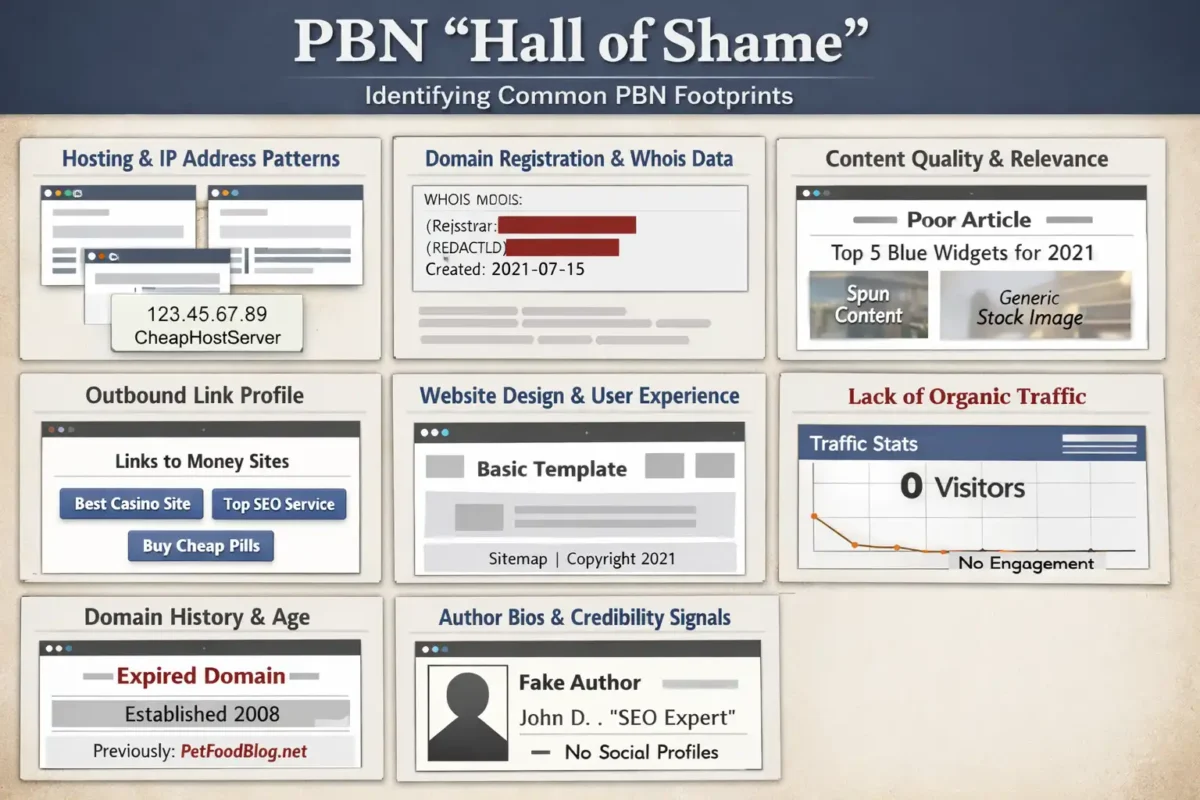
PBN Identification Checklist (Actionable Audit Framework)
| Red Flag Indicator | Description | Action / Observation Method |
| IP Address Patterns | Multiple unrelated domains sharing hosting or IP blocks | Use reverse IP lookup tools and Screaming Frog crawls |
| Whois Data Privacy | Repeated private registration across many sites | Run Whois checks and compare registrar and registration patterns |
| Content Quality | Thin, spun, irrelevant, error-filled articles | Manual content review; assess expertise and originality |
| Outbound Link Focus | Excessive money-site links and exact-match anchors | Analyze anchors and outbound links with Ahrefs or Semrush |
| Site Design & UX | Generic themes, poor navigation, no branding | Manual UX review and mobile testing |
| Organic Traffic | No rankings, traffic, or engagement | Check estimated traffic and keyword visibility in Ahrefs/Semrush |
| Domain History | Expired domain with unrelated past usage | Review historical versions via Wayback Machine |
| Author Bios | Fake, generic, or unverifiable authors | Verify author credentials and digital footprint |
🔑Strategic Takeaway: PBNs do not fail because people stop trying to hide them. They fail because fake signs cannot copy real trust and reputation across many sites. Once you know what to look for, the signs are clear.
For long-term SEO success, your best tool is good judgment. Being able to spot and avoid bad links is just as important as getting good ones.
Ethical & Sustainable Alternatives to PBNs for Link Building
If your goal is long-term rankings, brand trust, and compounding growth, the position is clear: ethical, value-driven link building beats manipulative shortcuts every time. PBNs try to imitate authority. Sustainable SEO earns it.
As someone who works in off-page SEO and outreach, I focus on strategies that align with how Google rewards websites today: relevance, helpfulness, trustworthiness, and real editorial choices.
💡Expert Tip: Focus on User Value First
Create content that genuinely helps, informs, or solves problems for your audience. When content delivers real value, links become a byproduct, not the goal.
The “Linkable Asset” Mindset
A linkable asset is any content that naturally gets links because it is helpful or different. Examples include:
- In-depth guides
- Original research or data studies
- Tools, calculators, or templates
- Definitive resource hubs
Instead of asking, “How do I get links?” ask, “Why would someone link to this?”
Proven Ethical Link Building Strategies
1) Guest Posting (Strategic & Relevant)
Guest posting works when done with intent, not volume.
How to do it right
- Identify authoritative, niche-relevant websites.
- Pitch original topics that fill content gaps
- Publish fewer, higher-quality placements.
Why it works: Editorial control stays with the publisher, which keeps links natural and trustworthy.
2) Broken Link Building
This method replaces broken links with better resources.
Mini how-to
- Find broken outbound links on reputable sites.
- Create or offer a superior replacement.
- Reach out with a helpful, non-pushy pitch.
Why it works: You’re improving the web, not manipulating it.
3) Content Marketing & Digital PR
This is where your reputation grows over time.
Effective formats
- Evergreen guides
- Industry surveys and original data
- Infographics and visual explainers
- Free tools or templates
Promote this content to journalists, bloggers, and creators. Editorial mentions lead to earned links that algorithms trust.
💡Expert Tip: Prioritize Relevance & Quality
One link from a trusted, related site is worth more than many links from unrelated places. Being relevant keeps you safe from penalties and also helps your rankings.
4) Resource Page Link Building
Many sites curate helpful resources.
How to execute
- Find niche-specific resource pages.
- Assess quality and relevance.
- Suggest your content as a genuine addition.
Why it works: These links exist specifically to help users find quality information.
5) Skyscraper Technique
Improve what already works.
Steps
- Identify content with many backlinks.
- Create something more comprehensive, up-to-date, or actionable.
- Reach out to sites linking to the original.
Why it works: You’re offering a better solution, not forcing placement.
💡Expert Tip: Build Relationships, Not Just Links
Long-term SEO wins come from genuine relationships with editors, creators, and site owners. Links follow trust.
6) Journalist Outreach and HARO
Platforms like Help a Reporter Out connect experts with journalists.
Why it works
- Editorial, high-authority links
- Strong E-E-A-T signals
- Brand visibility beyond SEO
💡Expert Tip: Diversify Your Link Acquisition
Relying on just one method creates patterns. Mix PR, outreach, content marketing, and broken-link fixes to build a more natural link profile.
Mini How-To: Ethical Link Building in Practice
- Audit existing content for link potential.
- Create one strong linkable asset per quarter.
- Build a list of relevant publishers and journalists.
- Personalize outreach with value-first messaging
- Keep track of your links, the anchors used in those links, and how relevant they are
- Repeat and refine
This system can grow without putting your website at risk.
Ethical Link Building Tactics vs. PBNs
| Tactic | Effort Level | Risk Level | Long-Term Value | Scalability |
| PBNs | Low initially | Very High | Negative to zero | High (but unstable and risky) |
| Guest Posting | Medium | Low | High | Medium |
| Broken Link Building | Medium | Low | High | Medium |
| Content Marketing / Digital PR | High | Very Low | Very High | High |
| Resource Page Link Building | Low–Medium | Very Low | Medium–High | Medium |
| Skyscraper Technique | High | Low | Very High | Medium |
| HARO / Journalist Outreach | Medium | Very Low | High | Medium |
Why these ratings matter
- Effort Level: Ethical strategies need more work at the start, unlike PBN shortcuts
- Risk Level: Editorial control dramatically reduces penalty risk
- Long-Term Value: Earned links compound authority over time
- Scalability: Systems based on content and real connections can grow smoothly
PBNs attempt to simulate trust. Ethical link building creates it.
If you want rankings that last, brands that grow, and SEO strategies you never have to fix later, invest in honest, value-driven link building. The results are not just safer, but also stronger.
PBN Penalty Recovery: What to Do If Your Site Is Affected
If your site has been affected (or you think it’s being hurt) by PBN links, you need a recovery plan that is careful, well-documented, and honest. The goal isn’t just to get your rankings back. It’s to rebuild trust and fix the problems that caused the drop in the first place.
A key point many people miss: in modern Google systems, spam links are often devalued rather than “boosting” you. Since Penguin is part of Google’s core algorithm, it works more granularly and can discount spam signals in real time. That means PBN links can quietly stop helping and then start hurting without an obvious warning.
Step 0: Confirm What Kind of Hit You’re Dealing With
1) Check for a Manual Action (the one Google explicitly tells you about)
In Google Search Console, open the Manual actions report under Security & Manual Actions. If there’s a manual action, Google will show it there, and some or all of your site may stop appearing in search results.
2) If there’s no manual action, assume algorithmic devaluation/ranking suppression is possible
You won’t always get a notification. This is where backlink auditing + pattern analysis matters.
Step 1: Identify Bad Links With a Proper Backlink Audit
Product recommendation (audit tools):
- Ahrefs Site Explorer
- Semrush Backlink Analytics
- Moz Link Explorer
What to do:
- Export your full backlink list (domains + URLs + anchor text + first seen dates).
- Sort by: low traffic domains, suspicious anchors, irrelevant niches, and unusual link velocity spikes.
- Pull the top linking domains by link count and review them first (PBNs often link repeatedly).
Manual review (use the PBN footprints from earlier):
- Does the blog have real branding, named authors, contact information, and stick to one main topic?
- Are outbound links heavily commercial and stuffed with exact-match anchors?
- Does the site have real organic traffic and rankings, or is it basically invisible?
Step 2: Document Evidence Like You’re Building a Case File
This step is what separates “random cleanup” from a credible recovery.
What to record:
- A spreadsheet with: linking domain, URL, anchor text, target page, date found, and PBN indicators.
- Screenshots of clear signs (very little content, strange links, basic website designs).
- Notes on any outreach attempts to remove links (even if ignored).
This documentation becomes critical if you need a reconsideration request.
Step 3: Decide If (and When) to Use the Google Disavow Tool
Google is very clear: disavow is an advanced feature and should be used with caution. It’s mainly intended for situations where you have a manual action for unnatural links, or where you strongly suspect you’re about to receive one and cannot get the links removed.
When disavow is appropriate:
- You have a manual action related to unnatural links.
- You’re dealing with clear negative SEO or a large, uncontrollable volume of spam/PBN links.
- You cannot remove links through outreach, and the risk is obvious.
💡Expert tip: Disavow harmful links proactively. If you can clearly confirm PBN or spam links and removing them is not possible, disavow can help lower the risk. Just don’t use it like an easy fix.
Step 4: Create a Disavow File (Step-by-Step)
File basics
- Format: .txt
- Encoding: UTF-8 or standard text
- One entry per line
Domains vs. URLs
- Prefer domain-level disavow for PBNs (networks often have multiple toxic pages).
- Use URL-level disavow only when a site is mostly legitimate, but one specific page/link is manipulative.
Example disavow file
# Disavow file created on 2025-12-22
# Purpose: Remove spammy and low-quality backlinks

# Disavow entire domains
domain:spammywebsite.com
domain:badlinks.net
domain:free-backlinks.xyz

# Disavow specific URLs
https://example.com/spam-page.html
https://anotherbadsite.com/cheap-links.html
Step 5: Upload the Disavow File
Upload via Google Search Console’s Disavow Links tool (it’s separate from normal reports). Google’s documentation walks through the process and warns that misuse can harm performance.
Step 6: Clean Up Your Own Site (Yes, This Matters)
Even if the main issue is backlinks, you should strengthen your on-site quality while waiting for recovery.
Do this in parallel:
- Remove or rewrite pages with little or repeated content (especially those created solely for SEO).
- Add more useful information to your main topics and link important pages within your site.
- Fix user experience problems: make sure your site works well on phones, stays steady while loading, and loads quickly.
- Strengthen trust signals by adding author bios, setting clear rules for your content, and including sources when needed.
Think of it as giving Google a clear reason to trust your site again once the toxic signals are neutralized.
Step 7: Submit a Reconsideration Request (Manual Actions Only)
If you have a manual action, Search Console lets you request a review after you fix the issues.
How to write a strong reconsideration request
- Be clear and honest: acknowledge the issue.
- Summarize actions taken:
- Audit completed
- Removal outreach attempted
- Disavow file submitted
- On-site quality improvements
- Include examples and attach/mention your documentation.
- Avoid excuses. Show control, process, and compliance.
Step 8: Patience and Monitoring (Recovery Takes Time)
Even after you clean things up, recovery is not instant. Google’s systems need time to check your site again and update their results. Set up alerts for new sites linking to you and sudden increases in links that use the exact-match anchors.
💡Expert Tip: Regularly audit your backlink profile
- Monthly for aggressive niches
- Quarterly for most brands
- Use Ahrefs or Semrush to spot bad links early, before they become a crisis.
Anonymized Case Study Concept (What Recovery Often Looks Like)
A service business used what they thought were strong blog links, but these turned out to be from a PBN network. Their site lost visibility quickly, then they found a manual action in Search Console. They checked their links with Ahrefs, identified about 120 bad domains, tried to remove them, blocked them, and rewrote weak service-location pages. After sending a clear reconsideration request with proof, the manual action was removed, and rankings began to return over the next several weeks. The biggest win was not just getting back on track, but replacing risky links with real, trusted mentions so the site stopped getting penalties.
PBN Penalty Recovery Plan
| Step | Description | Key Actions (Best Practices) |
| 1. Identify Bad Links | Audit backlink profile for PBN footprints | Use Ahrefs/Semrush/Moz exports; review anchors; manually inspect top referring domains; check GSC manual actions |
| 2. Document Evidence | Create a detailed record of suspicious links | Spreadsheet + screenshots + notes on footprints; track outreach attempts; keep dates and URLs |
| 3. Create Disavow File | Compile domains/URLs to disavow | Prefer domain-level for PBNs; use correct .txt format; add comments; avoid disavowing good links |
| 4. Clean Up Your Site | Improve on-site quality and UX | Content audit; rewrite thin pages; improve speed/mobile UX; strengthen E-E-A-T signals |
| 5. Submit Reconsideration | Manual actions only | Honest summary + proof of removals/disavow + documentation; keep it concise |
| 6. Monitor & Prevent | Prevent relapse and build ethically | Set alerts (Linkody/Monitor Backlinks); monthly/quarterly audits; shift to white-hat outreach + PR |
Key Takeaway
If you’ve been hit by PBN links, your recovery depends on two things: carefully removing or blocking the offending links, and showing Google that your site is clean and focused on users going forward. Cleanup is your reset. Building real relationships and getting trusted links is what keeps you safe after that.
Conclusion: Building a Strong, Future-Proof Link Profile
Private Blog Networks might still be used as a shortcut in SEO, but the truth is simple. PBNs are risky, misleading, and do not work in the long run. They are only made to trick search engines, which goes against how search engines judge trust, usefulness, and authority. What looks like an easy win often leads to losing rankings, losing website visitors, expensive fixes, and lasting harm to your website’s reputation.
It’s important to be clear about this: PBNs break Google’s guidelines. They are not a trick, not a gray area, and not a long-term plan. As Google’s systems get smarter, fake link networks are easier to spot and shut down. In the end, using PBNs is not just risky; it also weakens your SEO plan.
On the other hand, different types of link building gives you results that shortcuts cannot. Good methods like reaching out with helpful content, sharing news about your business, writing guest posts for related websites, and getting links by offering useful resources all add real value. These links are earned by being chosen by editors, align with Google’s guidelines, and make your website stronger over time, rather than putting it in danger. They also help your business by building trust, bringing in visitors from other sites, and making your brand more visible, not just in search results.
The key to a strong link profile is giving value to users. Content that truly helps, teaches, or solves problems will naturally get noticed and shared. When you focus on making real, useful content instead of trying to fake signals, links show your quality instead of being a trick.
💡Expert Tip: Be Wary of “Guaranteed” Rankings
Any company or person who promises guaranteed rankings, fast results, or lots of links without being clear about how they do it should make you worry. SEO does not work with promises. It works through steady effort, relevance, and building trust over time. Shortcuts are often hidden behind unclear promises.
The best way to make your SEO last is simple, but it takes discipline. Patience, good quality, and following the rules are the keys to long-term success. Rankings you get by doing things the right way are steadier, easier to keep, and much more valuable than anything you get by trying to cheat the system.
In the end, it is about your goals. You can go after short-term wins and take big risks, or you can build real authority the right way. Make smart, honest choices in your link building, use methods that match how search engines reward good content, and make sure your website is built on a strong, Google-approved base that will help you grow for years.