
Introduction
If you feel overwhelmed or discouraged by link building, you’re not alone. SEO is full of mixed advice, risky methods, and outdated strategies. Many chase any backlink, only to gain weak links that do not help, or worse, put their site’s reputation at risk.
For many people working in SEO, the hardest part is starting. Maybe your link requests get ignored. Maybe you can’t find the best websites to contact. Maybe you fear appearing like a spammer, even when you’re being honest. This leads to slow progress, few wins, and the sense that link building is too hard.
But here’s the good news: it doesn’t have to be this way. Old, random outreach wastes time and damages reputations. A smart plan works better. Focus on real connections, give value, and stay relevant. That’s how you build backlinks that boost rankings, visibility, and reputation.
In this guide, you’ll learn how to find real opportunities, write strong outreach emails, use the right tools, and avoid common mistakes. More importantly, you’ll learn to build backlinks based on trust, quality, and steady growth.
As an Off-Page SEO and Outreach Specialist, I’ve seen honest, safe link building transform brands in search rankings, reputation, and industry standing. This guide is based on real experience and proven methods to help you improve outreach and build valuable links.
Start applying these proven strategies today, and commit to transforming your link-building outreach now for measurable results!
What Exactly Is Link Building Outreach? A Clear, Modern Definition
Link building outreach means actively reaching out to website owners, editors, journalists, or content creators to get links to your content. You do this by offering real value, not by using tricks or paying for links. The main idea is not to ask for links without reason. Instead, it is about making connections, sharing your knowledge, and helping others improve their content while also making your brand more visible and trusted.
Instead of sending mass emails or waiting for site visits, outreach puts you in control. It means:
- Identifying the right prospects whose audiences align with your niche
- Finding out who is in charge and how to reach them
- Crafting a personalized pitch that explains why your idea is helpful
- Following up respectfully and professionally
- Securing a high-quality backlink that strengthens rankings, traffic, and credibility
The real goal is more than getting a link. It is to create new opportunities. Good outreach builds strong relationships, encourages collaboration, and builds trust in your niche.
This approach differs from fast, automated tactics such as submitting your site to lists, leaving forum comments, or using networks for content sharing. Those may be quick, but they rarely build real trust or lasting results. Outreach stands out because it is active, thoughtful, and personal, making it effective.
And this isn’t just opinion. Leading SEO authorities like Ahrefs, Moz, and Semrush consistently reinforce that outreach-based link building remains one of the most reliable ways to earn editorial backlinks and improve organic performance. When done well, it reflects expertise, supports useful content, and strengthens your site’s E-E-A-T signals, which Google increasingly values.
As an Off-Page SEO and Outreach Specialist, I have seen how effective this can be. Outreach changes link building from just trying to get as many links as possible to a process where you trade real value, based on what matters, being real, and growing over time.
Why Strategic Outreach Link Building Matters for Your SEO Success
Backlinks form the backbone of visibility, authority, and growth. When another website links to your content, Google sees your source as credible and useful. These digital “votes of confidence” help search engines decide which pages should rank higher.
High-quality backlinks lead to better rankings, more clicks, and a greater chance of converting visitors.
In addition to improving search rankings, backlinks bring targeted visitors from trusted sites, who are already interested and more likely to convert.
Strategic Outreach directly improves your website’s strength and trust signals:
- Domain Authority / Domain Rating: Increases as you gain more high-quality backlinks, indicating your site is more trustworthy.
- Organic Keywords & Rankings: Grow as Google sees your site as more useful and important.
- Traffic Growth: Increases over time as your rankings and visitor sources grow.
- Consistent, value-driven outreach builds authority, improves ranking, drives traffic, and enhances credibility for lasting results.
Beyond the Backlink: Outreach as a Brand Builder
What makes outreach powerful is that its value goes beyond SEO metrics. By working with trusted publishers, editors, and content creators, you not only build links but also relationships. These lead to:
- Brand mentions across trusted industry sites.
- Co-marketing partnerships and interviews.
- Long-term editorial collaborations.
- An expanding professional network.
- Elevated brand perception and authority.
As an off-page SEO specialist, I have seen how these networks open up new opportunities over time. Once you show your value, trust grows, and new links often come naturally. That is the real long-term strategy.
🎯Strategic outreach boosts rankings, trust, and steady growth, regardless of algorithm or competition changes.
Decoding the Landscape: Types of Link Building Outreach Strategies
No two websites, topics, or goals are the same, so your outreach strategy should be unique too. Successful link building means choosing methods that align with what you are good at, the tools you have, and your long-term goals. Here are some of the most effective outreach methods used today, each grounded in ethical best practices and focused on delivering value to everyone involved.
1. Guest Posting Outreach
What It Is:
Guest posting means writing original, high-quality content for another website in your niche. In return, you usually get a link back to your site in the article or in your author bio.
How It Works:
Find websites that fit your topic, look for subjects or missing information you can provide, and suggest article ideas that match their readers and style.
Offer Real Value First:
Editors are far more likely to accept pitches that clearly benefit their readers. Your angle, insights, and examples should deliver something new, not something recycled.
🔑Key takeaway: Avoid low-quality sites or networks that accept any content for quick links. Focus on relevance, authority, and audience fit.
2. Broken Link Building Outreach
What It Is:
Broken link building involves identifying links on other websites that no longer work, then offering your content as a useful replacement.
How It Works:
Use SEO tools to find broken links on trusted pages, especially on resource pages or competitor articles.
Recommended Tools:
Tools like Ahrefs or Semrush help you quickly find broken links on the websites you want to target.
🔑Key takeaway: Only suggest your content if it genuinely improves the site and replaces the broken link with something valuable.
3. Resource Page Outreach
What It Is:
Many websites keep lists of helpful resources, guides, or tools. Resource outreach involves suggesting your content for inclusion on these lists.
How It Works:
Search for opportunities by using queries like:
- “best [topic] links.”
- “[niche] + resources.”
- “top [keyword] websites.”
Clearly explain how your content fills a gap or adds value to their list of resources.
🔑Key takeaway: Personalization matters more than volume when reaching out to resources. Quality outreach yields better inclusion rates.
4. Unlinked Brand Mentions
What It Is:
This method focuses on finding online places where your brand, product, or content is mentioned but not linked back to your site.
How It Works:
When you find a mention, politely ask the website owner to turn the mention into a clickable link. Because the mention is already there, you often have a good chance of success.
🔑Key takeaway: Earn links from unlinked mentions by being helpful and non-intrusive when you request a link.
5. Skyscraper Outreach
What It Is:
Find popular content in your niche, create something much better, and reach out to sites linking to the earlier version.
How It Works:
Create 10x quality content that is much more complete, up-to-date, visual, and useful, then give website owners a strong reason to update their links to your new content.
🔑Key takeaway: Ensure your skyscraper content is truly better and unique to make outreach effective and ethical.
6. Expert Roundup or Collaborative Outreach
What It Is:
Roundup outreach brings together several experts in one article, with each expert sharing their ideas and often linking back to the main source.
How It Works:
Look for existing roundups you can join, or make your own by inviting other experts in your field. These connections often lead to natural links.
🔑Key takeaway: Collaborative outreach builds authority and relationships, respects accuracy, and values every expert’s contribution.
7. Contextual Link Insertions (Niche Edits)
What It Is:
This method is about adding your link naturally into existing content on trusted, relevant websites, especially older articles that are already valuable.
How It Works:
Find articles where your content can really help readers. Then, contact the website with a clear suggestion showing how your link adds to the topic.
💡Critical E-E-A-T & Guideline Reminder: Google’s link scheme policies warn against manipulative link placements, including paid or irrelevant insertions. Only pursue niche edits when your link improves the host content and benefits users. Avoid transactional placements or shortcuts, as they may harm long-term trust and rankings.
Choosing the Right Strategy
There is no single best outreach method, only the one that fits your goals, resources, and audience. What matters most is being relevant, real, and valuable. When done the right way, each of these strategies builds trust, stronger connections, and a backlink profile based on quality rather than just numbers.
As someone who works in off-page SEO, I have learned that choosing the right strategy is what makes most outreach succeed or fail. The right method turns your hard work into long-term results.
The Step-by-Step Blueprint for a Successful Outreach Campaign
From Planning to Payout: A Practical Methodology You Can Repeat
Outreach often feels like a numbers game: send more emails, hope for more links. But when you’re not getting replies, it’s rarely because you didn’t send enough. It’s usually because the campaign is missing key parts: unclear goals, weak reasons for people to care, reaching out to the wrong people, and messages that sound like everyone else’s. That leads to wasted time, few replies, and links that don’t make a difference.
A repeatable outreach process that ensures every email has a clear purpose, every person you contact is a good fit, and every follow-up is helpful.
As an Off-Page SEO and Outreach Specialist, I focus on honest link building through niche edits, guest posting, and digital PR. This blueprint is the exact process I use to get links that help rankings, build trust, and avoid spam or shortcuts.
Outreach Campaign Workflow
| Stage | Key Activities | Goal | Recommended Tools |
| 1. Preparation & Strategy | Set objectives, define audience, audit content assets, craft value proposition | Build a focused plan that avoids random outreach | GA4, GSC, content inventory |
| 2. Prospect Identification | Find niche-relevant, authoritative sites; competitor backlink research; search operators | Build a list of qualified link partners | Ahrefs, Semrush, Google Operators |
| 3. Contact Discovery | Find decision-makers; validate emails | Reach the right person reliably | Hunter.io, Snov.io, LinkedIn, Clearbit |
| 4. Personalization & Research | Analyze content, tone, audience needs, gaps | Create pitches that feel 1:1 | Manual review, BuzzStream |
| 5. Outreach Email | Subject, custom opener, value prop, CTA | Maximize opens + replies | Grammarly, templates |
| 6. Follow-Up | 2–3 polite follow-ups, spaced strategically | Increase replies without annoying people | BuzzStream, Mailshake |
| 7. Fulfillment | Deliver guest post / resource / fix quickly and well | Secure the link & relationship | Google Docs, email |
| 8. Tracking & Analysis | Track opens, replies, links, impact | Improve performance over time | Sheets/Airtable, Ahrefs, GA4 |
Step 1: Laying the Foundation (Strategy & Content Audit)
If you skip strategy, you’ll “do outreach,” but you won’t build outcomes.
Set clear and specific goals
Good outreach goals are specific and measurable.
Example: “Earn 10 contextual links from DR/DA 40+ sites in 90 days.”
Detailed goal options (pick 1–2 for each campaign):
- Number of links acquired
- How closely do the topics match your area
- Authority minimum (DA/DR range)
- Traffic quality (sites with real organic traffic)
- link type (guest post, niche edit, resource link, digital PR mention)
Find your best content to share
Outreach works best when your content is genuinely useful. Strong assets include:
- original research/data
- “ultimate guides”
- comparison posts
- checklists/templates
- statistics pages
- tools/calculators
- unique frameworks
Outreach Readiness Checklist
Before outreach begins, confirm:
- ✅ linkable asset selected
- ✅ clear value proposition (“why them, why now?”)
- ✅ prospect criteria defined
- ✅ sender setup ready (your website and email are set up correctly)
- ✅ tracking sheet or contact list ready
🎯Outreach in Action: A SaaS client wanted links fast. Instead of pushing blog posts, we built a stats-and-benchmarks page. It became the outreach “magnet,” and conversions jumped because we were offering something reference-worthy rather than promotional.
Step 2: Precision Prospecting (Finding the Right Partners)
Quality prospecting is where most campaigns are won or lost.
How to choose good prospects
Prioritize prospects that have:
- Clear topical match
- Clear rules for what they publish
- Active publishing
- Existing external links in content
- Organic traffic (even modest is fine)
Check where your competitors get their links (this is very effective)
In Ahrefs/Semrush, look for:
- Competitor links to pages similar to yours
- Places where your competitors have links but you do not.
- Resource pages linking to outdated competitors
Use Google search operators (quick wins)
Try:
- inurl:resources “your keyword.”
- intitle:resources + your niche
- “your topic” + “write for us”
- “recommended tools” + your keyword
Group your prospects (this helps get more replies)
Tag prospects by:
- Type: guest post / niche edit / resource page / PR mention
- Authority tier: DR 20–40 / 40–60 / 60+
- Angle: “fresh resource,” “update request,” “broken link fix,” etc.
🎯Outreach in Action: We found a competitor link on a resource page. Instead of asking for “a link,” we pitched a better alternative with updated insights and a cleaner UX. The editor swapped it in because it improved their page.
Step 3: Finding Contact Information
Reaching the correct person beats sending 200 emails to generic inboxes.
Ethical ways to find contacts
- About/Team pages
- Contact pages
- “Editor” or “Contributor” pages
- LinkedIn (content manager, SEO lead, editor)
- Hunter or Snov tools for finding email addresses
Verify emails
Sending emails to unverified addresses can hurt your chances of reaching inboxes and damage your reputation. Always check emails to avoid them bouncing back.
🎯Outreach in Action: We improved replies simply by switching from “info@” to named editorial contacts. Response rate increased because the message landed with someone who could actually say yes.
Step 4: The Art of Personalization (Make Every Email Feel Earned)
Personalization isn’t “Hi {FirstName}.” It’s proof you understand their world.
What real personalization looks like
Reference something specific:
- An article they published recently
- A section you liked (or could improve)
- A missing resource you can fill
- A broken/outdated link (if relevant)
Personalize your emails in a smart way, even when sending many
Do deeper research for:
- High-authority domains
- Topically perfect matches
- High-value relationship prospects
🎯Outreach in Action: One editor ignored the first email. On follow-up, we referenced a specific section of their guide and offered a ready-to-paste paragraph that improved it. They replied within a day because it saved them time.
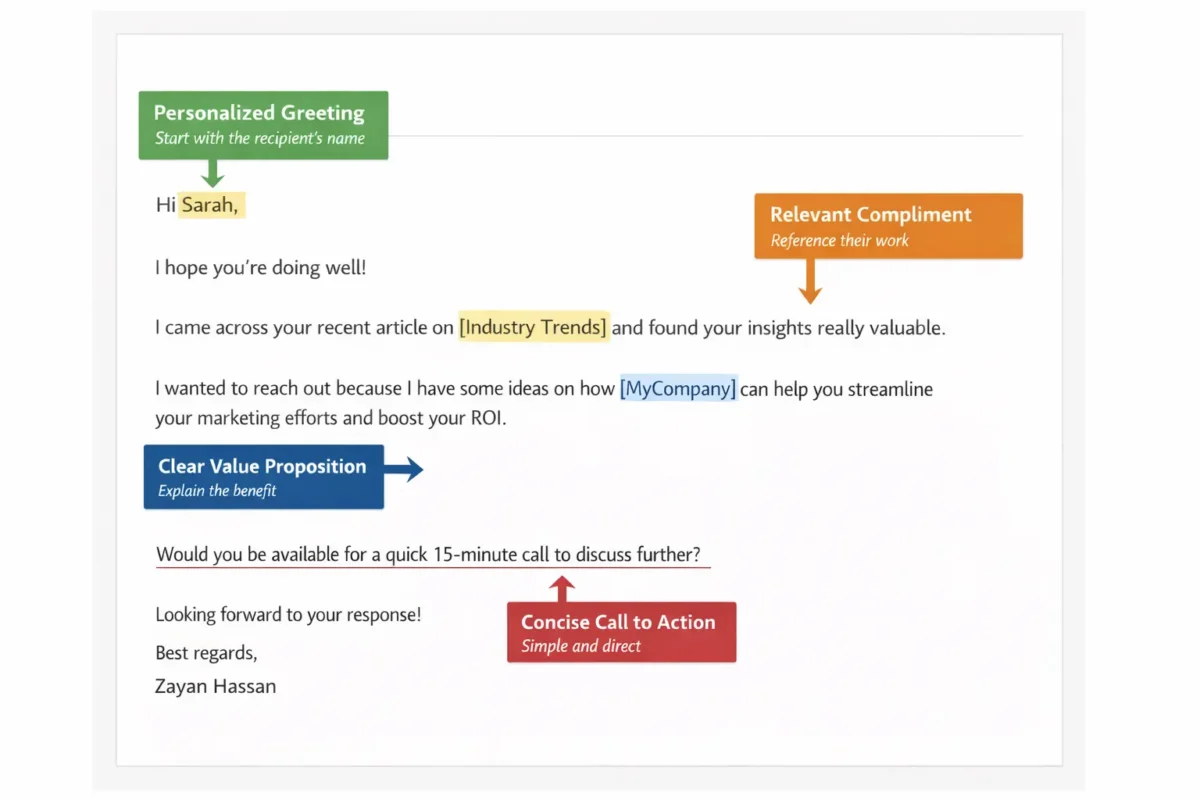
Step 5: Crafting the Outreach Email (The Pitch That Gets Replies)
Keep it short, specific, and value-first.
A simple structure that works
- Subject line: relevant and non-salesy
- Custom opener: mention the exact page/content
- Value proposition: what improves for them
- Proof: why your resource can be trusted (showing expertise and trustworthiness)
- CTA: one clear next step
Example CTA options:
- “Would you be open to reviewing it as a potential addition?”
- “If it’s a fit, I can send a suggested snippet to make it easy.”
- “Should I reach out to someone else on your team instead?”
🎯Outreach in Action: For updating existing articles, we often get links by offering a short 2–3 line addition that fits the article’s style. Editors like it because it saves them time.
Step 6: Follow-Up Strategies That Increase Success (Without Being Annoying)
Most wins happen in follow-ups, not the first email.
Recommended follow-up sequence:
- Follow-up #1: 3–5 days later (add a small new detail/value)
- Follow-up #2: 3–5 days later (new angle or simplified ask)
- Optional follow-up #3: politely finish the conversation.
The rule:
Never “circling back.” Always add something new:
- A better angle
- A specific suggestion
- A different resource
- A short snippet they can paste.
Step 7: Keep Your Promise & Get the Link
Once they say yes, speed + quality matters.
Tips for best results:
- Deliver quickly (within the timeline you promised)
- Keep formatting clean
- Confirm the anchor + URL are correct
- Verify link type (dofollow/nofollow) and placement context.
🎯Outreach in Action: We’ve turned one-off placements into ongoing partnerships simply by delivering fast, clean, editor-friendly content. Reliability compounds as more links are added over time.
Step 8: Tracking, Reviewing, and Improving
If you don’t track, you can’t improve.
What to track (the basics you need):
- Prospect URL + type
- Contact + email
- Date sent + follow-ups
- Opens + replies
- Outcome (yes/no/maybe)
- Link URL once live
- Impact (rankings/traffic lifts over time).
Use your results to improve:
- Low opens → test subject lines
- Low replies → improve targeting/personalization
- Lots of “no” → refine value proposition
- Links not helping rankings → make sure your links are closely related to your topic and fit well on the page.
Essential Tools for Streamlined Link Building Outreach
Leveraging Technology for Efficiency and Effectiveness (Without Sacrificing Quality)
Outreach gets messy fast when you’re juggling prospect lists, contact research, email sequences, follow-ups, and link tracking across multiple campaigns.
The real goal isn’t to automate just for the sake of it. It’s about setting up a system where tools handle the boring, repetitive tasks so you can focus on what matters: picking the right targets, making your messages personal, and building real relationships. That’s how you keep things honest, protect your brand’s reputation, and get links that actually help your rankings.
Below is the exact set of tools I recommend (and how to use them correctly) as someone who works in Off-Page SEO and outreach.
Where Each Tool Fits in the Outreach Workflow
Quick overview (so you don’t buy tools you won’t use)
- Prospecting & opportunity discovery: Ahrefs, Semrush
- Finding + verifying contacts: Hunter.io, Snov.io
- Campaign execution + follow-ups: BuzzStream, Mailshake
- Tracking + collaboration: Google Sheets, Airtable
- Pitch assets (visuals): Canva, Visme
- Copy quality control: Grammarly, Hemingway Editor
1) Ahrefs: Your Prospecting and Link Intelligence Engine
Use Ahrefs when you need clarity on who links, why they link, and what you can offer that’s better.
Best use cases in outreach
- Competitor backlink analysis: Find sites already linking to similar content (warm opportunities).
- Backlink gap research: Find websites that link to your competitors but not to you.
- Broken link identification: Spot dead outbound links and replace them with your resource.
- Content gap insights: See what topics in your niche get linked to often (and what your site is missing).
How it integrates into your workflow (practical steps)
- Pick 2–3 top competitors ranking for your target pages.
- Find their most linked pages and the websites that link to them.
- Sort your prospects by how relevant and high-quality they are (don’t go after every site with a high authority score).
- Build an outreach angle:
- “Your page links to an outdated resource. Here’s a stronger replacement.”
- “You referenced this stat. Here’s a newer dataset you can cite.”
💡Ethical note: Ahrefs is a research tool, not a shortcut tool. The win comes from how you translate insights into a helpful pitch.
2) Semrush: Competitive Insights + Content Marketing Opportunity Finder
Semrush is similar to Ahrefs, but it’s better when you want a bigger picture of your marketing, especially if outreach is just one part of your overall content plan.
Best use cases in outreach
- Competitor analysis: Identify who’s winning visibility and what content earns mentions.
- Site audits: Identify technical issues before building links to weak pages.
- Keyword and topic discovery: Create content that naturally gets mentioned and linked to.
How to use it alongside Ahrefs
- Use Ahrefs to understand “who links and where.”
- Use Semrush to see what types of content help you grow and to check if an idea is worth pursuing.
If you’re watching your budget, start with just one tool (Ahrefs or Semrush), then add more later.
3) Hunter.io / Snov.io: Contact Discovery + Deliverability Protection
Finding emails is easy. Finding the right emails (and making sure your messages don’t bounce back) is what keeps your sender reputation safe.
What these tools do well
- Identify corporate email formats (e.g., firstname@domain.com).
- Locate decision-makers (editors, content managers, marketing leads).
- Verify email validity to reduce bounces.
Why verification matters (don’t skip this)
- Fewer bounces → better deliverability.
- Better deliverability → more inbox placement
- More inbox placement → more replies
- More replies → more links (without spamming)
💡Best practice: If you’re seeing bounce rates creep up, slow down and re-verify. Deliverability is a long game.
4) BuzzStream / Mailshake: Outreach Operations (Campaigns, Follow-ups, Responses)
Once your list gets bigger than 30 to 50 people, doing outreach by hand is no longer practical. That’s when outreach platforms are most useful if you use them the right way.
BuzzStream (strong for relationship-based outreach)
- Organizes prospects by domain/contact
- Notes, tags, relationship history
- Reminders to follow up and work with your team
- Great for ongoing partnerships (guest posts, niche edits, PR relationships)
Mailshake (strong for sequence-driven outreach)
- Email sequences + follow-up automation
- Personalization fields (when your research is solid)
- Track replies and see how well your emails are doing
💡Ethical outreach rule: Automate the sending, not the thinking. If your emails read like templates, you’ll get template-level results.
Expert Tip: Track Everything Meticulously (This Is Non-Negotiable)
Outreach success is often invisible until you track it properly.
At minimum, track:
- prospect URL + domain
- contact name + email
- outreach angle (resource, niche edit, guest post, broken link, PR)
- dates: sent + follow-ups
- status: no reply / replied / negotiated / live link
- final link URL + anchor text + target page
💡Tools like BuzzStream and Mailshake help, but your tracking system should be easy to check and download. That’s how you keep your results safe and keep winning.
5) Google Sheets / Airtable: Your Central Control Panel
Even if you use BuzzStream or Mailshake, I still recommend keeping a clean “master tracker.”
Google Sheets (simple, fast, universal)
- Great for early-stage campaigns
- Easy collaboration
- Flexible filtering and segmentation
Airtable (powerful when you scale)
- Database-style setup (better than spreadsheets for tracking many campaigns at once)
- Better ways to see your data (like boards, calendars, and custom dashboards)
- Easier to sort by campaign type and status
Recommended segmentation fields
- Campaign type (guest post / niche edit / PR / resource)
- Authority level (for example, 20–40, 40–60, or 60+)
- Relevance score (high, medium, or low)
- Status stage (queued, sent, follow-up, won, live)
6) Canva / Visme: Visual Assets That Increase “Yes” Rates
A surprising outreach advantage: good visuals make things easier.
Use Canva/Visme to create:
- infographics for guest posts
- custom charts from your data
- simple visual summaries (like quick stat cards)
- featured images that editors can use immediately
This works because you’re not just asking for a link, you’re giving them something that makes their content better.
7) Grammarly / Hemingway Editor: Clean, Confident Outreach Copy
Editors and site owners respond to clarity.
- Grammarly: catches mistakes, tone problems, and awkward wording.
- Hemingway: makes you write simply, with shorter sentences and clearer structure
Quick standard for outreach emails
- 80–150 words (usually enough)
- 1 clear request (don’t ask for too many things at once)
- 1 clear value point (why it helps them)
- 1 call to action (simple next step)
A Simple “Tool Stack” Setup for Beginners
If you’re starting from scratch, here’s a practical, budget-aware stack:
- Ahrefs or Semrush (pick one) → prospecting
- Hunter or Snov → email discovery + verification
- Google Sheets → tracking
- Grammarly → copy cleanup
- Add BuzzStream or Mailshake once volume increases.
Common Outreach Mistakes to Avoid: Learning from Pitfalls
Navigating the Minefield: What Not to Do (and What to Do Instead)
If outreach feels unpredictable, it’s usually not because you need better templates. It’s because a few common mistakes quietly ruin your chances of getting emails delivered, trusted, and taken seriously before your pitch even gets a fair shot.
Below are the biggest mistakes I see (and the fixes I use as someone who works in SEO and outreach), with a strong focus on honest, helpful link building that follows Google for Developers.
1) “Spray and Pray” Outreach
What it looks like: Sending the same email to over 200 sites with little or no personalization.
Why it fails:
- Low relevance = low replies
- Lots of emails bouncing back or not getting replies makes your email address look bad, so your future emails end up in spam.
- Editors can spot generic outreach instantly, so even good offers get ignored.
Do this instead (simple fix):
- Start smaller: 30–60 highly qualified prospects per campaign.
- Personalize the first 1–2 lines based on something real (a specific page, section, or missing resource)
- Group your lists by the type of outreach you’re doing (e.g., resource page, link update, guest post, or broken link fix).
🎯Outreach in Action: One well-researched list of 40 niche-perfect prospects consistently beats a list of 400 “maybe” sites because relevance creates momentum.
2) Targeting the Wrong Sites (Off-Niche or Mismatched Authority)
What it looks like: Sending software content to a food blog, or asking very high-authority sites to link to a short, basic guide.
Why it fails:
- You waste time on prospects who can’t say “yes” logically.
- You damage credibility when the request doesn’t fit their audience.
- You miss easy wins from mid-tier sites that actually need your resources.
Do this instead:
- Create a simple checklist for choosing who to contact:
- Topic match (they have the same audience or problems)
- Good quality content (real posts, real authors, and regular updates)
- Make sure your content is as good as what’s already on their site.
3) Treating Outreach Like a Transaction (Not a Relationship)
What it looks like: “Hi, add my link?” with no context, no benefit, no collaboration.
Why it fails:
Editors are not just there to give out links. Real outreach is more like working together: you’re helping them improve a page, update something, or add something truly useful.
💡Expert Tip: Focus on Relationship Building, Not Just Link Acquisition.
The best outreach results compound when you:
- Share helpful insights even if they don’t link.
- Offer a ready-to-use snippet.
- Recommend a fix (broken link, outdated stat, missing resource).
4) No Follow-Up (Quitting After One Email)
What it looks like: Sending one email, then moving on.
Why it fails:
People miss emails. Inboxes are crowded. Most outreach wins happen after follow-up #1 or #2.
Do this instead:
- Use a light follow-up sequence: 2–3 follow-ups, spaced 3–5 days apart.
- Each follow-up must add new value (not “just checking in”):
- alternative angle
- shorter ask
- paste-ready snippet
- new supporting data point
💡Power of Persistence: A polite follow-up isn’t annoying when it’s useful; it’s professional.
5) Weak or Missing Value Proposition
What it looks like: Asking for a link to content that’s average, outdated, or not clearly better than what they already have.
Why it fails:
You can’t get links through outreach if your content isn’t good enough to be link-worthy.
Do this instead:
Before outreach, make sure your asset is:
- Genuinely helpful and specific (not generic)
- Easy to read quickly (well organized)
- Trustworthy (shows sources, proof, and examples)
- Updated (or clearly marked with dates)
Google repeatedly emphasizes creating helpful, people-first content, the same principle that earns natural links and makes outreach easier. (Google for Developers)
6) Using Black-Hat or Manipulative Link Tactics
What it looks like: Buying links that help in rankings, excessive use of too many links, using software to create links, or paying for guest posts without marking them properly.
Why it fails (and why it’s not worth it):
Google explicitly calls out link spam as links created primarily to manipulate rankings, such as buying/selling links for ranking purposes, excessive link exchanges, and automated link creation.
Safe alternative:
When money is exchanged, such as for ads or sponsorships, Google recommends qualifying links with rel=”nofollow” or rel=”sponsored” to avoid passing ranking credit. (Google for Developers)
If you want long-term results, build links you’d be comfortable explaining publicly: links you earned by being helpful, relevant, and high quality.
7) Not Tracking Results (So You Can’t Improve or Prove ROI)
What it looks like: Trying to keep track of outreach just by using your inbox and memory.
Why it fails:
Without tracking, you can’t answer:
- Which subject lines got opens
- Which segments replied the most
- Which angles converted into links
- How outreach impacted rankings/traffic over time
Do this instead:
Track at minimum:
- prospect + URL + niche
- outreach angle (resource/niche edit/guest post/broken link)
- dates sent + follow-ups
- status (no reply / replied / won / live)
- live link URL + target page
This is how you turn outreach from random lucky breaks into something you can do successfully again and again.
8) Not Knowing When to Give Up (Gracefully)
What it looks like: chasing unresponsive or poor-fit prospects too long.
Why it fails:
It wastes time and can make people think less of your brand.
💡Expert Tip: Know When to Give Up (Gracefully).
A clean rule:
- If there’s no response after 2–3 value-driven follow-ups, archive it
- If the site feels irrelevant or low-quality, don’t force it; refine your targeting instead.
End things politely with a friendly message. Leaving on good terms protects your reputation and keeps the chance for future relationships.
Measuring the Success of Your Outreach Efforts: Proving ROI
Beyond Just Backlinks: Understanding the Full Impact
If you don’t measure outreach properly, it’s easy to fall into one of two traps:
- You celebrate links that don’t actually move anything, or
- You assume outreach “doesn’t work” because you’re only looking at backlinks.
In my campaigns, I track outreach like a step-by-step process: email, then conversations, then links or mentions, then results for SEO and the business. Here’s how to do it in a simple way.
The Outreach ROI Scorecard (What to Measure)
| Metric | What It Tells You | How to Calculate / Track | Why It Matters |
| Open Rate | Subject line + deliverability health | Opens ÷ delivered | Low opens usually mean boring subject lines or problems getting emails to people |
| Response Rate | Targeting + relevance + personalization quality | Replies ÷ delivered | The best leading indicator of outreach quality |
| Click-Through Rate (optional) | Interest in your asset (if you included a link) | Clicks ÷ delivered | Helpful, but not needed since many editors respond without clicking. |
| Link Acquisition Rate | Efficiency of turning pitches into links | Links secured ÷ delivered (or ÷ replies) | Your core “conversion rate” for link building |
| Backlink Quality | Whether links are likely to help | Relevance + placement type + traffic signals | One strong link is better than ten weak ones. |
| DA/DR Trend (directional) | Authority growth over time | Track monthly in Ahrefs/Semrush | Don’t worry about daily ups and downs; focus on the overall trend. |
| Keyword Movement | SEO impact on target pages | Track target keywords weekly | Confirms whether link building supports rankings |
| Organic Traffic Growth | Whether SEO gains translate into visits | GA + GSC | The KPI most stakeholders understand |
| Referral Traffic | Direct value from new links | GA referral reports, UTMs if applicable | Helps prove value even before rankings move |
| Brand Mentions / Social Shares | PR-like impact beyond links | Alerts + social monitoring + manual checks | Mentions build trust and can lead to future links |
Step-by-Step: How to Set Up Measurement (Simple + Reliable)
Step 1: Track email performance inside your outreach system
Whether you use a CRM (BuzzStream/Mailshake) or a spreadsheet, log these per campaign:
- delivered
- opens (if available)
- replies (positive / neutral / negative)
- follow-ups sent
- meetings/calls booked (if relevant)
Quick interpretation rules
- Low open rate → subject lines or deliverability problem
- Good opens, low replies → messaging or targeting mismatch
- Good replies, low links → weak offer/asset, unclear next step, or slow fulfillment
Step 2: Track link acquisition like a funnel (not a tally)
I recommend tracking two link acquisition rates:
- Campaign Link Rate = links secured ÷ emails delivered.
- Conversion from Conversation = links secured ÷ positive replies
This tells you whether the issue is:
- getting attention (top of funnel), or
- Closing the deal (mid-to-bottom funnel).
Step 3: Measure SEO impact in Google Search Console + Analytics
Use Google Search Console to validate SEO outcomes:
- target page impressions and clicks
- average position for target queries
- query growth over time (branded and non-branded)
Use Google Analytics to validate business outcomes:
- organic sessions trend (sitewide + landing-page level)
- referral traffic from placed links
- assisted conversions (if your setup supports it)
💡Pro tip: Measure results for each page, not just the whole website. Outreach often helps certain pages first.
Step 4: Track backlink growth and quality in Ahrefs/Semrush
Use these tools for:
- new/lost links (velocity matters)
- signs that the websites linking to you are high-quality
- anchor text distribution (keep it natural)
- Comparing your link growth to your competitors
💡Important: DA and DR are scores from outside tools. Use them as a rough guide, not as the only way to measure results.
Your “Outreach Tracker” Template (What Columns to Include)
If you’re using Google Sheets/Airtable, here’s a practical column set:
Prospect
- Domain
- URL of target page (where the link would go)
- Contact name / role
- Prospect type (guest post / niche edit / resource / PR mention)
- Relevance tier (High/Med/Low)
- Authority tier (e.g., 20–40 / 40–60 / 60+)
Outreach
- Outreach angle (broken link, update, resource add, etc.)
- Date sent
- Follow-up #1 date
- Follow-up #2 date
- Status (Sent / Replied / Negotiating / Won / Live / Closed)
Outcome
- Link live URL
- Target URL (your page)
- Anchor text
- Link attribute (follow/nofollow/sponsored)
- Referral traffic (30/60/90 days)
- Notes (details about your relationship with the contact)
Attributing Value: How to Prove ROI Without Overpromising
Backlinks don’t have a universal dollar value, but you can assign a sensible value using two angles:
1) Estimated traffic value (conservative, performance-based)
Use:
- referral traffic from the link (GA)
- organic traffic lift on the target page (GA/GSC)
- conversions attributed to those sessions (if tracked)
This is the cleanest ROI story because it’s based on measurable outcomes.
2) Strategic value (brand, visibility, and building good relationships)
Some outreach wins are valuable even without a direct link:
- brand mentions in respected publications
- relationships with editors that lead to repeat placements
- invitations to contribute, partnerships, podcast features, roundups
These benefits reduce future outreach costs and increase acceptance rates over time; that’s real ROI, even if it doesn’t show up as “link acquired” on day one.
What “Success” Usually Looks Like in Practice
Instead of chasing a single benchmark, aim for improvement cycle over cycle:
- open rate rises as deliverability + subjects improve
- Response rate rises as targeting + personalization improve.
- link rate rises as your offer and fulfillment tighten
- organic/referral impact rises as you build more relevant authority
The point is not just “more links.” It’s more outcomes per hour spent, rankings, traffic, trust, and relationships.
Conclusion: Your Path to Link Building Mastery
The Future of Your Website’s Authority Starts Now
Effective link-building outreach isn’t about sending more emails; it’s about building a system that consistently earns trust.
If you remember one thing from this guide, let it be this: the internal links help your rankings over time almost always come from careful planning, personal messages, honest actions, and ongoing improvement.. When you think about outreach this way, you stop just looking for links and start building real authority.
The principles that make outreach work (and keep it white-hat)
- Smart planning: clear goals, the right resources, and practical targets
- Precision prospecting: relevance first, authority second
- Personalized communication: earn attention by proving you understand their site and audience
- Ethical practices: no tricks, just outreach that gives real value and follows the rules
- Continuous improvement: track results, learn from patterns, and refine each campaign
And yes, high-quality relevant backlinks are still essential in modern SEO. They are not just signs for rankings. They are like recommendations that help your site get noticed, trusted, and perform better in search results when you earn them the right way.
Outreach isn’t a campaign. It’s an asset.
One of the biggest differences between average and top outreach is what they aim for:
- Average outreach focuses on transactions (get the link, move on).
- Great outreach focuses on building relationships (earn trust, create more chances to work together).
When you build genuine relationships with editors, site owners, and content managers, you get more than just one link. You also get access to:
- faster placements in future campaigns
- easier collaboration on guest posts and niche edits
- chances to get your brand mentioned online
- a stronger reputation within your niche
That’s how outreach compounds.
What to do next (start today)
Don’t wait until everything feels perfect. Start by applying one actionable step immediately:
- Build a small, high-quality prospect list (30–50 sites).
- Pick one truly link-worthy asset.
- Write 10 highly personalized emails.
- Track outcomes and iterate.
Small, consistent execution beats “big outreach plans” that never go live.
Your turn
I’d love to hear where you’re at right now:
- What’s your biggest outreach challenge: finding prospects, getting replies, or earning placements?
- Or if you’ve had a win recently, what worked?
Drop your successes in the comments. There’s a lot you can learn from real campaigns. And if you want to learn more, look into advanced guides and tools to reach more people or improve your messages. If you need extra help, working with outreach experts can also help you get better results, especially if you want strong, trustworthy links that last.