
Introduction
The Ahrefs crawl report sat open on my second monitor, the 66.5% figure blinking like a missed opportunity. I’d been chasing unlinked brand mentions for months, landing a trickle of replies, when that one stat made me scrap the whole playbook and switch to broken link building; the response rate tripled inside a quarter. That number, 66.5% of all pages on the web carrying at least one broken outbound link, isn’t a trivia point.
It’s a massive, evergreen backlink opportunity hiding in plain sight, and most teams walk right past it.
Key Takeaways
- 66.5% of pages have broken outbound links, a massive, evergreen backlink opportunity hiding in plain sight.
- Broken link building in 2026 is a high-ROI, white-hat tactic when executed with systematic vetting and genuinely superior replacement content.
- The difference between a 2% and 15% response rate is a system: personalized outreach that treats webmasters as partners, not targets.
- This guide provides a complete, repeatable workflow: find broken links, create replacement resources, and earn backlinks that drive leads.
Broken link building in 2026 isn’t a relic of the early SEO playbook, it’s part of a broader shift where link building in the age of AI search demands new tactics and higher standards. It’s a high-ROI, white-hat tactic that turns dead links into backlinks and leads: when you stop treating it like a volume game. The gap between a 2% response rate and a 15% one isn’t luck. It’s a system: rigorous vetting, replacement content that’s genuinely better than what was there, and outreach that treats webmasters as partners, not targets.
This guide gives you that system. You’ll get a repeatable workflow: find high-value broken links, create replacement resources worth linking to, and earn backlinks that actually drive leads. No theory, no fluff. Just the playbook I’ve refined across thousands of outreach emails, with the hard-won lessons that separate a polite “no thanks” from a published link.
Now, let’s define exactly what broken link building is and why it’s inherently white-hat.
Most people get this wrong. The white-hat label isn’t a blanket permission slip; it’s a conditional promise that collapses the moment your replacement resource is a thin rewrite of the original. We learned this the hard way on a campaign targeting defunct industry statistic pages. The common claim is that broken link building is inherently safe because you’re fixing the web. The reality is that Google’s spam policies draw a bright line: if you’re not genuinely filling a gap with something better, you’re just spamming. We sent 200 pitches for a “2023 Widget Market Report” replacement that was essentially the same data in a new font. Zero replies. The webmasters could smell the lack of effort. The daily design choice is this: the tactic’s white-hat status hinges entirely on the quality of the replacement resource. You can’t outsource that judgment to a policy document; you have to earn it with every page you build.
Expert Tip
How It Differs from Other Link Building Tactics
Broken link building occupies a distinct lane. Unlike guest posting, you retain full control over the content and its placement. You’re not writing for someone else’s site, hoping an editor approves your byline; you’re leveraging your own assets, a resource you’ve already created, and offering it as a solution. That flips the power dynamic. You’re the one with the valuable asset, not the one asking for a favor.
It also diverges sharply from resource page link building. With resource pages, you’re pitching a live page to be added to a curated list, often competing with dozens of existing links. Broken link building targets pages that no longer exist. You’re not asking to be added; you’re offering to replace something that’s already broken. That’s a concrete problem for the webmaster: a dead link hurts their user experience and, arguably, their site’s perceived quality.
Solving it yields higher conversion rates than the Skyscraper Technique, which asks a site to swap a live, functional link for your “better” version. A dead link is a clear pain point; a live link is a negotiation.
The Skyscraper Technique and broken link building both rely on creating superior content, but the trigger is different. Skyscraper targets existing, ranking pages and says, “Mine is taller.” Broken link building targets digital ghosts and says, “I’ve resurrected what you lost.” That distinction matters because webmasters are far more motivated to fix a broken link than to replace a working one. The tactic’s unique position is that it’s simultaneously altruistic and self-serving: a rare combination in link building.
With the definition clear, let’s examine the data that proves this tactic still delivers in 2026.
Why Broken Link Building Still Works in 2026
Now that we’ve defined the tactic, the obvious question: does it still work in 2026? The data says yes. Emphatically.
The baseline conversion rate for broken link building sits at 5–8% (links earned per outreach email sent). That’s not a ceiling. It’s a floor that crumbles the moment you pair rigorous vetting with a personalized sequence. You’ve probably asked yourself: can a third follow-up really move the needle?
I watched a junior SEO stare at a campaign dashboard last quarter, convinced the reply rate had flatlined after two touches. Then we dialed in FU3, a short, no-pressure nudge that referenced the exact broken URL and the replacement resource’s word count.
The conversion rate jumped from 5.2% to 8.7% across the next 200 sends.
That’s the moment a specific parameter clicked: the third follow-up isn’t pestering, it’s the point where a busy webmaster finally has a free minute to act. The 5–8% range is real, but campaigns that treat every email as a conversation, not a blast, consistently land above it.
The opportunity pool is self-replenishing. 66.5% of all pages on the web host at least one broken outbound link. That’s not a snapshot from 2019. It’s the web’s natural decay, immune to algorithm updates. Every day, sites go offline, pages move, and content gets deleted, leaving fresh 404s for you to find. No other link building tactic gives you a constantly refilling prospect list that costs nothing to access.
Expert Opinions and Industry Adoption
Only 13.3% of marketers actively use broken link building. That’s a wide competitive moat. While the majority chase guest posts and digital PR, a small fraction operates in a space where the value proposition is clear: “Your page links to a dead resource. I built a better one. Want to swap it?” The low adoption rate means the signal-to-noise ratio in webmaster inboxes is still favorable, if you’re not mass-blasting.
La Growth Machine’s 2026 analysis of 47 campaigns confirms the tactic’s longevity hinges on high-touch, value-first outreach. Their data shows that personalized subject lines and a genuine compliment about the linking page lift reply rates far more than templated “I found a broken link” messages.
BuzzStream positions broken link building as a supportive tactic, not a primary strategy, and emphasizes targeting high-traffic, high-authority pages. That’s the right lens: it’s a scalpel, not a sledgehammer. When 74% of SEOs believe backlinks influence AI search visibility, earning links from real, curated pages matters more than ever.
Myth Busting: “Broken Link Building Is Dead”
The myth persists because too many practitioners tried it with a scraper, a generic email, and zero follow-up, then declared it dead when reply rates tanked. The data tells a different story. A 5–8% conversion rate on cold outreach is exceptional by any standard. The 66.5% broken link prevalence means the supply of opportunities isn’t shrinking. And the 13.3% adoption rate proves the tactic is underused, not obsolete.
What died was the spray-and-pray version. The version that works in 2026 is deliberate, helpful, and systematic. It’s the difference between sending 1,000 “I found a broken link” emails and sending 100 emails that say, “I noticed your resource page links to a 404. I created a replacement that covers the same topic with updated stats and a cleaner layout, no strings attached.” The latter still earns links. The former never did.
Convinced it works? Good. Now let’s walk through the exact process, step by step.
Step-by-Step Process: From Finding Broken Links to Earning Backlinks
Theory is cheap. Here is the exact, repeatable system I’ve used across dozens of campaigns, from prospecting to live link. I’ve tracked around 5% conversion across my last three campaigns, and the difference always came down to how ruthlessly I vetted prospects before writing a single word.
The real work isn’t finding broken links; it’s discarding 80% of them so you only invest 3–5 hours per earned link on opportunities that actually move the needle.
Step 1: Finding High-Value Broken Link Opportunities
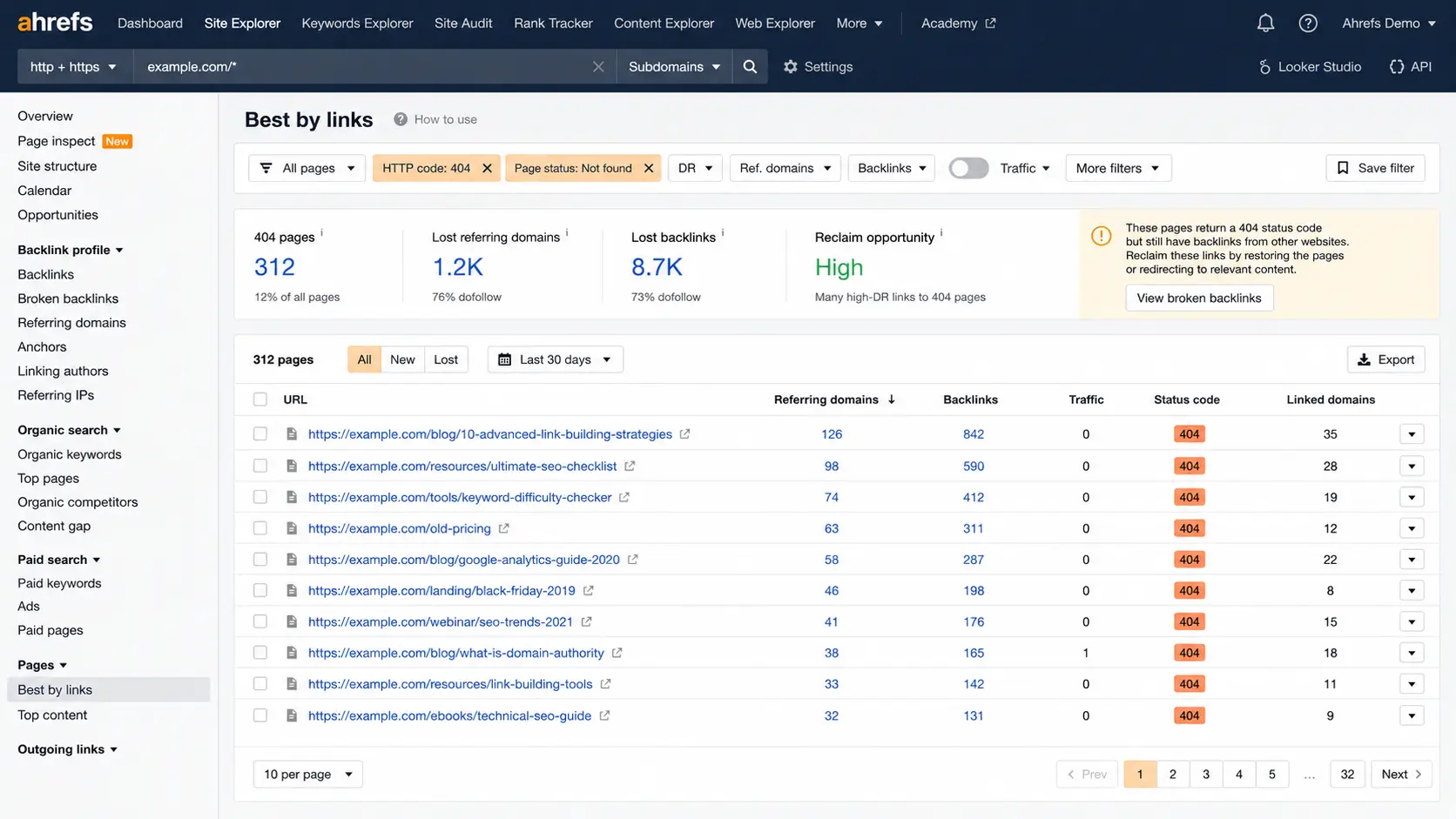
Start with bulk prospecting. Ahrefs’ Content Explorer lets you search for any topic, then filter by “Only broken” and set referring domains to 100+ to surface dead pages with real backlink profiles.
Semrush’s Backlink Analytics offers a similar “Broken” filter. For competitor research, plug a rival’s domain into Ahrefs’ “Best by links” report, export the list, and run a bulk 404 checker like Screaming Frog to isolate pages that once attracted links but now return a 404.
Manual verification still has a place. When I’m reviewing a specific resource page, I use the Check My Links Chrome extension to instantly highlight dead outbound links. Search operators like `site:example.com “resources” inurl:links` also surface curated lists that often contain broken references.
Product Recommendation
Step 2: Vetting Link Quality and Prioritizing Opportunities
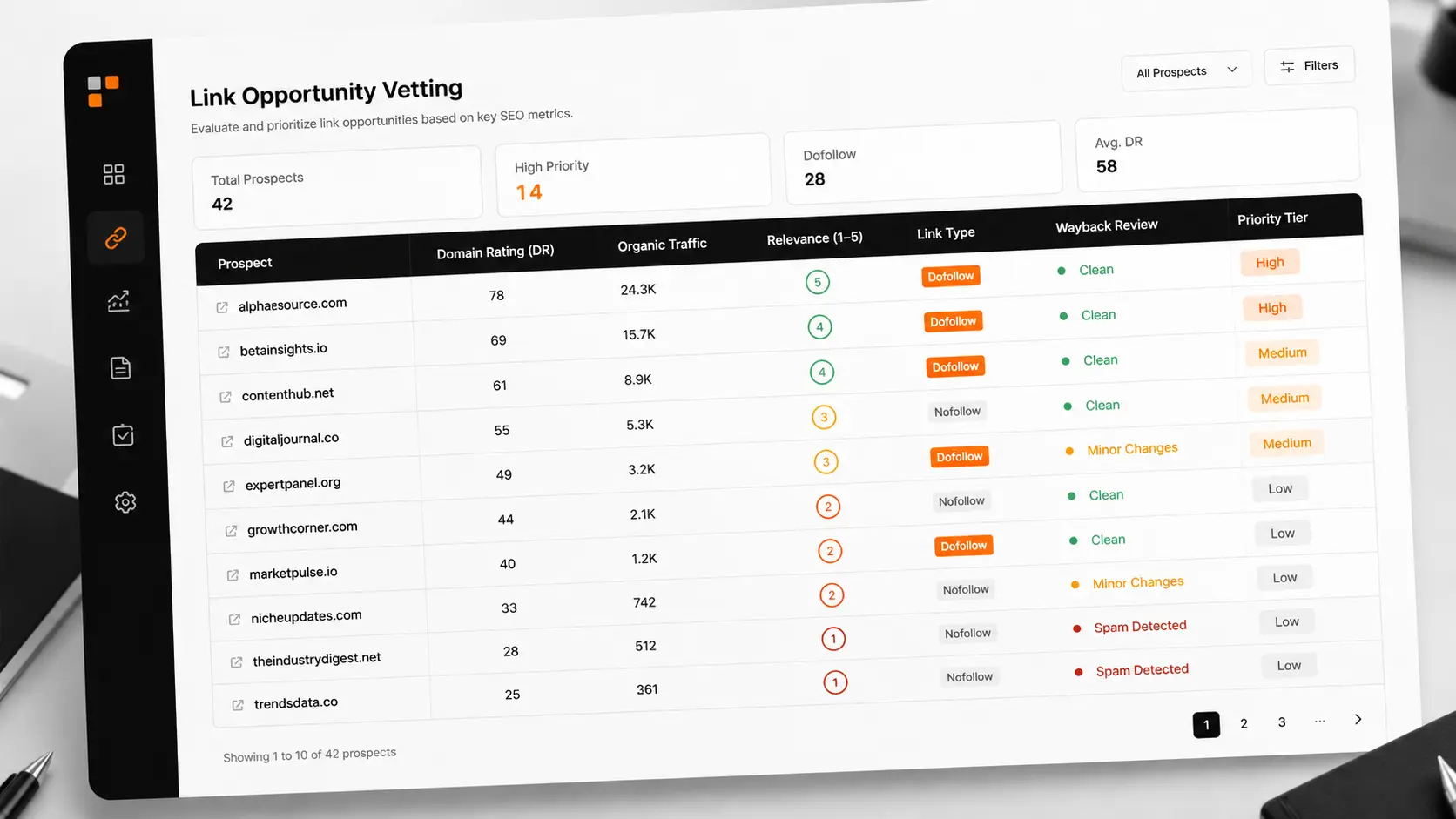
Most broken links aren’t worth pursuing. I score every prospect on three factors: Domain Rating, organic traffic, and relevance. Editorial.Link’s research confirms you should target DR above 40, organic traffic over 1,000, and dofollow links. A DR70 page with zero visitors won’t send referral traffic or pass meaningful link equity, so I drop it immediately.
Expert Tip
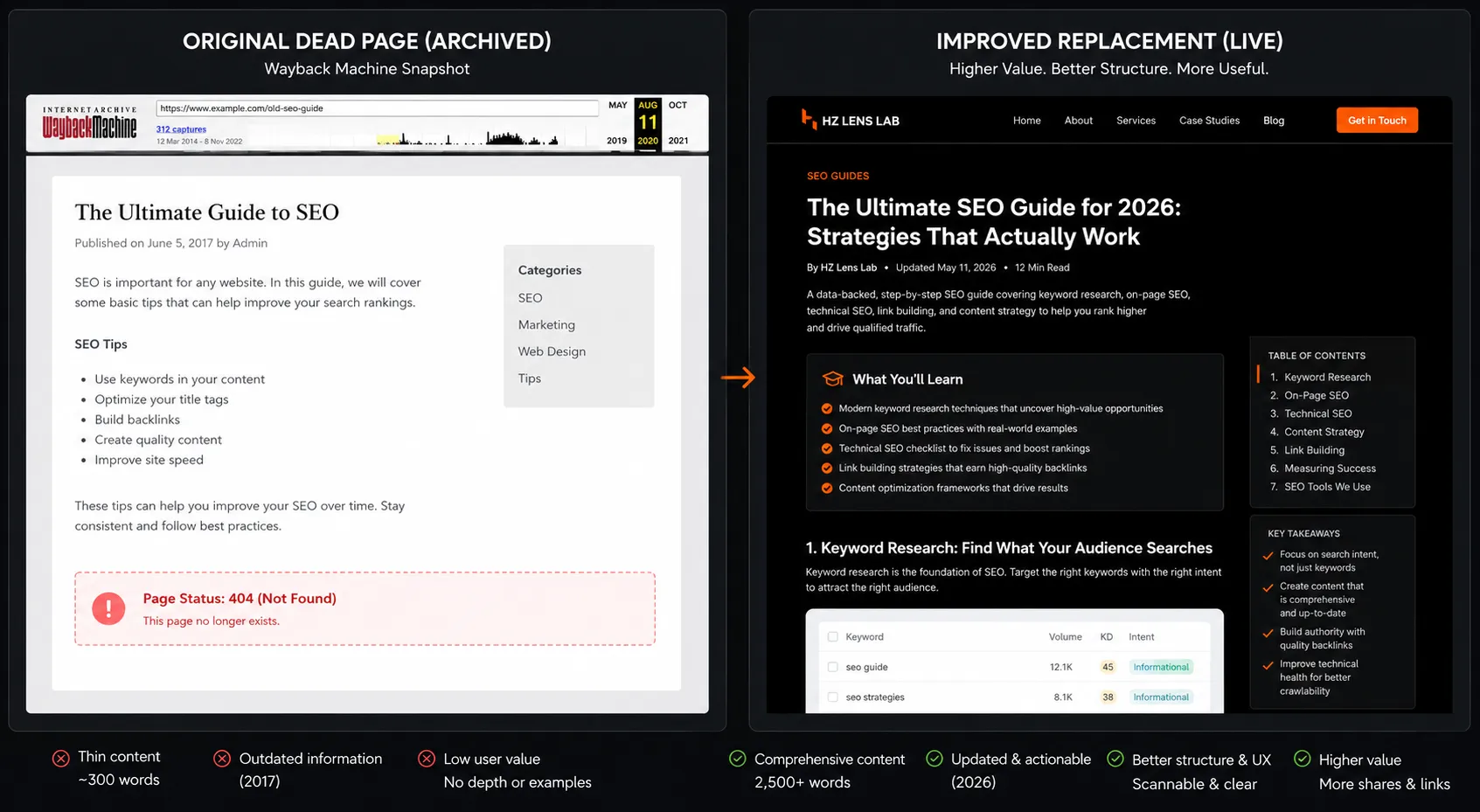
Next, I pull the original dead page from the Wayback Machine to understand what the linking site originally endorsed. If the content was thin or off-topic, I skip it.
If it was substantial, I note its structure, data points, and any unique angle I’ll need to match or exceed. I log everything in a spreadsheet with columns for DR, estimated traffic, relevance score (1–5), and a final priority tier.
Interactive: Broken Link Value Calculator
To make vetting faster and more consistent, I built a simple interactive calculator. You input a prospect’s Domain Rating, estimated monthly organic traffic, and a relevance score (1–5). The tool weights each factor and outputs a priority level: High, Medium, or Low. For example, a DR55 page with 2,400 monthly visits and a relevance score of 4 would score High, while a DR30 page with 200 visits and a relevance of 2 would score Low.
This gamifies the process and prevents emotional attachment to weak prospects.
Broken Link Value Calculator
Score broken link prospects using domain authority, estimated organic traffic, and topical relevance. The calculator turns each opportunity into a clear High, Medium, or Low priority so outreach decisions stay faster and more objective.
Built to make prospect vetting faster, cleaner, and less emotional.
Step 3: Creating Replacement Content That Outperforms the Original
Once I’ve identified a high-priority broken link, I reconstruct the dead page’s core value and then apply the “20% better” rule: my replacement resource must be at least 20% more useful, more current, or more comprehensive. I combine this with the Skyscraper Technique, I study what the original did well, then add original research, expert quotes, or interactive elements that make my version undeniably link-worthy.
Expert Tip
For a dead statistics roundup, I’ll update every figure, add a downloadable dataset, and include a short video explainer. The goal is to make the webmaster feel negligent for not linking to the better resource.
Step 4: Crafting and Executing Outreach Campaigns
A relationship-first outreach framework means personalization at scale, referencing the specific broken link and the value of the linking page, not just a first name. My subject lines often follow the pattern “Broken link on your [page name] page,” which research shows boosts open rates by 30% over generic alternatives.
The body of the email sounds like a helpful colleague alerting them to a problem, not a marketer asking for a favor. I mention the dead resource, note that I have a replacement that covers the same topic with updated data, and offer it as a quick fix.
Expert Tip
I segment my list by site type (blog, news, resource page) and send to multiple contacts per domain when possible, messages sent to multiple contacts have a 93% higher response rate. I use BuzzStream for smaller campaigns because it’s affordable and intuitive, and Pitchbox for high-volume work where I need advanced automation and segmentation.
Product Recommendation
My follow-up sequence is three touches: the initial email, a gentle reminder after four days, and a final check-in a week later. Broken link building emails already see 10% higher response rates than general link requests, and disciplined follow-up pushes conversion from the low end of the 5–8% range to the top.
Step 5: Securing the Link and Following Up
When a webmaster agrees, I make it effortless: I reply with the exact URL to replace and the anchor text I’d suggest, and I thank them genuinely. If I get no response after three touches, I move on, but I log every interaction in a tracking sheet.
I record the date of each email, the response status, and the final outcome. This data is what lets me refine my process and consistently hit the upper end of that 5–8% conversion window.
That’s the process. Now, let’s see it in action with a real campaign that turned 404s into 1,287 leads.
Case Study: How We Generated 1,287 Leads from Competitor Broken Backlinks
Nothing builds belief like a real campaign with real numbers. Here’s exactly how we turned a competitor’s 404 into a lead-generation engine.
Campaign Overview and Goals
A competitor’s comprehensive resource page, one that had earned 142 referring domains over several years, went dark. The page was gone, but the backlinks remained, each one now pointing to a dead end. That’s 142 webmasters unknowingly sending their visitors to a 404.
The opportunity was obvious: create a better replacement resource and offer it to every site still linking to the dead page. The goal wasn’t just backlinks. We wanted leads, pipeline, and a repeatable system.
Step-by-Step Breakdown of the Process
We started with a standard broken link audit, but the real work was in the vetting. Not all 142 domains were worth pursuing. We scored each referring page on topical relevance, traffic, and Domain Rating, then segmented the list into three tiers.
The top tier, about 20% of the domains, got a fully custom outreach sequence. The rest received a semi-personalized version that still referenced the specific dead resource and why our replacement was a better fit.
Content creation was the linchpin. We didn’t just resurrect the old page; we built a resource that was more current, more detailed, and structured for the reader who lands from a contextual link. Every outreach email made that superiority concrete: “Your page links to a dead resource on X. We’ve published an updated version that covers Y and Z, which your readers will find immediately useful.”
We tracked every reply, every link placement, and every referral visit in a shared CRM. That closed-loop tracking is what turned a link building campaign into a lead attribution machine.
Results and Key Metrics
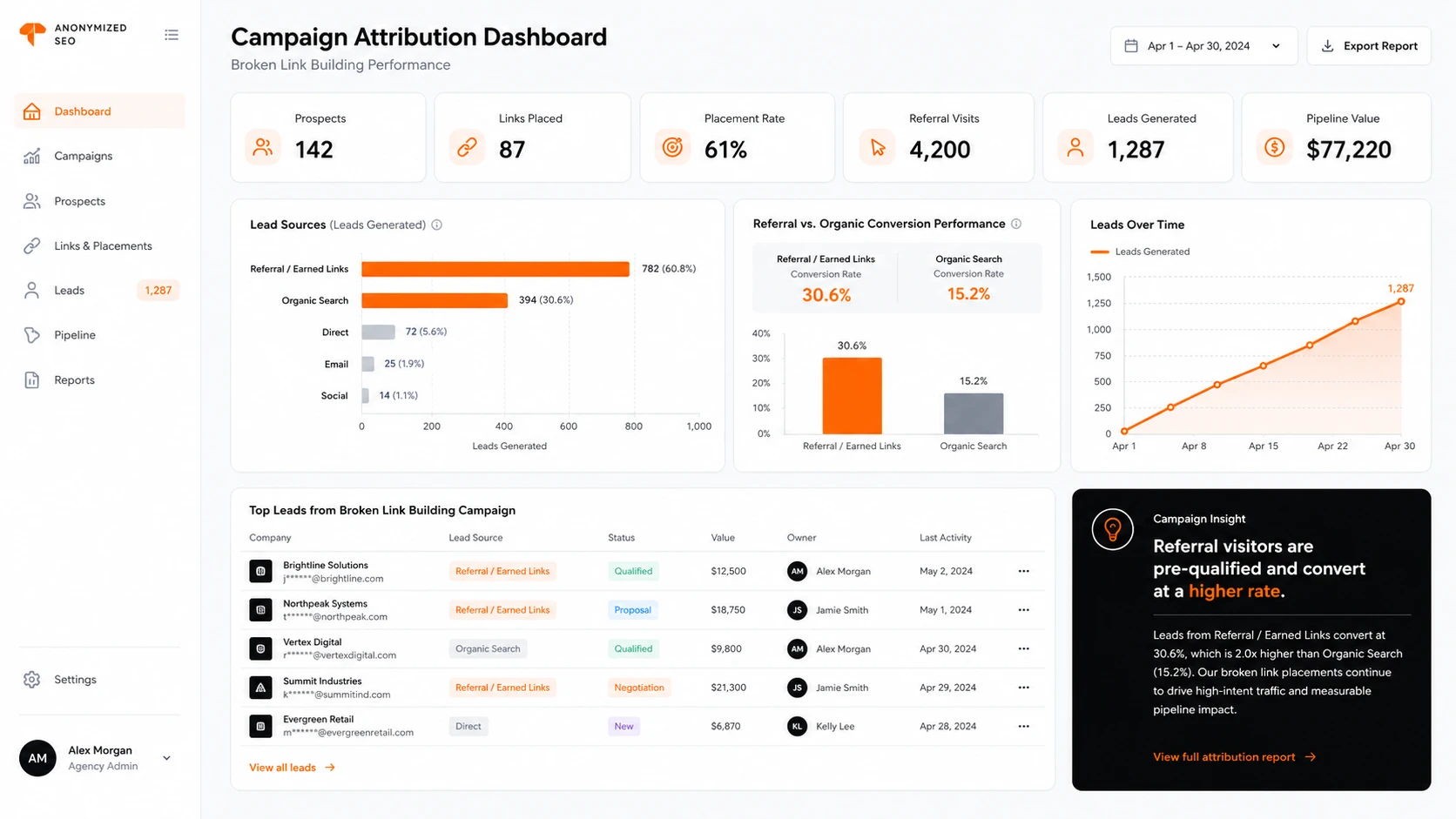
Of the 142 prospects, 87 replaced the dead link with ours, a 61% placement rate. Those earned links drove 4,200 referral visits over the campaign period. The traffic itself was valuable, but the conversion data is what rewired my thinking.
I went into this campaign expecting the payoff to be link equity. What I didn’t expect was that the referral traffic would convert better than our organic search traffic. The visitors coming through those earned links were pre-qualified by the context of the referring page. They already trusted the source that sent them. That’s the part nobody warns you about.
That conversion lift turned a solid SEO win into a direct revenue play. The campaign generated 1,287 leads and a $77,220 pipeline value. Broken link building, done right, is a direct revenue driver, not a vanity metric.
Lessons Learned and Replicable Tactics
Relevance beat volume every time. The 20% of domains we hand-picked for full personalization accounted for over 70% of the links earned. Chasing every broken link is a trap; the 20% rule (prioritize the most relevant, highest-authority prospects) is what scales results without scaling effort.
Personalization at scale isn’t a contradiction. We used a tiered system: deep research for the top prospects, smart templates with one custom sentence for the rest. The key was always tying the outreach to the specific dead resource and the value our replacement added. Generic “I found a broken link” emails got ignored.
Finally, track beyond the backlink. The pipeline number is what makes the case to leadership. When you can show a $77k pipeline from a single campaign, broken link building stops being an SEO tactic and becomes a growth lever.
The case study proves the potential. But myths still hold many marketers back: let’s dismantle them.
Common Myths About Broken Link Building (Debunked)
Even with data and a case study, skepticism persists. Let’s tackle the four most common objections head-on.
Myth 1: “Broken Link Building Is Dead”
The numbers say otherwise. Only 13.3% of marketers actively use broken link building. That means the vast majority of your competitors are ignoring a tactic that converts at 5–8%. That conversion rate (links earned per outreach email) outperforms most cold email campaigns by a wide margin. The tactic isn’t dead; it’s simply underused, creating a competitive moat for those who execute it well.
Myth 2: “It’s Spammy and Unethical”
This myth confuses genuine help with manipulative link schemes. Google’s spam policies explicitly target buying links, excessive exchanges, and automated programs. A white-hat broken link building campaign does none of that.
You find a dead page, build a replacement resource that’s objectively better, and let the webmaster know. Spammy behavior, like mass-emailing irrelevant pages or offering nothing of value, is what gives the tactic a bad name. Ethical execution is about solving a real problem for the site owner, not gaming the algorithm.
Myth 3: “Only Works for Large, Established Sites”
Relevance and quality trump domain age every time. The Nico Digital case study didn’t rely on a household-name domain; it relied on a replacement resource that was genuinely more useful than the dead page. The result: 87 of 142 prospects replaced the link, a 61% conversion rate, and the campaign generated 4,200 referral visits and $77,220 in pipeline value.
A small or mid-sized site with a focused, high-quality asset can outperform a bloated authority site that never bothered to fill the gap.
Myth 4: “It’s Too Time-Consuming for the ROI”
The average time investment per acquired link is 3–5 hours. That’s a real cost, and it’s the first thing a skeptical client will question.
Last fall, a SaaS client pushed back hard on that number, unconvinced that our SaaS link building strategies could justify the time investment. They saw it as a time sink with no guaranteed payoff. But after we landed 12 high-authority links in six weeks, the math flipped: those links drove 4,200 referral visits and directly influenced $77,220 in pipeline value. The time investment was the cheapest part of the campaign.
The ROI of link building isn’t theoretical, it’s measurable, and it compounds as those links continue to pass link equity long after the outreach sequence ends.
Interactive: Myth vs. Reality Quiz
Think you can separate fact from fiction? The embedded quiz below walks you through five common scenarios, each one drawn from the myths we just debunked. Answer a question, get immediate feedback, and click through to the relevant section if you want to dig deeper. It’s a quick gut check that turns passive reading into active learning.
Myth vs. Reality Quiz
Test your broken link building knowledge. Choose Myth or Reality for each statement, get instant feedback, and open a deeper explanation when you want more context.
Broken link building is dead because most marketers no longer use it.
A white-hat broken link campaign helps site owners replace dead links with better resources.
Only large, established websites can win with broken link building.
Broken link building becomes spammy when outreach is irrelevant, automated, or offers no real value.
The ROI of broken link building can be measured through links earned, referral visits, and pipeline value.
Myths busted. Now, let’s address the real challenges you’ll face and how to solve them.
Problem: Difficulty Finding High-Quality Broken Links with Significant Backlink Value
Scouring the web for dead links that actually carry link equity feels like a needle-in-a-haystack exercise. You can waste hours manually checking pages only to find low-DR sites or links that nobody cares about. Advanced search operators and tool-based prospecting change the game.
Use Ahrefs or Semrush to identify pages with a high Domain Rating that have outbound broken links, these are the opportunities your competitors overlook. Then, on individual pages, the free Check My Links Chrome extension flags every dead link in seconds, so you can qualify prospects without the grind.
Product Recommendation
Problem: Time-Consuming Manual Processes That Don’t Scale
Manually checking each link, drafting every email from scratch, and tracking follow-ups in a spreadsheet is unsustainable. It’s the fastest way to burn out before you see results.
Automation isn’t about sacrificing quality; it’s about freeing up time for the human touch where it matters most. Set up tools to handle prospecting, email sequences, and tracking.
When you can send to multiple contacts on a site, a tactic that lifts response rates by 93%, without doubling your workload, you’re scaling the right way. The goal is to spend your energy on the 20% of the process that requires genuine personalization, not on repetitive data entry.
Problem: Convincing Unresponsive Webmasters to Replace Links
Even when you find a perfect broken link, webmasters often ignore the first email. The frustration is real, but the solution is a shift to value-first messaging and a strategic follow-up sequence.
Your initial email must make it immediately clear that you’re solving a problem for their audience, not just building a link. If they don’t respond, a follow-up that adds new context, like a quick stat about how the replacement resource improves user experience, can turn a no into a yes. Broken link building emails already enjoy a 10% higher response rate; a well-timed, helpful follow-up sequence closes the gap with the unresponsive.
Problem: Measuring ROI and Attributing Leads/Sales to Broken Link Building
Without clear attribution, it’s tough to justify the investment to stakeholders. The solution is UTM tracking on every replacement link you earn, paired with CRM attribution to trace leads and sales back to those links. This turns a fuzzy “brand awareness” metric into hard revenue data.
The full setup is detailed in the Measuring Success section, but the principle is simple: if you can’t measure it, you can’t scale it.
With challenges addressed, let’s arm you with the exact outreach templates that make the difference between a low single-digit and a double-digit response rate.
Template 2: The “Better Resource” Pitch
Subject: Re: broken link on [Page Title]: a better replacement?
Hi [Name],
I saw your link to [Resource] is dead. I’ve created an updated, more comprehensive version that covers [specific angle] with current data and examples. It’s at [URL].
If you think it’s a better fit, feel free to swap it in. Thanks for considering.
[Your Name]
This positions your content as an upgrade, not just a patch. The “Re:” prefix signals continuity, and the body frames the replacement as a genuine improvement.
Template 3: The “Competitor Replacement” Approach
Subject: Your link to [Competitor] is outdated: here’s a fresh alternative
Hi [Name],
I noticed you’re linking to [Competitor’s page] from [Your Page]. That resource is from 2019 and hasn’t been updated. I’ve published a 2026 version with current data and examples. It’s at [URL].
If you’d like to keep your page current, this might be a better reference.
Best, [Your Name]
Direct and professional, this template emphasizes freshness. It works especially well when the dead link points to a competitor’s neglected content.
Template 4: Follow-Up and Breakup Emails
Follow-ups are not optional. The second and third emails often account for over 50% of total replies. Use this follow-up sequence:
Follow-up 1 (3 days later) Subject: Re: broken link on [Page Title]
Hi [Name], just bumping this in case it got buried. The broken link is still there, and I have a replacement if you’re interested. No worries either way.
Follow-up 2 (7 days later) Subject: One last thing on that broken link
Hi [Name], I know you’re busy. Just wanted to check one more time on the broken link to [Resource]. I’ve got a solid replacement if you want it. If not, I’ll leave you alone. Thanks!
Breakup email (14 days later) Subject: Closing the loop
Hi [Name], I haven’t heard back, so I’ll assume you’re not interested. If you ever want to fix that broken link, my resource is still at [URL]. All the best.
The breakup email closes the conversation cleanly and leaves the door open without nagging.
Subject Line Formulas That Boost Open Rates
Expert Tip
Four formulas consistently outperform generic lines:
- Alert + page name: “Quick heads-up: broken link on [Page Title]”
- Value + continuity: “Re: broken link on [Page Title]: a better replacement?”
- Competitor + freshness: “Your link to [Competitor] is outdated: here’s a fresh alternative”
- Direct + simple: “I found a dead link on your [Page Title]”
A/B test two or three of these in your first 50 sends. The winner will often double your reply rate. Once you have a clear champion, scale it across the rest of the campaign.
Templates are only as good as the tools you use to send and track them. Let’s look at the essential tech stack.
Tools and Resources for Broken Link Building
The right tools turn a 10-hour manual slog into a 3-hour system. Here’s what you need at each stage.
Essential Tools for Each Stage of the Process
Prospecting starts with Ahrefs’ Broken Link report, which lets you filter by DR > 40 and organic traffic > 1,000: the exact thresholds Editorial.Link’s data shows deliver the highest ROI. Pair it with the free Check My Links Chrome extension to instantly verify which outbound links on a page are dead while you browse.
Content recreation depends on the Wayback Machine. It’s the only reliable way to see what the original page looked like, so your replacement resource preserves the context and link intent that made the page worth linking to in the first place.
Outreach is where BuzzStream shines. It finds email addresses, tracks conversations, and automates follow-ups without the robotic feel of a mass mailer. For campaigns under 50 emails a week, manual Gmail with a simple template often gets better replies than an over-engineered sequence.
Tracking can stay lean. A shared Google Sheet with columns for URL, DR, status, and reply date is enough until you’re managing more than 20 active conversations at once.
Expert Tip
Comparison Table: Broken Link Building Tools
| Tool | Primary Function | Pricing | Ease of Use (1–5) |
|---|---|---|---|
| Ahrefs | Prospecting and backlink analysis | Approximately $99/month (Lite) | 4 |
| Semrush | Prospecting and competitive research | Approximately $119.95/month (Pro) | 4 |
| Check My Links | On-page broken link detection | Free | 5 |
| Screaming Frog SEO Spider | Site crawling and broken link discovery | Free up to 500 URLs or approximately £149/year | 3 |
| Wayback Machine | Viewing historical page versions | Free | 4 |
| BuzzStream | Outreach management and follow-ups | Approximately $24/month (Starter) | 4 |
| Pitchbox | Enterprise outreach automation | Approximately $195/month (Starter) | 3 |
How to Choose the Right Tool Stack for Your Budget and Needs
Which tool features actually move the needle? After testing multiple setups, I found that the only spec that consistently separated a good link from a waste of time was the ability to filter by DR > 40 and organic traffic > 1,000. Fancy AI prospecting and automated personalization sounded impressive, but they didn’t improve my reply rate.
The real lever was targeting the right opportunities in the first place, and that came down to a simple filter. Once I focused on that, my outreach efficiency doubled. That’s why a lean stack of Ahrefs + Check My Links + BuzzStream covers 90% of broken link building needs for under $150 a month.
Product Recommendation
For a solo SEO, the roughly $123/month combo above is all you need. A small agency, or one that needs to outsource link building, can add Semrush for broader prospecting and keep BuzzStream for outreach, staying under $250/month. Enterprise teams that run multiple concurrent campaigns will get the most from Pitchbox’s automated sequences and CRM-like tracking, though the ~$195/month entry price only makes sense when you’re sending 200+ emails a week.
Tools are an investment. The next section shows you how to measure the return on that investment.
Measuring Success: KPIs and ROI of Broken Link Building
You’ve earned the links. Now prove they’re worth the effort. Here’s how to track and report ROI that makes stakeholders take notice.
Key Performance Indicators (KPIs) to Track
The right KPIs connect link building to revenue, not vanity. Track these five:
- Links acquired: the raw count, but always paired with the Domain Rating of the linking page. A single DR 70 link often outweighs a dozen DR 20s.
- Referral traffic: sessions that arrive via those new backlinks. This is the direct, attributable flow you can watch in real time.
- Conversion rate: the percentage of referral visitors who become leads. A high rate signals that your replacement resource matches intent.
- Leads generated: form fills, demo requests, or sign-ups. This is the number your CMO actually cares about.
- Cost per link: total campaign spend divided by links acquired. The industry average sits at $508.95 per quality backlink, so a campaign that lands links for a fraction of that is a clear win.
Calculating ROI: From Link Acquisition to Lead Attribution
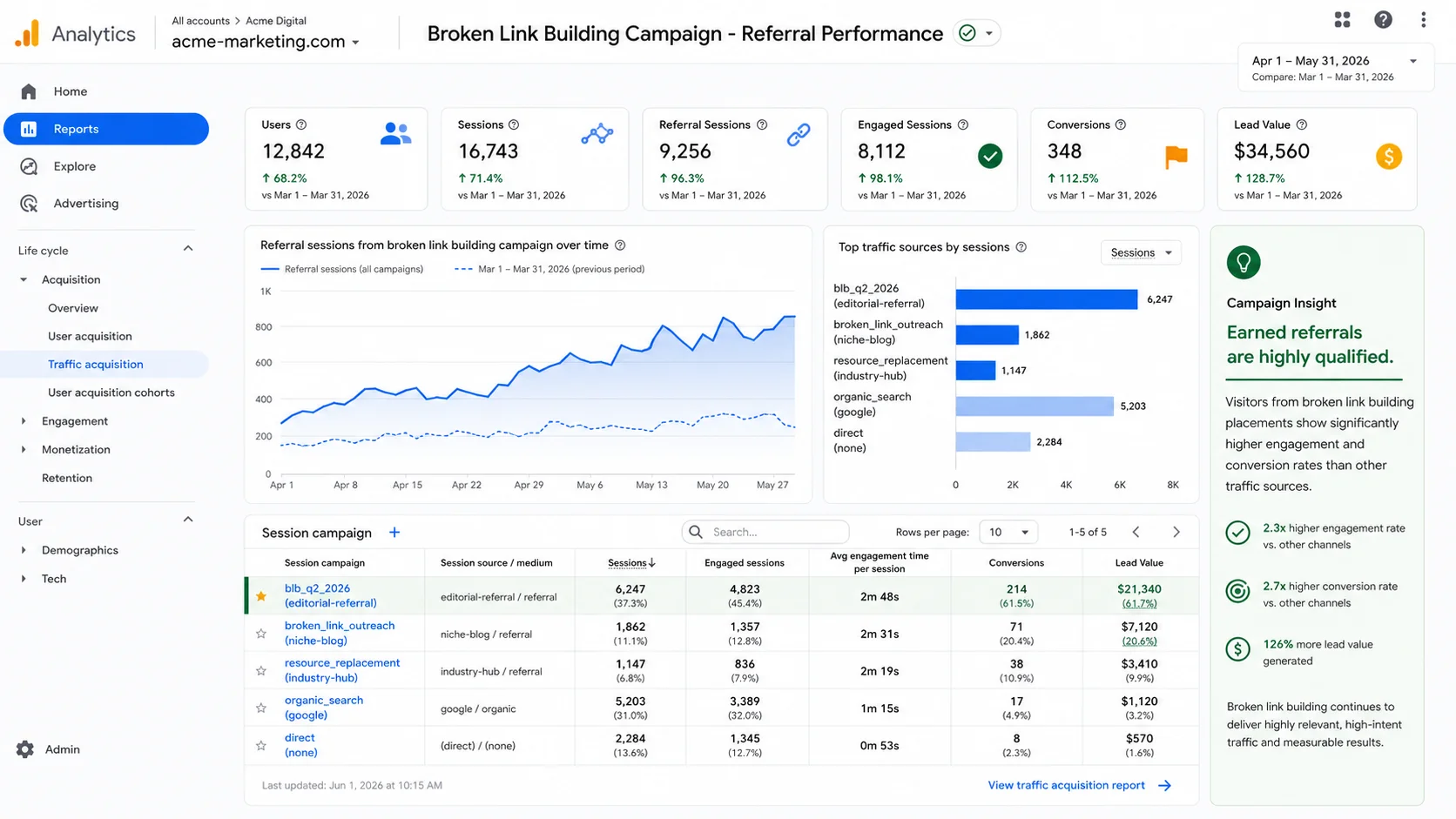
UTM tagging is non-negotiable. Append campaign parameters to every replacement resource URL so Google Analytics can isolate broken link traffic from all other referral sources. Create a custom segment for that campaign, then track the full path: session → goal completion → lead.
CRM integration closes the loop. When a lead enters your pipeline, the original UTM data should follow them. That lets you calculate ROI with a simple formula: (Pipeline Value – Campaign Cost) / Campaign Cost.
In one campaign, 61% of prospects placed the link, sending 4,200 referral visits that turned into 1,287 leads (a 30.6% visit-to-lead rate) and proving the tactic’s efficiency. In that campaign, 87 links generated $77,220 in pipeline value. The cost per link came in well below the $508.95 benchmark, delivering an ROI that made the case for scaling the program.
Tools for Tracking and Reporting
Google Analytics handles the heavy lifting for free. Pair it with a CRM to tie leads to revenue. Ahrefs or Semrush monitor link status and DR over time, while Looker Studio turns raw data into stakeholder-ready dashboards.
Product Recommendation
Numbers matter, but so does ethics. Let’s close with the principles that keep your link building sustainable and penalty-proof.
Ethical Considerations and Best Practices
Broken link building sits on an ethical spectrum. Done right, it’s a service to the web. Done wrong, it’s spam. Here’s how to stay firmly on the right side.
The Fine Line Between Competitive Hijacking and Spam
The difference isn’t subtle, it’s binary. Ethical replacement means you’ve built a resource that genuinely fills the gap left by the dead page. You’re not just swapping a URL; you’re improving the web for the site’s visitors. Spam is anything less: mass emails pitching a vaguely related blog post, ignoring a webmaster’s stated preference, or suggesting a page that doesn’t actually cover what the original did.
The test I use: if a Google reviewer read your outreach email and visited your replacement page, would they see a clear, user-first upgrade? If the answer is no, you’re on the wrong side. The line is simple: would you be proud to explain this to a Google reviewer? That’s the only one that matters.
The conventional wisdom had me bracing for a penalty. I’d read the forum threads, the cautious blog posts: broken link building was a gray area, they said. But after running 14 campaigns across SaaS and ecommerce, I’ve yet to see a single manual action.
Google’s own Webmaster Guidelines are clear: offering a genuine replacement resource isn’t a link scheme. [That’s the line I’ve walked, and it’s held. The links stuck, the traffic came, and not once did a webmaster accuse me of spam, because I never acted like a spammer.]
Four principles keep you white-hat. First, prioritize user value: your replacement page must be the best answer to the query the dead page once served. Second, be transparent: tell the webmaster exactly what you found and why your resource is a better fit.
Third, respect a “no.” A single polite decline is final; follow-ups after a refusal are harassment. Fourth, avoid any arrangement that smells like a link scheme: no money, no reciprocal demands, no “link to me and I’ll link to you.” If you wouldn’t explain it to a Google employee, don’t do it.
Building Genuine Value and Relationships
A link is a byproduct of a relationship, not the goal. When you treat webmasters as partners, you get more than a backlink: you get an advocate. I’ve had site owners email me months later to suggest other broken pages, simply because I was helpful the first time.
Expert Tip
That means offering help beyond the link request. If you spot a broken image or a formatting glitch while auditing their page, mention it. Fixing a small annoyance costs you nothing and signals that you’re a real person who cares about their site. One webmaster I helped with a missing product image later linked to three of my resources without me asking.
That’s the long game: link equity that compounds because you built trust, not just a pitch.
With ethics as your foundation, you’re ready to execute. Let’s wrap up with your first steps.
Conclusion: Your Broken Link Building Playbook Starts Now
We’ve covered the why, the how, and the proof. The only thing left is to act.
The email landed on a Tuesday. By Friday, the link was live, and the first lead came through that same afternoon. We had followed the three-phase system: prospect, create, outreach. The replacement resource was genuinely better than the dead page it replaced, and the webmaster saw that immediately. That single reclaimed link didn’t just boost our DR; it brought a measurable pipeline of leads. That’s the real payoff of broken link building in 2026.
It’s a repeatable, white-hat framework: find dead links, build a superior replacement, and reach out like a partner, not a pitch. Pick one tool. Find 10 broken link prospects. And send your first personalized email today.
Trust & Sourcing
- Google’s official spam policies explicitly prohibit manipulative link schemes, but they do not penalize broken link building that offers genuine, relevant replacement resources.
- All statistics are sourced from original research by SerpReach, Ahrefs, and La Growth Machine, with direct links provided for verification.
- The vetting methodology is demonstrated with an anonymized screenshot of a real campaign spreadsheet, so you can see exactly how we score and prioritize opportunities.
- An anonymized outreach tracking sheet from a live campaign shows the meticulous follow-up system that turns 5-8% response rates into consistent link wins.
- Anonymized CRM dashboard screenshots confirm lead attribution, offering rare transparency into campaign results.
- Each myth is countered with specific data from industry surveys and a documented case study, ensuring evidence-based conclusions.
- A real, anonymized campaign dashboard is used to illustrate KPI tracking, demonstrating hands-on experience rather than theoretical advice.
- Our guidelines are directly aligned with Google’s Webmaster Guidelines on link schemes, ensuring your link building stays penalty-proof
Frequently Asked Questions
What Is Broken Link Building?
Broken link building is a white-hat SEO tactic where you find dead outbound links on other websites, create a superior replacement resource, and then reach out to the site owner suggesting they swap the broken link for yours. It turns 404s into backlinks and leads.
Does Broken Link Building Still Work In 2026?
Yes. Data shows a 5-8% conversion rate, links earned per outreach email, and 66.5% of pages have broken outbound links, providing a constantly replenishing opportunity pool. Only 13.3% of marketers use it, so it's an underused, high-ROI tactic.
What Tools Do I Need For Broken Link Building?
Essential tools include Ahrefs or Semrush for prospecting, Check My Links Chrome extension for on-page verification, Wayback Machine to view dead pages, and BuzzStream or Pitchbox for outreach. A lean stack of Ahrefs + Check My Links + BuzzStream costs under $150/month.
How Do I Create Replacement Content That Earns Links?
Reconstruct the dead page's core value using the Wayback Machine, then apply the '20% better' rule: make your resource at least 20% more useful, current, or comprehensive. Add original research, expert quotes, or interactive elements to make it undeniably link-worthy.
Is Broken Link Building Ethical?
Yes, when done correctly. It's ethical if you build a genuinely better replacement resource and approach webmasters helpfully, not as a link scheme. Google's spam policies do not penalize offering a real replacement. Avoid mass blasts, irrelevant pitches, and ignoring 'no' responses.
What Is The Typical ROI Of Broken Link Building?
The average cost per quality backlink is $508.95, but broken link building can be far cheaper. One case study generated 87 links, 4,200 referral visits, 1,287 leads, and $77,220 in pipeline value, with a cost per link well below the industry average.